AI Slop Is Flooding Your Feed. Here’s How to Fight Back
Something feels wrong when you scroll through social media lately. The posts look real enough. But they feel hollow, weirdly familiar, and oddly lifeless. You’re not imagining it.
The internet is drowning in AI slop. And unless you know what to look for, you’re probably consuming more of it than you realize.
What AI Slop Actually Means
The word “slop” used to describe leftover animal feed. Cheap, low-quality, made from scraps. That’s exactly what AI slop is in the digital world.
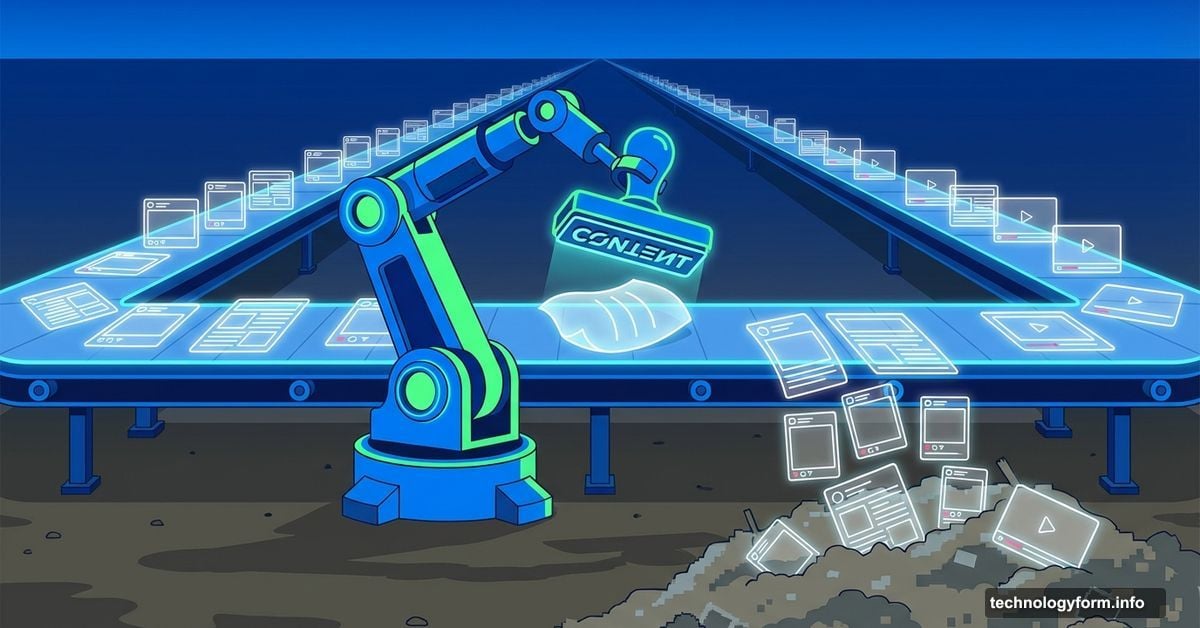
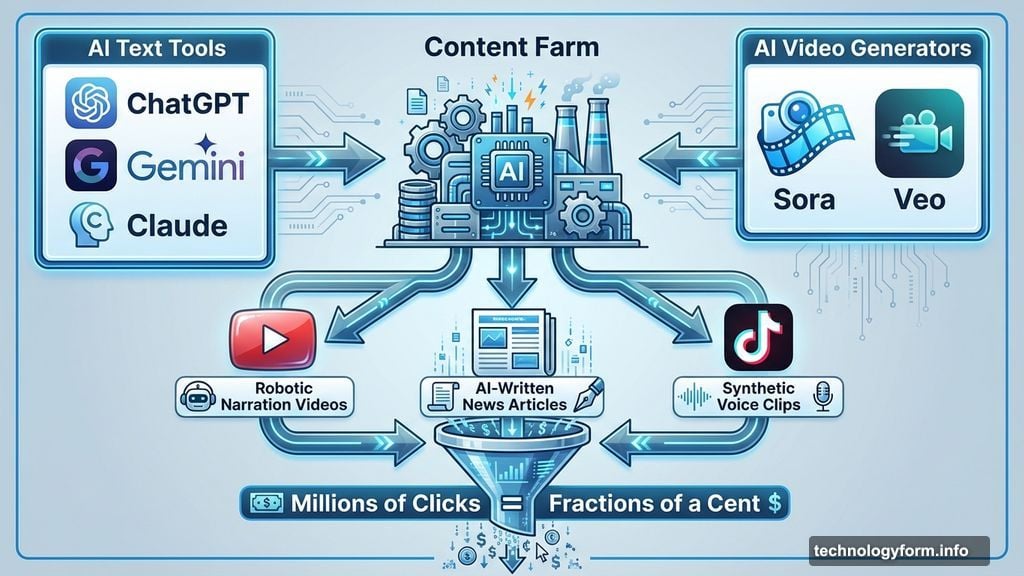
It’s content generated fast and carelessly, with no concern for originality or accuracy. You’ll find it everywhere. YouTube videos with robotic narration over stolen footage. “News” websites recycling AI-written articles from each other. TikTok clips featuring voices that sound like Siri attempting human emotion.
Even John Oliver dedicated an entire segment to the problem. It’s that widespread.
The real issue isn’t that AI can’t create good content. It’s that too many people use AI tools to flood every platform with material that looks informative but genuinely isn’t. The goal isn’t to entertain or educate. It’s to earn a fraction of a cent per view, multiplied by millions of clicks.
AI Slop vs. Deepfakes vs. Hallucinations
These three terms get mixed up constantly. But they’re actually very different problems.
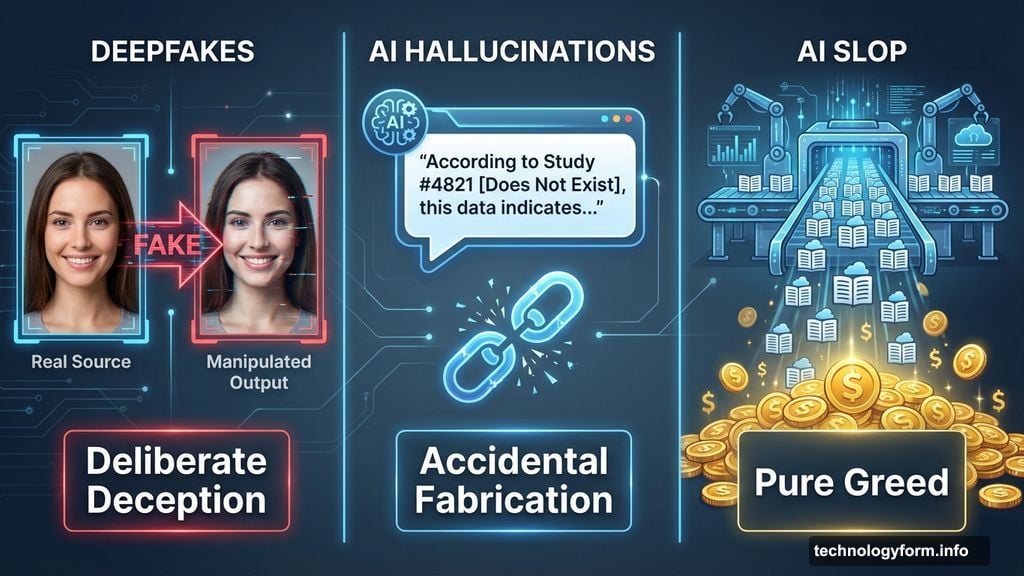
Deepfakes are precision forgeries. Someone uses AI to make a real person appear to say or do something they never did. The intent is deliberate deception, whether it’s a fake political speech or a voice clone used in a financial scam. The danger is how convincing they can be.
AI hallucinations are technical errors. A chatbot cites a study that doesn’t exist or invents a legal case from thin air. The model isn’t trying to mislead anyone. It’s simply predicting the next likely word and getting it wrong.
AI slop is broader and far more careless than either. It happens when people mass-produce articles, videos, music, and images without checking whether any of it is accurate or coherent. It clogs feeds, boosts ad revenue, and buries search results under repetitive nonsense. Its inaccuracy comes from indifference, not deceit.
So here’s the short version. Deepfakes deceive on purpose. Hallucinations fabricate by accident. AI slop floods the internet out of pure greed.
Where All This Slop Comes From
AI technology got powerful and cheap at the same time. That combination opened a door that’s been nearly impossible to close.
Tools like ChatGPT, Gemini, and Claude can generate readable text, images, and videos in seconds. Newer AI generators like Sora and Veo pushed that even further. Content farms quickly realized they could fill websites, social feeds, and YouTube channels faster than any human team could ever write, edit, or film.
The platform algorithms made things worse. Most reward quantity and engagement, not quality. Post more, grab more attention, even if what you’re posting is nonsense. AI makes scaling that strategy trivially easy.
The results are striking. One YouTube channel with just four videos has racked up 4.2 million subscribers and hundreds of millions of views. No human team built that audience through craft or original storytelling.
Sean King O’Grady, an award-winning filmmaker and creator of the docuseries Suspicious Minds, has watched this evolution closely. He notes that the novelty wears off fast. “The novelty of a lot of this new slop will also wear off extremely quickly,” he says.
But the sheer volume keeps coming anyway.
How AI Slop Damages More Than Your Feed
At first glance, a few bad posts seem harmless. Maybe you get a laugh. But volume changes everything.
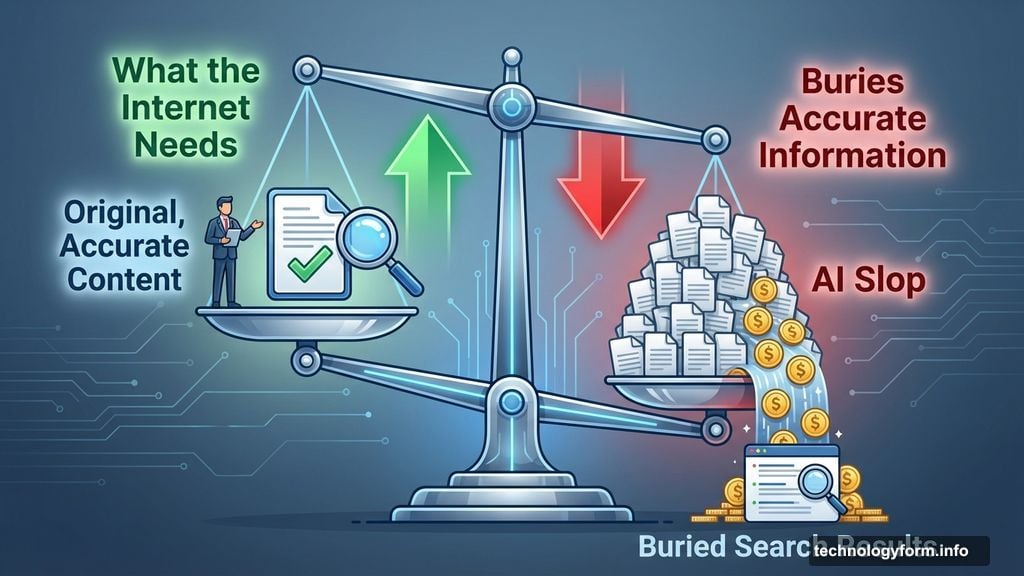
As more junk circulates, credible sources get pushed down in search results. Human creators get crowded out. And the line between truth and fabrication starts to blur. When half of what you see looks like a simulation, trusting the rest becomes genuinely harder.
That erosion of trust has real consequences. Misinformation spreads faster when nobody knows what’s real. Scammers use AI to build convincing fake brands or impersonate real people, including officials. Advertisers find their campaigns appearing next to AI slop on platforms like YouTube, damaging their credibility by association.

O’Grady sees a deeper cultural cost developing. He points to the normalization of violent or grotesque AI mashups going viral. “I think the internet, in a strange way, has desensitized all of us to violence in a pretty horrible way,” he told CNET. “I wonder what that says about our humanity.”
His concern goes beyond economics. The cultural direction worries him more than the financial disruption of generative AI.
C2PA Provenance Standards and Platform Responses
Some companies are pushing back, though none have a complete solution yet.
Platforms like Spotify have started labeling AI-generated media and adjusting algorithms to downrank low-quality output. Google, TikTok, and OpenAI have promised watermarking systems to help users distinguish human content from synthetic material. However, those methods are still easy to evade. Screenshot an image, re-encode a video, or lightly rewrite AI text, and the watermark disappears.
A more structural approach involves a framework called C2PA, short for Coalition for Content Provenance and Authenticity. It’s an industry standard backed by Adobe, Amazon, Microsoft, and Meta. C2PA embeds metadata directly into digital files to show when and how content was created or edited. In theory, it lets you trace whether an image, video, or article came from a verified human source or an AI generator.
The challenge is adoption. Metadata can be stripped. Most platforms don’t enforce the standard consistently. And O’Grady is skeptical that labeling alone will solve anything. He worries that false AI watermarks could be used to dismiss genuinely real footage as fake. “I don’t think labeling will do much,” he says. “The watermarks could also be used to de-authenticate things that were authentically real.”
Some creators are taking matters into their own hands. Many journalists and artists now include a simple note in their work stating no AI was used, reassuring readers that a person, not a prompt, created what they’re reading.
Spotting AI Slop in the Wild
You can train yourself to recognize common patterns. AI-generated text tends to reuse specific phrases with suspicious frequency. Watch for words like “tapestry,” constructions like “in the era of,” and the double-move of “not only… but also.” These phrases feel vaguely human but land hollow.
For images, look for unnatural sheen on skin, objects that blur or disappear at the edges, and backgrounds that don’t quite add up geometrically. Hands and fingers remain a reliable tell, though AI image models are improving fast.
For video, pay attention to lighting consistency, lip sync accuracy, and whether background movement looks physically plausible.
O’Grady’s 10-year-old spotted a hyper-realistic Sora clip of Marc Cuban that O’Grady himself created and immediately called it out. “Get that AI slop out of my face,” the kid said. Younger audiences who grew up online sometimes have sharp instincts here. But AI is improving rapidly, and whatever model exists today is the least capable it will ever be.
The Best Defense Is Your Attention
Stopping AI slop completely isn’t realistic. Once mass production of words and images became nearly free and easy, the floodgates opened. AI doesn’t weigh truth, taste, or originality. It responds to probability. That’s exactly what makes slop so easy to produce and so hard to escape.
But awareness genuinely helps. The more people learn to spot patterns and slow down before sharing, the less oxygen slop gets.
O’Grady frames the cognitive cost in straightforward terms. “I think all of this is probably very bad for your brain, the same way that junk food is,” he says. “Your mind is what you put into it. If it’s what we’re consuming all day because it’s all that’s out there, I think that’s pretty dangerous.”
So slow down. Check sources. Reward creators who put in real effort. The internet has faced spam, clickbait, and disinformation waves before. AI slop is the next version of that same story, just faster and slicker. Whether the web holds onto its integrity depends on how much we still value human work over machine output.