Mistral AI Drops New Coding Models to Chase Cursor’s Crown
French AI startup Mistral just launched Devstral 2, their newest coding model. It’s a clear shot at bigger players like Anthropic and the hot vibe-coding startups everyone’s talking about.
The timing makes sense. Vibe-coding tools like Cursor and Supabase are exploding in popularity. Developers love writing code through natural language instead of memorizing syntax. So Mistral wants in.
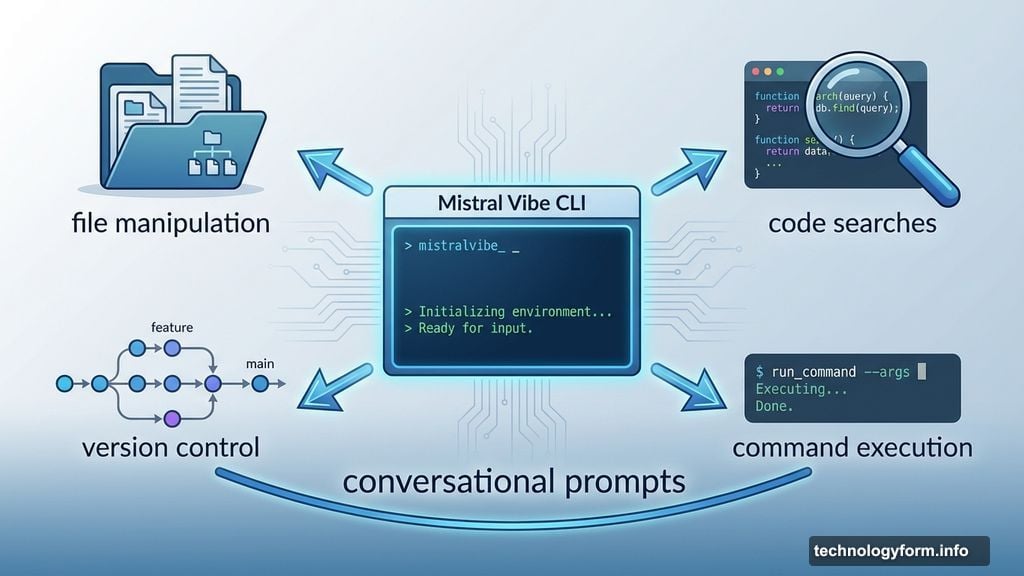
Plus, they’re not just releasing models. They built Mistral Vibe, a command-line interface that lets you automate code through conversational prompts. It handles file manipulation, code searches, version control, and command execution without switching between tools.
Context Awareness Sets Devstral Apart
Mistral’s betting on something most coding models ignore: context.
Their Le Chat assistant already remembers previous conversations. Now Vibe CLI does the same thing. It scans your file structures and Git status to understand what you’re actually working on.
That matters for real production work. Generic coding models give generic answers. But context-aware tools adapt to your specific codebase, team conventions, and project history.
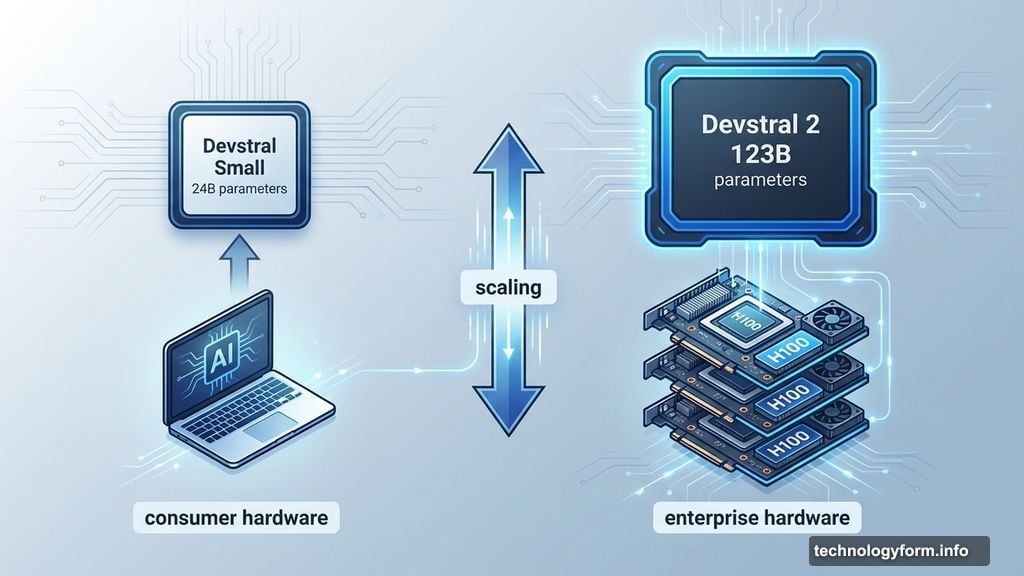
However, there’s a catch. Devstral 2 demands serious hardware. You’ll need at least four H100 GPUs or equivalent to deploy it. That’s enterprise-grade equipment most developers don’t have sitting around.
Two Models for Different Use Cases
Mistral split their release into two versions.
Devstral 2 weighs 123 billion parameters. It’s the heavy hitter for production environments. But it requires that enterprise hardware we mentioned.
Devstral Small comes in at 24 billion parameters. That makes it runnable on consumer hardware. So individual developers can test it locally without cloud costs.
The licensing differs too. Devstral 2 uses a modified MIT license while Devstral Small ships under Apache 2.0. Both allow commercial use, but Apache 2.0 provides more patent protection.
Pricing Follows Aggressive Strategy
Mistral’s playing smart with pricing. Devstral 2 is completely free right now through their API.
Once the free period ends, costs hit $0.40 per million input tokens and $2.00 per million output tokens. Devstral Small costs less at $0.10/$0.30 per million tokens.
That pricing undercuts many competitors. Mistral clearly wants developers hooked on their platform before charging full price. It’s a common strategy but effective when the product delivers.
Vibe Coding Battle Heats Up
The vibe-coding space got crowded fast. Cursor dominates mindshare among developers right now. But Mistral’s not alone in challenging them.
Multiple AI labs launched coding-specific models this year. Anthropic’s Claude excels at code. OpenAI’s GPT-4 handles programming tasks well. Google’s Gemini joined the race too.
What sets Mistral apart? Their focus on production workflows and context awareness. Most tools optimize for quick demos or simple scripts. Mistral built for messy real-world codebases.
They also partnered with existing tools. Kilo Code and Cline integrated Devstral 2 already. Mistral Vibe CLI runs as a Zed extension so developers can use it inside their IDE.
European Champion Flexes Muscles
Mistral’s become Europe’s AI darling. Their latest valuation hit €11.7 billion (about $13.8 billion) after Dutch semiconductor giant ASML led a Series C round in September.
That €1.3 billion investment ($1.5 billion) signals serious confidence. ASML makes the machines that manufacture advanced chips. They know AI’s future depends on compute power.
For context, Mistral’s now worth more than most European tech unicorns. They’re competing directly with American AI giants despite less funding and smaller teams.
Real-World Performance Questions Remain
Flashy launches mean nothing if models don’t perform. Early reviews will determine whether Devstral 2 actually competes with established coding tools.
Key questions developers ask:
- Does context awareness actually improve code quality?
- How accurate are the natural language code generations?
- Can it handle complex refactoring across multiple files?
- Does the free tier last long enough to evaluate properly?
Mistral’s track record suggests quality. Their previous models impressed developers with reasoning capabilities. But coding models require different skills than general-purpose LLMs.
The hardware requirements also limit testing. Most developers can’t spin up four H100s to try Devstral 2. So initial adoption might skew toward enterprises with existing GPU infrastructure.
Where This Leaves Developers
If you’re coding today, you’ve got options. Cursor still dominates for seamless IDE integration. GitHub Copilot leverages Microsoft’s distribution advantages. Anthropic’s Claude excels at explaining complex code.
Mistral enters this crowded market with context awareness and aggressive pricing. Whether that’s enough depends on execution. The models need to actually deliver better code than alternatives.
For European developers, there’s pride in supporting a homegrown AI champion. But most developers care more about productivity than geography. Mistral’s success depends on building genuinely superior tools, not just waving the European flag.
The vibe-coding wars just got more interesting. Developers win when competition drives innovation and lowers prices. So Mistral’s entry benefits everyone, regardless of which tool you ultimately choose.