
Half of Social Media Users Want Clearer AI Labels, New Survey Finds
Scrolling through your social media feed lately feels different. Something’s off, but you can’t always put your finger on it. That’s because AI-generated content has quietly taken over, and most of us are struggling to tell what’s real anymore.
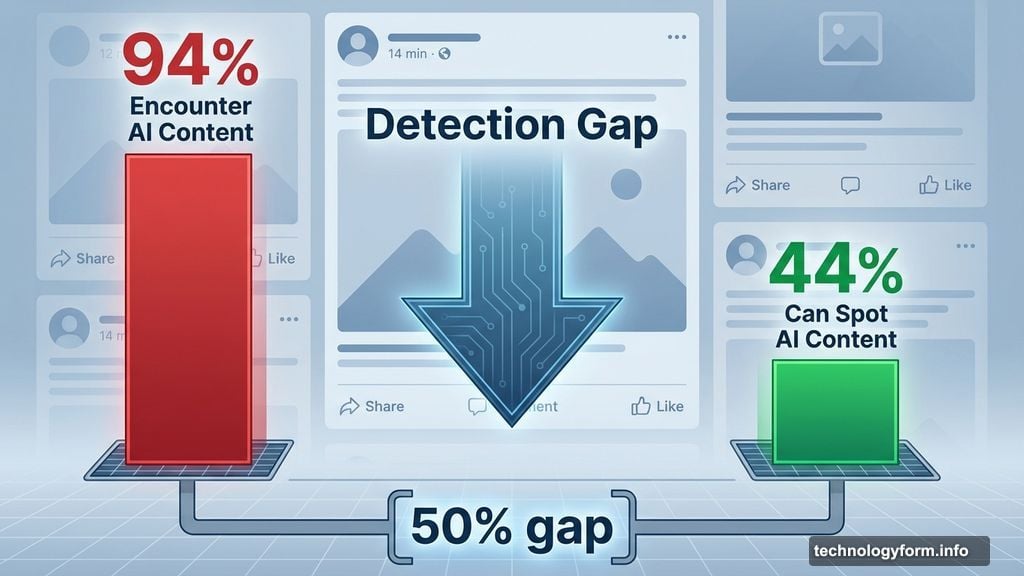
A new CNET survey reveals just how widespread this problem has become. Of 2,443 US adults who use social media, a full 94% believe they regularly encounter AI-created or AI-altered content. Yet only 44% feel confident they can actually spot the difference between real photos and videos and AI-generated ones. That gap between exposure and detection is a serious problem — and people are starting to demand solutions.
The Detection Gap Nobody Warned Us About
Here’s the uncomfortable truth. Spotting AI content is getting harder every month, not easier.
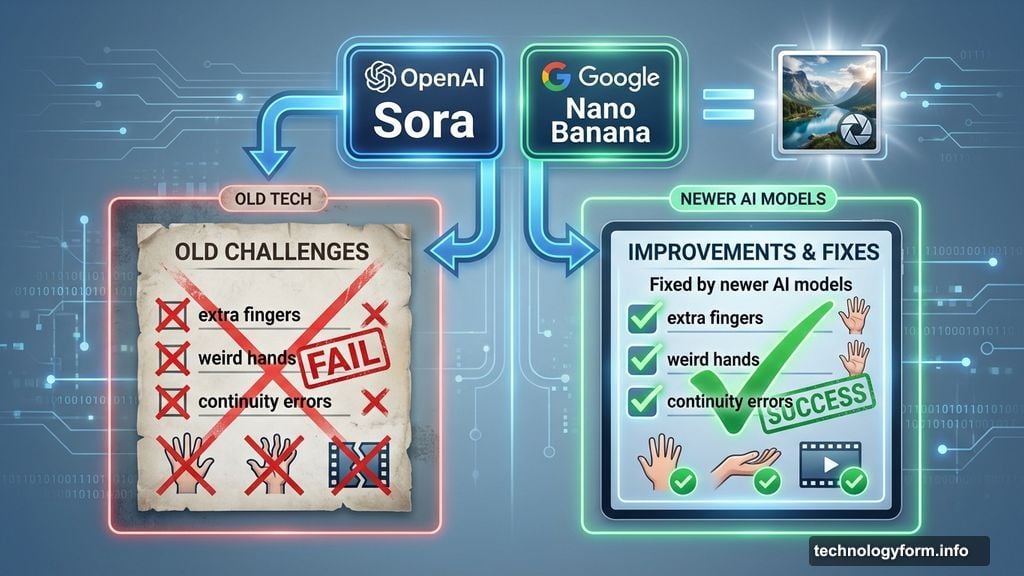
Tools like OpenAI’s Sora video generator and Google’s Nano Banana image model now produce eerily realistic media. Chatbots write text that sounds just like a real person typed it. And the old visual tricks we relied on? Mostly gone.
Remember checking images for extra fingers or weird hands? Newer AI models have largely fixed those tells. Continuity errors in videos, the kind that used to scream “AI made this,” show up far less often now. So the quick visual scan that used to help just doesn’t cut it anymore.
A full quarter (25%) of US adults admit they aren’t confident at all in their ability to spot AI media. Older generations feel this most acutely. About 40% of Baby Boomers and 28% of Gen Xers say they’re not sure they could identify AI-generated content even when they’re looking for it.
What People Do When Something Looks Suspicious
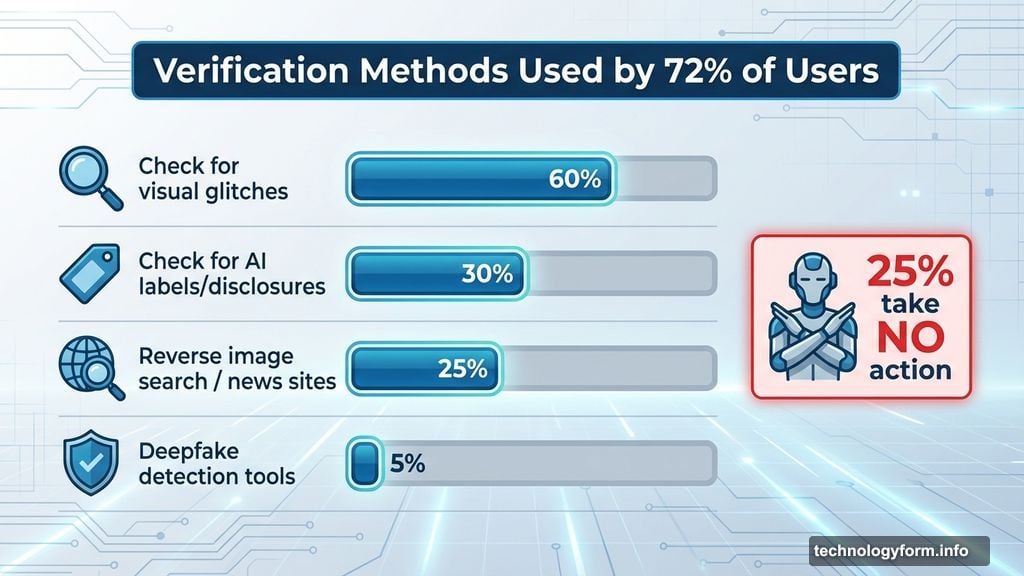
Most people don’t just scroll past when something seems off. About 72% of US adults take some kind of action to verify content when their suspicions kick in.
The most common move? Looking closely for visual glitches or weird artifacts. Over half of respondents (60%) do this. But as AI improves, those visual clues are disappearing fast.
The next most popular methods tell an interesting story about how verification habits are shifting. About 30% check for labels or disclosures on the post itself. Another 25% search for the same content elsewhere online, like on news sites or through reverse image searches. Both approaches show people are learning to look beyond the image itself for context.
Deepfake detection tools, despite being purpose-built for exactly this problem, remain surprisingly underused. Only 5% of respondents reported actually trying one.
![Social media users checking phones with suspicious expressions, representing the challenge of identifying AI-generated content online]
And then there’s the group doing nothing at all. A full 25% of US adults don’t take any steps to verify what they’re seeing online. That number climbs to 36% among Boomers and 29% among Gen Xers. That’s a lot of people potentially consuming and sharing AI-generated misinformation without realizing it, especially concerning given how AI has already proven effective as a tool for fraud and abuse.
Better Labeling Tops the Wish List
So what do people actually want done about all this? The CNET survey asked respondents about their preferred solutions, and the results were clear.
Half of US adults who use social media (51%) believe AI-generated and edited content needs better labeling. Support was strongest among Millennials at 56% and Gen Z at 55%. When people can’t trust their own eyes, they want the platforms to do some of the work for them.
Right now, labeling relies heavily on creators voluntarily disclosing that they used AI. Platforms can sometimes detect and label AI content automatically, but it’s an imperfect process that produces inconsistent results. That’s exactly why so many people feel the current system isn’t working.
A more extreme view also has significant support. One in five respondents (21%) believe AI content should be completely banned from social media with no exceptions at all. That number is highest among Gen Z at 25%, which might surprise people who assume younger users are more comfortable with AI tools. Apparently, comfort with using AI doesn’t always translate into wanting to see it everywhere on social platforms.
Another 36% land in the middle, supporting AI content but only with strict regulation.
The low value people place on AI content helps explain these numbers. Only 11% of respondents said they find AI-generated posts useful, informative, or entertaining. Another 28% say it provides little to no value to their feeds. When most people see AI content as noise rather than signal, it makes sense they’d want more control over what they see.
What Platforms Are Actually Doing
Social media companies haven’t ignored the problem entirely. All major platforms allow AI-generated content, provided it doesn’t violate broader content rules around illegal or abusive material. But a few are starting to give users more control.
Pinterest introduced filters last year that let users reduce how much AI-generated content appears in their feeds. TikTok is currently testing similar features. The idea is straightforward: let people choose their own AI content tolerance rather than having the algorithm decide for them.
It’s a start. But with 51% of users wanting better labels and 21% wanting an outright ban, platforms still have a long way to go to meet user expectations.
Practical Steps You Can Take Right Now
While the big platforms figure things out, there’s plenty you can do to protect yourself from AI-generated content.
Your first line of defense is healthy skepticism. If something looks too perfect, too dramatic, or too emotionally manipulative, pause before sharing or believing it. Check the account that posted it. AI slop accounts often have feeds full of random, disconnected videos with no consistent theme, no real following, and sometimes spam links sprinkled in.
For content that really has you suspicious, try a dedicated deepfake detection tool. The Content Authenticity Initiative offers one that works with multiple file types and is a solid starting point for anyone new to these tools.
If you want to clean up your feeds, CNET has guides for muting Meta AI on Instagram and Facebook and filtering AI posts on Pinterest. Marking posts as “not interested” also helps train the algorithm over time. Outside of social media, you can turn off AI features entirely on Apple devices, Pixel and Galaxy phones, and inside Google Search, Gmail, and Docs.
This Problem Isn’t Going Away on Its Own
The data from this survey paints a clear picture. Most people know AI content is everywhere, but very few feel equipped to deal with it effectively. The tools and knowledge to fight back exist, but they’re not reaching enough people fast enough.
Better labeling would help enormously. If creators and platforms disclosed AI use consistently and clearly, that 51% asking for it would finally get something they’ve been missing. But labeling alone isn’t a complete solution when AI detection technology itself is still catching up to AI generation technology.
For now, the most powerful thing you can do is stay skeptical, share verification strategies with people around you, and use the tools that exist. We’re all going to get fooled occasionally. That’s not a personal failure. It’s the reality of a moment when AI generation has outpaced our collective ability to spot it.
The survey was conducted by YouGov Plc on behalf of CNET, with fieldwork completed February 3–5, 2026. The sample of 2,530 US adults included 2,443 social media users, with results weighted to be representative of all US adults aged 18 and older.