AI’s Next Frontier: Your Phone, Not the Cloud
Cloud-based AI sounds convenient. Tap a button, wait a second, get your answer. But that system’s already showing cracks.
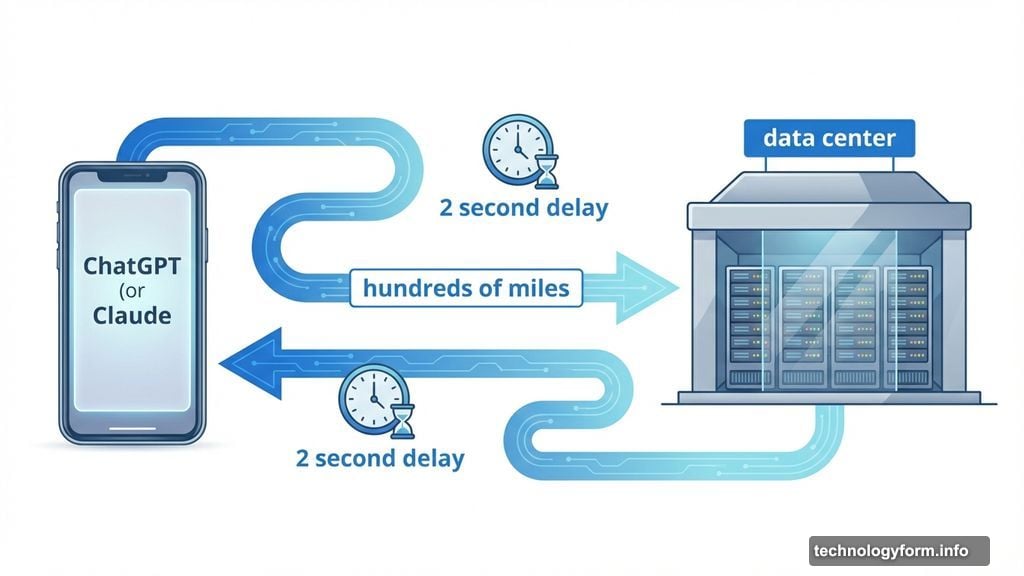
When you ask Claude or ChatGPT a question on your phone, your request travels hundreds of miles to massive data centers. Those servers process your prompt, generate a response, then beam it back to your device. It works fine for casual tasks like generating cat stories or drafting emails.
But what about tasks that can’t afford a two-second delay? Or information too sensitive to send through a dozen corporate servers?
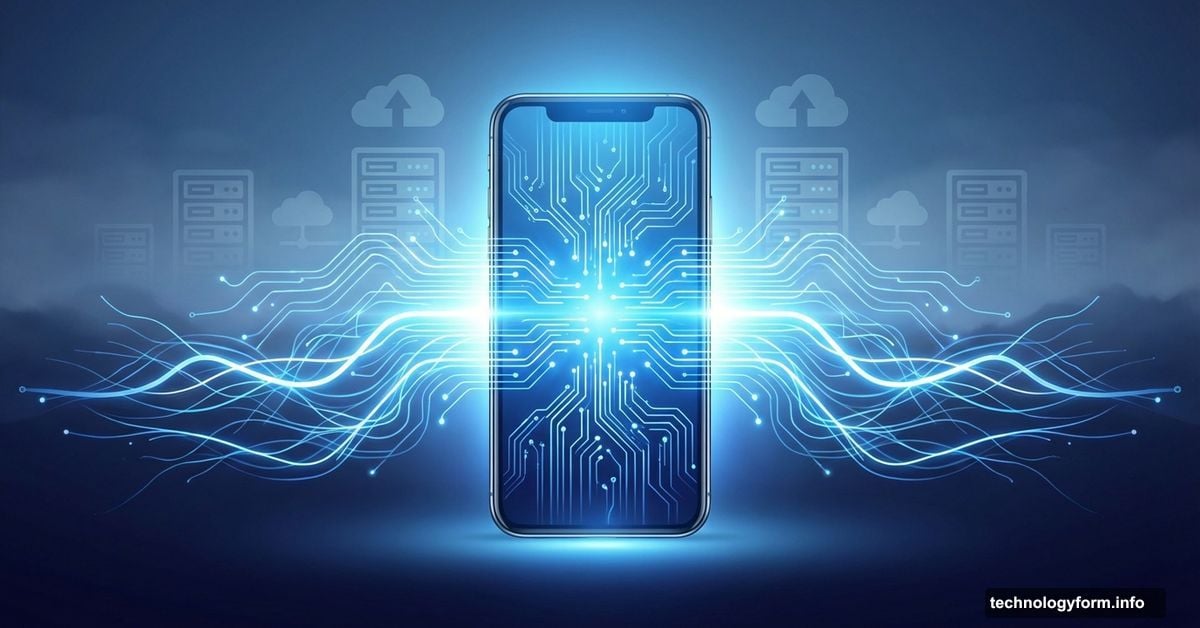
The AI industry is shifting. Processing is moving off centralized cloud servers and onto the device in your pocket.
Speed Matters More Than You Think
Cloud-based AI creates lag. Your request travels to a data center, gets processed, then returns. That round trip takes seconds.
For a chatbot conversation, no big deal. But imagine AI-powered glasses warning you about an obstacle in your path. A two-second delay could mean walking straight into a pole.
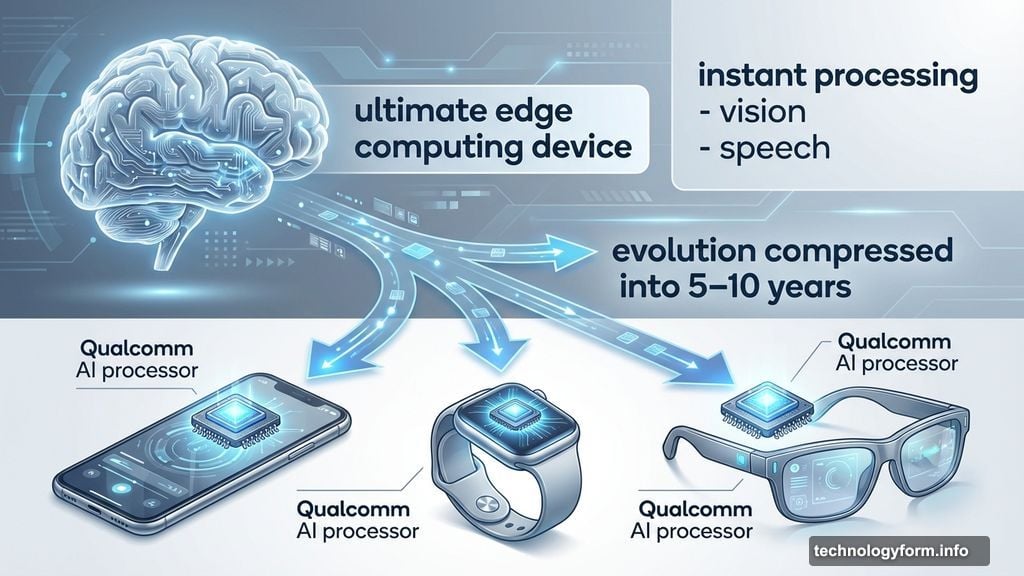
Mahadev Satyanarayanan, a computer science professor at Carnegie Mellon University, studies edge computing—the practice of processing data as close to the user as possible. He points to the human brain as the ultimate edge computing device. Your brain doesn’t offload vision or speech recognition to some distant processor. It all happens instantly, right there in your head.
“Here’s the catch: It took nature a billion years to evolve us,” Satyanarayanan told me. “We don’t have a billion years to wait.”
So developers are compressing that evolution into five or ten years. They’re building smaller, faster AI models that run directly on phones, laptops, and wearables.
Your Phone Already Runs AI
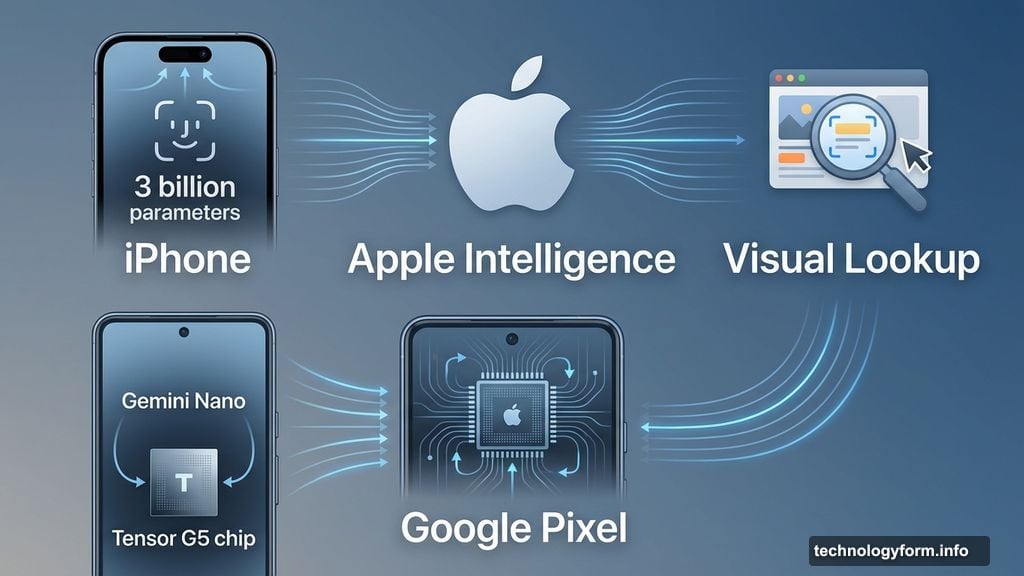
On-device AI isn’t new. When Face ID launched on iPhones in 2017, it used on-device neural processing. That’s not generative AI like ChatGPT, but it’s still fundamental artificial intelligence.
Today’s iPhones run a 3 billion parameter AI model locally. That’s tiny compared to massive models like DeepSeek-R1, which has 671 billion parameters. But it doesn’t need to be huge. It’s built for specific tasks like summarizing messages or recognizing images.
Apple calls this system Apple Intelligence. It powers features like visual lookup, letting you search for things you’ve screenshotted without typing a query.
Google’s Pixel phones run Gemini Nano on their custom Tensor G5 chips. That model surfaces relevant information from your emails and messages right when you need it—no manual searching required.
Moreover, companies like Qualcomm are designing processors specifically for AI tasks. Every major phone manufacturer now prioritizes AI capabilities in their hardware.
But phones are spacious compared to smartwatches or glasses. How do you fit powerful AI models into those tiny devices?
The Cloud Backup Plan
Not every AI task can run entirely on-device. When a request exceeds your device’s capabilities, it offloads to cloud-based models.
That creates a problem. If your data leaves your device, you lose one of on-device AI’s biggest advantages: privacy.
Vinesh Sukumar, head of generative AI and machine learning at Qualcomm, emphasizes user control. “What we’re pushing for is to make sure the user has access and is the sole owner of that data,” he said.
Companies handle this differently. Qualcomm requires user permission before offloading data to the cloud. Plus, users can decline that permission entirely.
Apple uses Private Cloud Compute. Any offloaded data only processes on Apple’s own servers. Only the minimum required data gets sent, and none of it gets stored or accessed by Apple.
These approaches work, but they add complexity. Each handoff between device and cloud creates a potential vulnerability.
Privacy Becomes Paramount
On-device AI keeps your information locked down. Your preferences, browsing history, location data—all the personal details AI needs to work effectively—stay encrypted on your device.
Cloud-based AI sends that information flying across the internet. Every transmission creates risk. Furthermore, you’re trusting multiple companies to handle your data responsibly.
That trust matters more as AI gets more personal. Health data, financial records, private communications—these aren’t things most people want bouncing between corporate servers.
Local processing eliminates that risk. Your data never leaves your encrypted device.
The Cost Equation Changes
Running AI in the cloud costs money. Data centers consume enormous amounts of energy. Companies pay for that compute power with every request processed.
On-device AI flips that model. Once the model’s on your device, there’s no ongoing cost. Your phone becomes the data center.
Charlie Chapman develops Dark Noise, a sound-mixing app. He uses Apple’s Foundation Models Framework to let users create custom sound mixes. The AI selects different sounds and adjusts volumes—all on-device.
“If some influencer randomly posted about it and I got an incredible amount of free users, it doesn’t mean I’m going to suddenly go bankrupt,” Chapman explained.
That changes the economics for developers. Small apps can offer AI features without worrying about runaway infrastructure costs.
However, developers face new challenges. On-device models vary by device. Apps need more work to function consistently across different hardware.
Meanwhile, major tech companies spend billions building data centers. Shifting processing to consumer devices could reduce that infrastructure burden significantly.
Speed Still Needs Work
The promise of on-device AI hinges on speed. Tasks like object recognition, navigation, and real-time translation can’t tolerate lag.
Satyanarayanan’s research tracks how well current technology handles different AI tasks. Object image classification works well—devices deliver accurate results within 100 milliseconds.
“Five years ago, we were nowhere able to get that kind of accuracy and speed,” he said.
But four other critical tasks still require cloud processing: object detection, instant segmentation, activity recognition, and object tracking. Devices can’t yet handle these tasks quickly enough locally.
That gap will close. Hardware keeps improving. AI algorithms get more efficient. Satyanarayanan expects major breakthroughs within five years.
The Hardware Race Accelerates
Specialized AI chips are proliferating. Every major chipmaker now designs processors optimized for machine learning tasks.
Those chips need to balance several factors: processing power, energy efficiency, physical size, and cost. Mobile devices face particularly tough constraints.
Qualcomm, Apple, Google, and others compete to build the best AI-capable mobile processors. Each generation brings meaningful improvements in speed and efficiency.
Meanwhile, new device categories emerge. AI glasses, like the Oakley Meta Vanguard shown at CES 2026, overlay workout metrics from paired devices. Those require fast, local processing to feel responsive.
At the same event, Nvidia showcased the DGX Spark—a dedicated device for running intensive video generation models locally. That eliminates expensive cloud subscription fees for creators.
These specialized devices hint at AI’s future. Instead of general-purpose cloud models handling everything, we’ll see targeted AI hardware for specific tasks.
Real-World Applications Emerge
Satyanarayanan envisions AI glasses that warn you before you trip on uneven pavement. Or devices that recognize people you’re talking to and surface relevant context about past conversations.
These scenarios require computer vision, fast processing, and complete privacy. You can’t wait two seconds for an obstacle warning. Furthermore, you probably don’t want your device sending video of everyone you meet to corporate servers.
On-device AI makes these applications possible. But the technology isn’t quite there yet.
“These are going to emerge,” Satyanarayanan said. “We can see them on the horizon, but they’re not here yet.”
The timeline depends on continued hardware improvements and more efficient AI models. Both are advancing rapidly.
The Hybrid Future
Complete independence from cloud AI probably isn’t realistic—or even desirable. Some tasks benefit from massive models with hundreds of billions of parameters.
The future likely involves seamless switching between on-device and cloud processing. Your device handles routine tasks locally. When you need more power, it offloads to the cloud with your permission.
This hybrid approach maximizes both privacy and capability. You get fast, private processing for most tasks. Complex requests that require more computing power get handled in the cloud.
The challenge is managing that handoff smoothly. Users shouldn’t need to think about where their AI is running. It should just work, transparently choosing the best option for each task.
Companies building this infrastructure face difficult engineering challenges. They need to make on-device models as capable as possible while ensuring cloud offloading happens securely.
The pace of improvement suggests we’ll see dramatic changes soon. Five years ago, on-device AI couldn’t match today’s capabilities. Five years from now, today’s limitations will seem quaint.
Your phone will handle tasks that currently require data center processing. Glasses and watches will run sophisticated AI models that today would drain their batteries in minutes.
That shift fundamentally changes AI’s economics and privacy implications. Instead of relying on corporate cloud infrastructure, we’ll carry powerful AI processors in our pockets.
The cloud isn’t going away. But for many AI tasks, your device increasingly becomes the smarter choice.