The Pentagon Wants Total AI Control. Anthropic Just Said No
The Defense Department handed down an ultimatum. Use Claude for “all lawful purposes” or lose $200 million. Anthropic chose the hard way.
Most AI companies bend when the Pentagon knocks. Not this time. According to Axios, Anthropic is the lone holdout among major AI firms refusing to give the military carte blanche access to its models. That stubbornness might cost them their entire DoD contract.
Three Companies Folded. One Didn’t
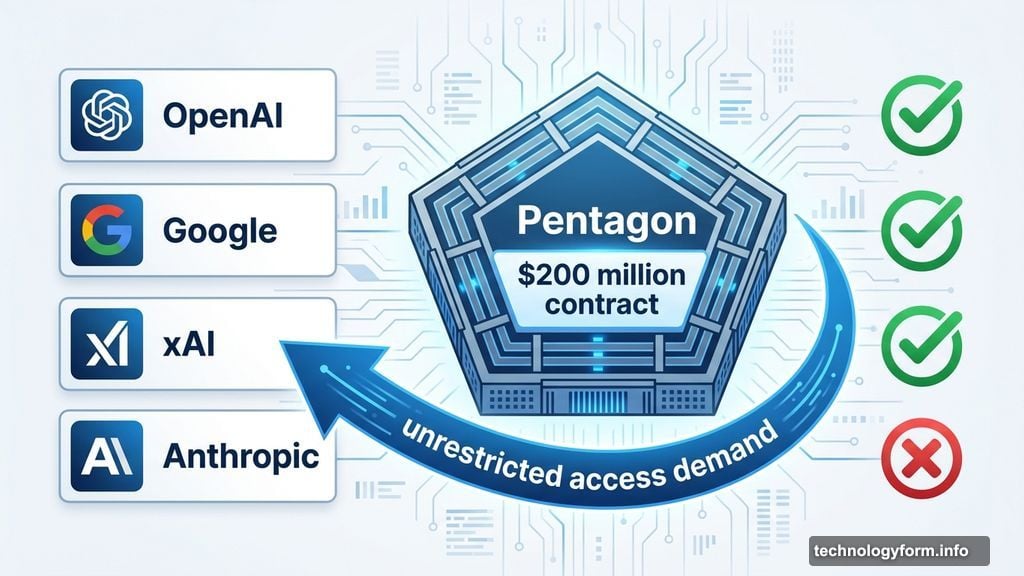
The Pentagon made the same demand to OpenAI, Google, xAI, and Anthropic. Give us unrestricted access to your AI models for any legal military operation.
Three companies played ball. One Trump administration official told Axios that one company already agreed. Two others showed flexibility. Translation: they’ll probably cave soon.
Anthropic stood firm. The company reportedly won’t budge on specific red lines. No fully autonomous weapons. No mass domestic surveillance. Those aren’t negotiable.

So the Defense Department threatened to kill their $200 million contract. That’s a lot of money to walk away from on principle.
Claude Already Flew Combat Missions
Here’s the twist. The Pentagon already used Claude in real operations.
The Wall Street Journal reported that Claude powered intelligence analysis during the U.S. military operation that captured Venezuelan President Nicolás Maduro. That happened despite ongoing disagreements between Anthropic and Defense officials over acceptable use cases.
Did Anthropic know Claude was flying combat missions? The company told Axios they “have not discussed the use of Claude for specific operations with the Department of War.” That’s a carefully worded denial. It doesn’t say they weren’t informed at all. Just that they didn’t discuss specifics.
The distinction matters. If the Pentagon used Claude without explicit approval for that operation, it validates Anthropic’s concerns about mission creep.
Why Anthropic Draws Hard Lines
Most AI companies talk about responsible AI. Anthropic actually tries to enforce it.
Their usage policy explicitly bans autonomous weapons systems. No AI deciding who lives or dies without human oversight. Plus, they prohibit mass surveillance applications that threaten civil liberties.
Those restrictions cost them business. But they’re also what separates Claude from competitors willing to take any check from any government agency.
The Defense Department wants flexibility. Military operations move fast. Bureaucratic approval processes for AI usage slow things down. So they’re pushing for blanket authorization to use Claude however they see fit within legal boundaries.
But “lawful purposes” leaves enormous room for interpretation. What’s legal under military law during wartime? Pretty much everything short of war crimes. That’s too broad for Anthropic’s comfort.
The $200 Million Question
Can Anthropic afford to lose this contract? Financially, probably. The company raised billions from investors. A $200 million DoD deal matters but won’t make or break them.
Strategically, it’s trickier. Government contracts validate AI companies. They signal trust and capability. Losing the Pentagon as a customer raises questions other potential clients might ask.
Moreover, if Anthropic walks away, the Pentagon will just use a competitor’s model instead. Claude gets replaced with ChatGPT or Gemini. The military operation continues. Nothing changes except which company profits.
That’s the cynical calculation pushing other AI firms to accept Pentagon demands. Better us than them. At least we can influence how it’s used from the inside.
Anthropic rejects that logic. They’d rather lose the revenue than compromise their safety standards. It’s principled. It’s also naive if they think their absence stops the Pentagon from deploying AI in controversial ways.
What Comes Next
This standoff probably ends with Anthropic losing the contract. The Defense Department won’t back down. They need AI tools for intelligence analysis, logistics, and operational planning. If one company won’t cooperate, dozens more will.
Then what? Anthropic maintains its ethical standards but loses influence over military AI deployment. The Pentagon gets its unrestricted AI access from more compliant vendors. Nobody wins except maybe Anthropic’s PR team, who can claim the moral high ground.
The real issue isn’t this specific contract. It’s whether AI companies can meaningfully constrain how governments use their technology. Once these models are deployed, enforcing usage restrictions becomes nearly impossible.
You can write strong policies. You can refuse certain customers. But you can’t control what happens after the model ships. That’s the uncomfortable truth nobody wants to admit.
Anthropic is betting that principled resistance matters even when it doesn’t stop the behavior you oppose. Maybe they’re right. Or maybe they’re just leaving money on the table while accomplishing nothing.
Time will tell which principle costs more.