Art Schools Are Forcing AI Into the Curriculum. Not Everyone Is OK With That.
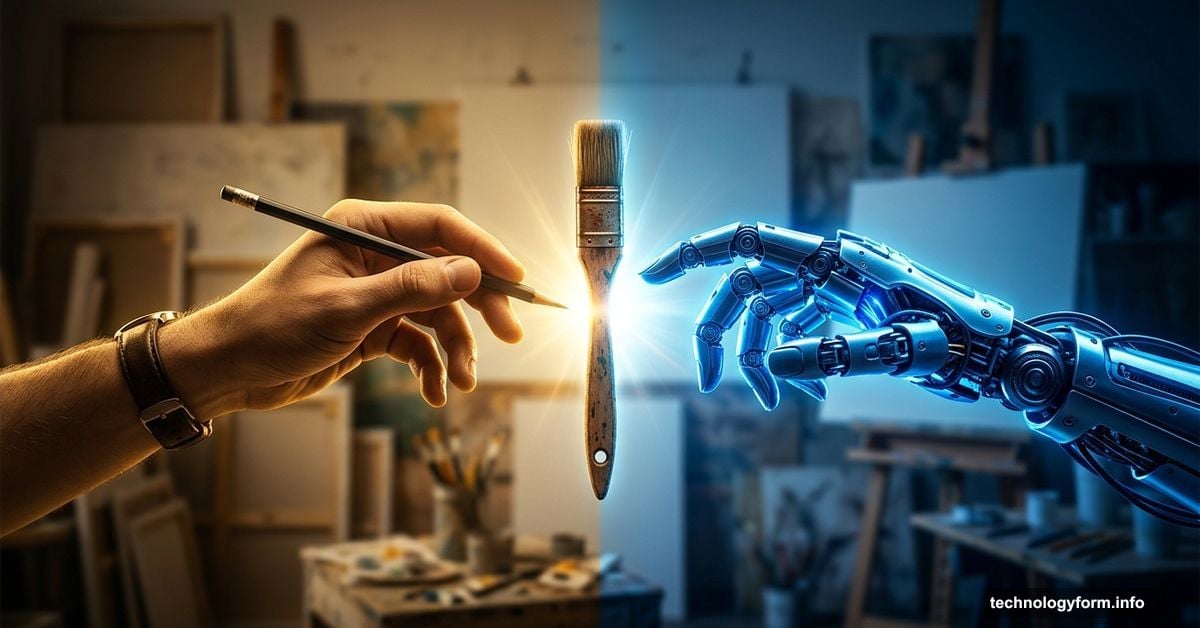
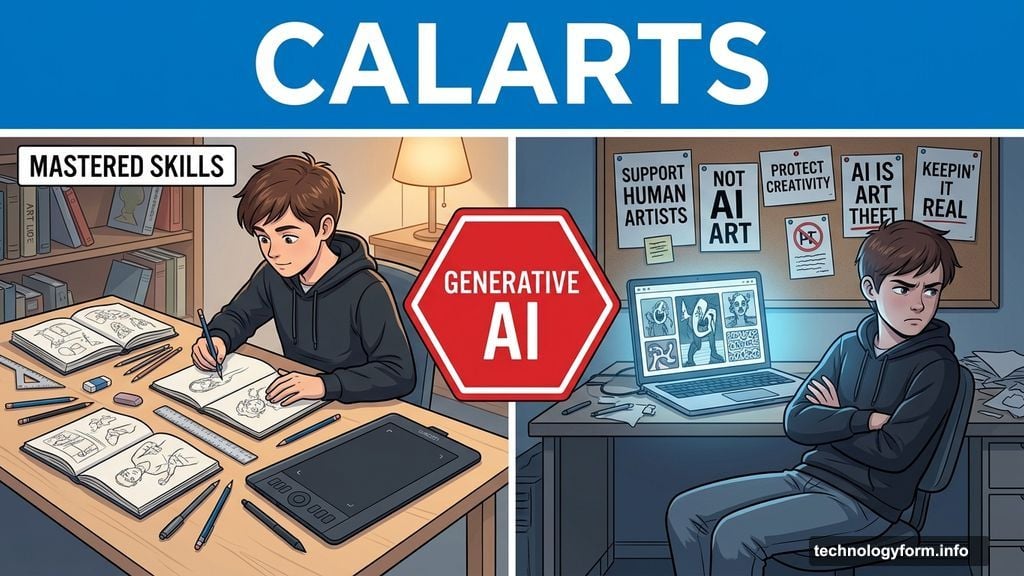
There’s a quiet crisis happening inside creative institutions right now. Students who spent years mastering drawing, animation, photography, or design are watching their schools embrace the same technology many of them fear most.
Generative AI isn’t just reshaping professional creative industries. It’s reshaping the classrooms meant to prepare people for those industries. And a lot of students and faculty aren’t thrilled about it.
Creative Campuses Are Already Pushing Back
The tension isn’t abstract. It’s showing up in hallways and galleries.
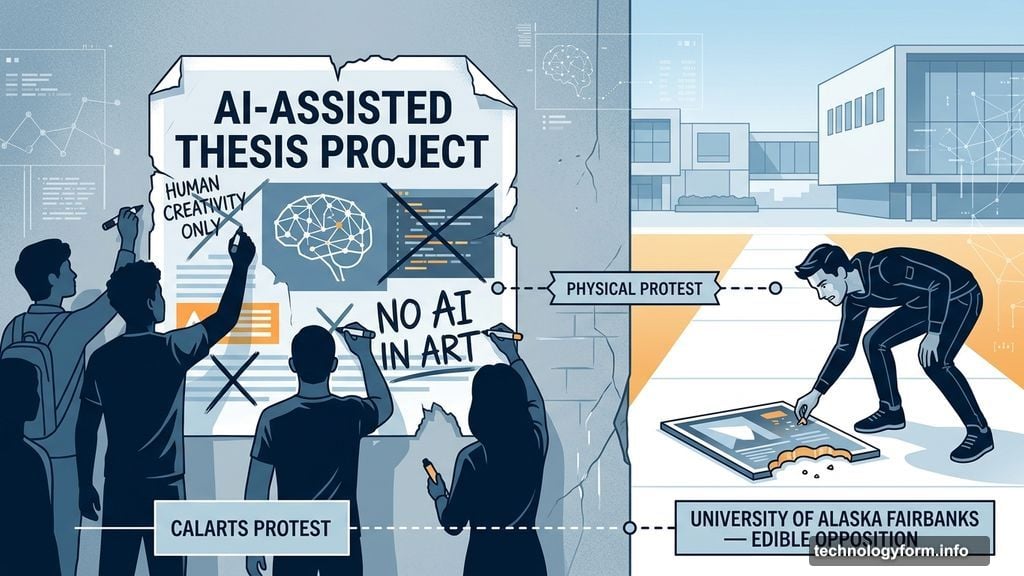
Earlier this year, anti-AI posters spread across California Institute of the Arts (CalArts) after students reportedly altered promotional materials for an AI-assisted thesis project. At the University of Alaska Fairbanks, one film student’s protest was more dramatic. They physically ate another student’s allegedly AI-generated display piece in an act of edible opposition.
These aren’t isolated moments. They reflect a broader frustration building across creative higher education. Students passionate enough to pursue a skilled craft — and take on significant debt to do so — aren’t exactly eager to become glorified prompt engineers.
Schools Are Teaching AI Whether Students Like It or Not
Despite the pushback, major creative institutions are moving forward with AI integration anyway.
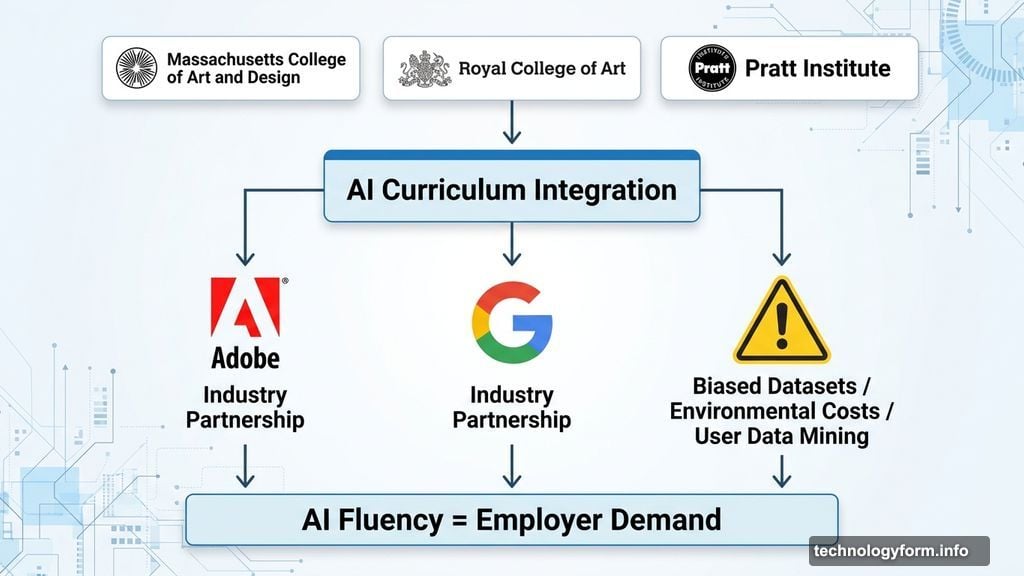
The Massachusetts College of Art and Design, CalArts, London’s Royal College of Art, and dozens of other programs now encourage students to explore generative AI tools across multiple disciplines. The framing isn’t “use AI instead of your skills.” It’s more like “understand AI so you don’t get blindsided by it.”
CalArts communications lead Robin Wander told The Verge the school aims to give students an active role in shaping these technologies rather than simply reacting to them. That means access to the latest tools, direct partnerships with companies like Adobe and Google, and space for critical conversation about the ethical and environmental costs of AI.
The Pratt Institute put it plainly in a published statement. They acknowledge that AI tools often mine user data, run on biased datasets, and carry serious environmental costs. But they also recognize that AI fluency is increasingly what employers are looking for. So they’re teaching it.
The Argument For Integrating AI Into Art Education
Ry Fryar, assistant professor of art at York College of Pennsylvania, represents the more measured approach many educators are taking.
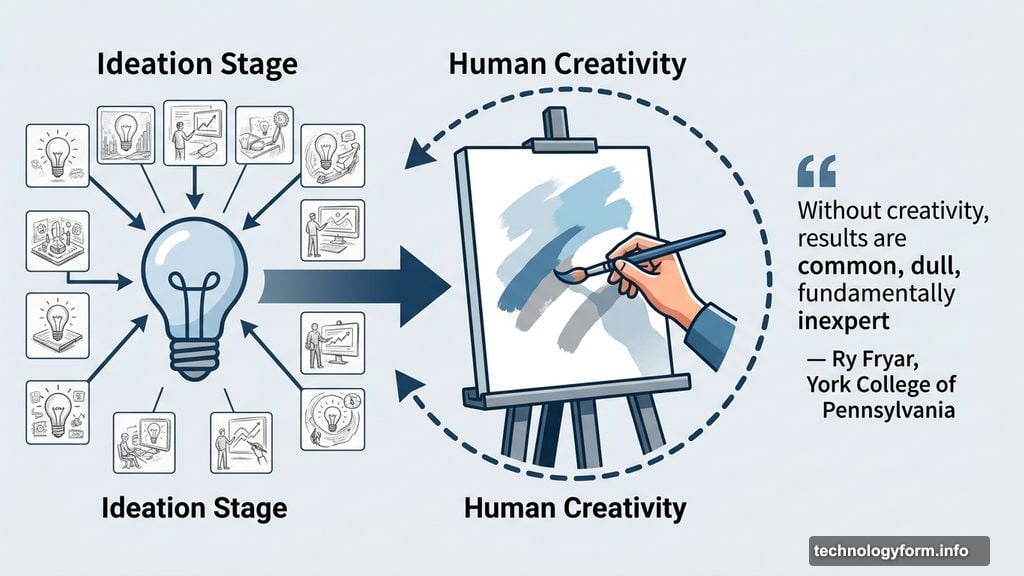
For Fryar, the goal isn’t to hand creative work over to AI. It’s to use AI in the early stages of ideation — sketching out visual concepts quickly before committing to a direction — while keeping genuine human creativity at the center of the final result.
“The focus is on creativity itself, because without that, the results are common, therefore dull and fundamentally inexpert,” Fryar told The Observer. The emphasis is on guiding AI tools professionally, not surrendering to them.
Some programs go further. CalArts launched the Chanel Center for Artists and Technology, which lists artificial intelligence and machine learning as core focus areas. Arizona State University is offering a course called “The Agentic Self” in Spring 2026, led by musician will.i.am. Students at ASU’s Games, Arts, Media, and Engineering school will learn to build their own agentic AI systems — ones intended to function as a digital extension of their creative identity and goals.
Will.i.am described the course as “a solution to AI replacing human jobs.” ASU President Michael Crow backed the partnership by saying graduates need to be ready for a major shift in how jobs relate to AI. The course builds on will.i.am’s Focus Your Ideas (FYI) tool, a platform that lets users generate text and images, collaborate on projects, and get design feedback from an AI chatbot.
What Students Are Actually Worried About
The concerns aren’t just philosophical. They’re practical and financial.
Many generative AI models were trained on scraped images, music, and designs — often pulled from the internet without the original creators’ knowledge or compensation. That raises serious copyright questions that remain largely unresolved. Students who spent years developing a distinctive visual style aren’t thrilled to learn that style might already be baked into a model somewhere.
Then there’s the job market question. If companies can use AI tools to handle work they previously paid designers, animators, and photographers to do, fewer jobs exist for graduates. Text-to-image tools like Midjourney and Google’s Nano Banana can produce polished visuals from a short description. Music generators like Suno and Udio are filling streaming platforms with AI-generated songs. Video models like Veo 3, ByteDance’s Seedance, and OpenAI’s Sora — before it was quietly discontinued last week — have already spooked animators and VFX artists across the industry.
A study from the Ringling College of Art and Design, conducted in late 2023, found that 70 percent of students felt “somewhat” or “extremely” negative toward AI. Most said they didn’t want it anywhere near their curriculum. Schools are largely pressing ahead anyway.
The Uncomfortable Position Schools Are In
Creative institutions are caught between two uncomfortable truths.
On one side, students are paying real money to develop real skills, and they deserve educators who take those skills seriously. On the other side, the professional industries those students are heading into are already being reshaped by AI tools, whether anyone likes it or not. Sending graduates out without any understanding of that landscape isn’t protection. It’s just avoidance.
Wander from CalArts put it directly: schools have a responsibility to help students engage with and critique these tools, because technology has always been part of creative industries. Knowing how something works — including its limitations and ethical problems — is different from endorsing it.
That argument makes sense on paper. But it still doesn’t sit easily with a student who chose art school specifically to develop skills that AI now mimics at scale. Being told to “master the tools threatening your career” feels less like empowerment and more like being asked to train your own replacement.
The honest truth is that no one really knows how this plays out. AI evangelists on social media make confident claims every time a new model drops, but the real-world implications for working creatives are still unfolding. Schools are making judgment calls under genuine uncertainty.
What does seem clear is that the students sitting in these classrooms right now are navigating something genuinely difficult. They’re not wrong to be angry. And they’re not wrong to keep asking whether their schools are preparing them for the future — or just making peace with it.