
AI Is Reshaping How People Search for Homes — and Negotiate the Price
House hunting has always been stressful. But a new wave of AI tools is quietly changing how buyers browse listings, visualize spaces, and even walk into negotiations with agents.
I spent time testing one of these tools firsthand. And I spoke to a real estate expert who’s watched buyer behavior shift dramatically over the past 18 months. What I found was genuinely useful — but also a little unpredictable.
Here’s what you need to know before you start relying on AI to find your dream home.
Virtual Staging Tools Let Buyers See Past Bad Decor
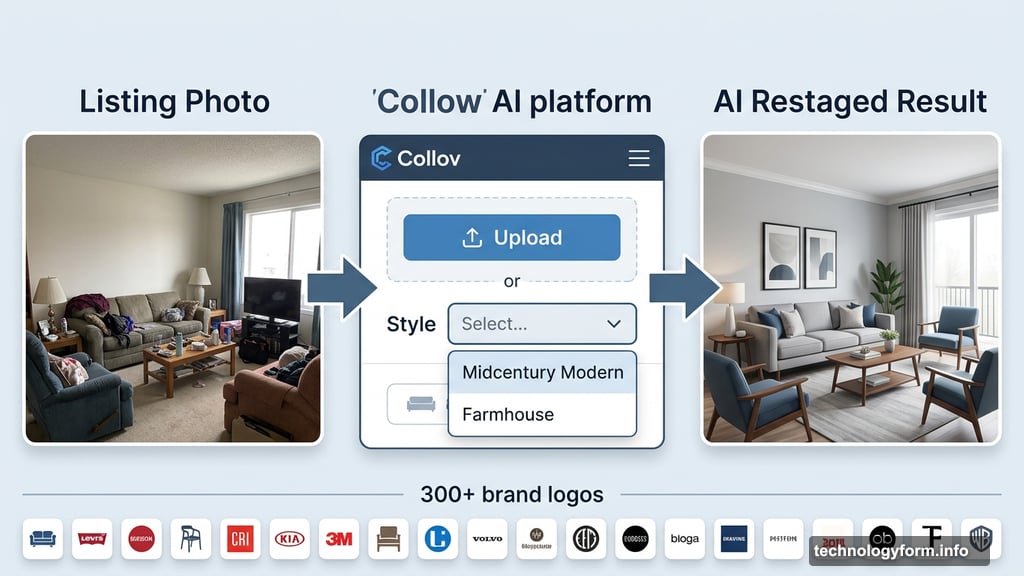
One of the biggest frustrations in home browsing? Listings full of someone else’s furniture, clutter, or questionable taste. That’s exactly the problem Collov AI wants to solve.
The platform lets buyers upload photos from listings — or snap pictures during actual showings — and instantly restage the space in different design styles. Think Midcentury Modern, Farmhouse, or anything in between. Plus, you can pull furniture recommendations from over 300 brands directly inside the app.
Payton Stiewe, president of real estate brokerage Engel & Völkers covering San Francisco, Marin County, and Burlingame, uses Collov AI with buyers regularly. He puts it plainly.
“When we tour homes with buyers, one of the biggest challenges isn’t the house itself. It’s what’s inside it,” Stiewe explains. “Even when a home is professionally staged, or especially when sellers still have their personal belongings in the space, buyers can struggle to see past someone else’s style.”
So instead of asking buyers to imagine the room differently, Stiewe just shows them. “That clarity changes everything,” he says. “They stop second-guessing and start making confident, informed decisions.”
AI Virtual Tours Work Without a Floor Plan
Beyond still images, Collov AI offers something called an AI Virtual Tour. You upload a sequence of static listing photos, and the platform generates an interactive video walkthrough — no floor plan required.
The tool uses the order of photos provided by the listing agent to build the tour, which helps prevent the AI from randomly rearranging rooms. That’s a thoughtful design choice, and it mostly works.
For renters, this feature is especially handy. If you’re traveling or your partner can’t make it to a showing, a virtual walkthrough gives you a much better feel for a space than scrolling through static photos.
Where Collov AI Stumbles
I tested the AI Virtual Staging feature myself, and the results were genuinely fun — but not flawless.
I found a well-priced listing that had great bones but underwhelming styling. I downloaded six room photos and uploaded them to Collov AI. Within seconds, the platform generated five different design variations for each room.
Most of them looked impressive. But here’s where things got interesting.
In one design, the AI added a small wall and a piece of furniture inside an open archway — something that doesn’t exist in the actual house. That’s a textbook AI hallucination. I flagged it using the chat feature, the AI removed it, and then promptly added an extra cabinet somewhere else.
I also noticed one version completely restructured a room’s layout — something Collov AI specifically states it won’t do.
When I brought this up with Collov AI’s founding marketing director Markk Tong, he explained that the causes typically include photo quality constraints, room geometry ambiguity, and what he called “model stochasticity” — basically, the inherent randomness baked into how AI generates images. To manage this, the platform generates multiple variations so users can pick the most accurate one, with unlimited free regenerations included.
Collov AI also built its own diffusion model to comply with regulations from the Multiple Listing Service and the National Association of Realtors. Those rules prohibit AI-generated photos from altering the structure of a space. Other tools — including ChatGPT, which I’ve tested for interior design — don’t follow these guidelines and regularly move windows, doorways, and walls around.

“You cannot alter the window, the door or the architecture elements of your original photo,” Tong says. “You can, however, transition interiors and exteriors from night to day, summer to fall, rain to shine, declutter a desk, fill a pool or remove a car from the driveway.”
In practice, the tool mostly holds to that standard. But you do need to check each result carefully.
Membership ranges from $19 to $127 per month, depending on which features you need. The virtual staging and interior design options sit at the $19 tier. The AI virtual tour requires the $79 plan. A free trial is available if you want to test it before committing.
Buyers Are Showing Up to Negotiations Better Prepared
Collov AI handles the visual side of home search. But AI is also changing what happens before buyers even pick up the phone to call an agent.
Cain Cooke, chair of the Real Estate Institute of South Australia and an expert voice on the Industry Advisory Board for the Australian Institute of Business, has tracked this shift closely.
“Buyers are using AI to prepare for negotiation by prompting it to identify comparable sales, understand seller motivation signals, and even script out negotiation approaches before they pick up the phone to an agent,” Cooke says. “The research phase has compressed dramatically, but more than that, the preparation phase has too.”
That’s a meaningful change. Buyers are arriving at first conversations with agents far more informed than they were 18 months ago.
But Cooke raises an important concern. If a buyer arrives at the negotiating table with an AI-generated strategy, they might feel more confident than the situation actually warrants — especially if the AI’s research contains errors or gaps.
“AI is a great starting point, not a finishing point,” he says.

Smarter Property Valuations Are Coming
Beyond staging and negotiations, Cooke sees AI reshaping several other parts of the real estate process.
On automated property valuations, he says tools are already moving well beyond simple median-price estimates. The next generation will pull in hyperlocal variables — school zone changes, infrastructure announcements, neighborhood-level sentiment, even the quality of a specific street.
“Producing assessments that are nuanced with deep local insights,” Cooke says.
For rental management, AI looks set to handle lease renewals, maintenance triage, compliance tracking, and routine tenant communications with minimal human input. For settlements, expect AI-assisted contract preparation, automated title checks, digital condition verification, and faster coordination between banks, councils, and other stakeholders.
Cooke also sees potential for AI to replace static listing pages on platforms like Zillow with conversational, intelligent interfaces — essentially letting buyers ask questions about a property and get real answers in real time, rather than scrolling through photos and bullet points.
What to Take Away From All This
AI tools for home buying are genuinely useful. But they’re not ready to replace your judgment.
Collov AI made it easy and entertaining to visualize spaces in different styles, and I can see why agents like Stiewe use it to close deals faster. The outdoor redesigns especially impressed me — watching a backyard transform with fairy lights at night was a nice touch. Still, you have to stay alert for AI quirks, because sometimes a wall appears where there definitely wasn’t one before.
And if you’re planning to use AI-generated data to guide your negotiation strategy, treat it as research to start from — not a script to follow blindly. The data might be outdated, incomplete, or just plain wrong. A skilled agent still knows things no AI can surface from a web search.
The smartest approach right now is to use these tools to get informed and inspired, then bring that energy into conversations with people who know your local market deeply.