Wall Street Hedges Its Bets. China’s AI Chipmakers Just Got Very Interesting
Global investors are quietly rebalancing their AI portfolios. The move isn’t dramatic or sudden, yet it’s reshaping where capital flows next.
Money that once piled exclusively into U.S. tech giants is now spreading east. China’s AI companies offer something Wall Street can’t ignore: lower valuations, government backing, and room to run. Plus, recent IPO explosions have made the opportunity impossible to dismiss.
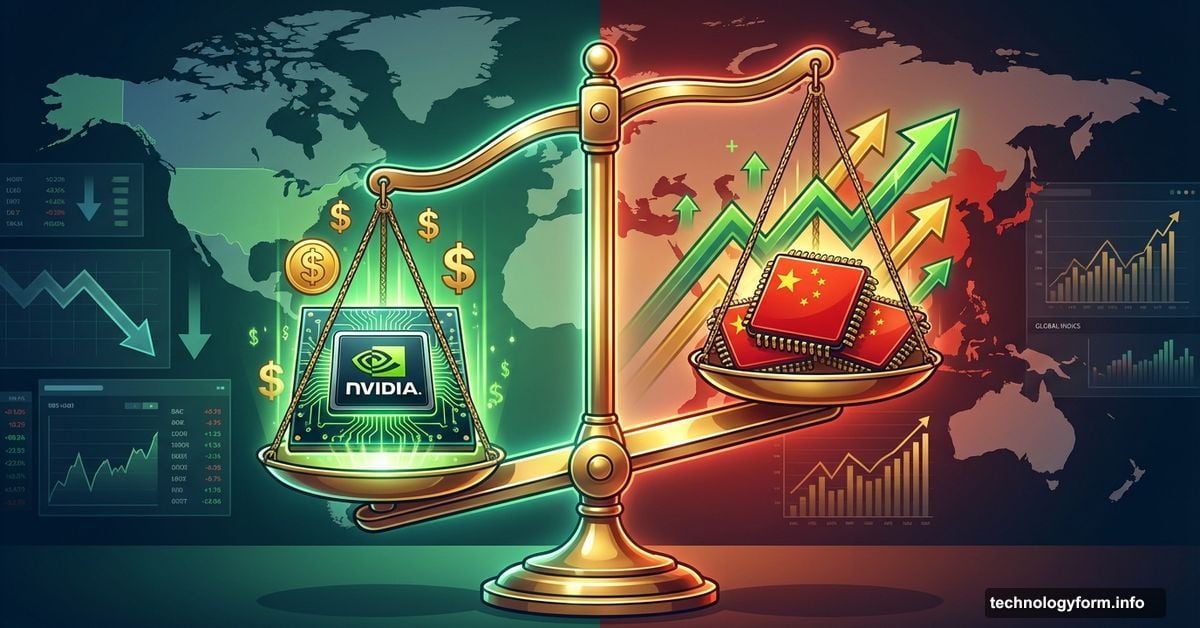
Nvidia’s Dominance Created a Problem
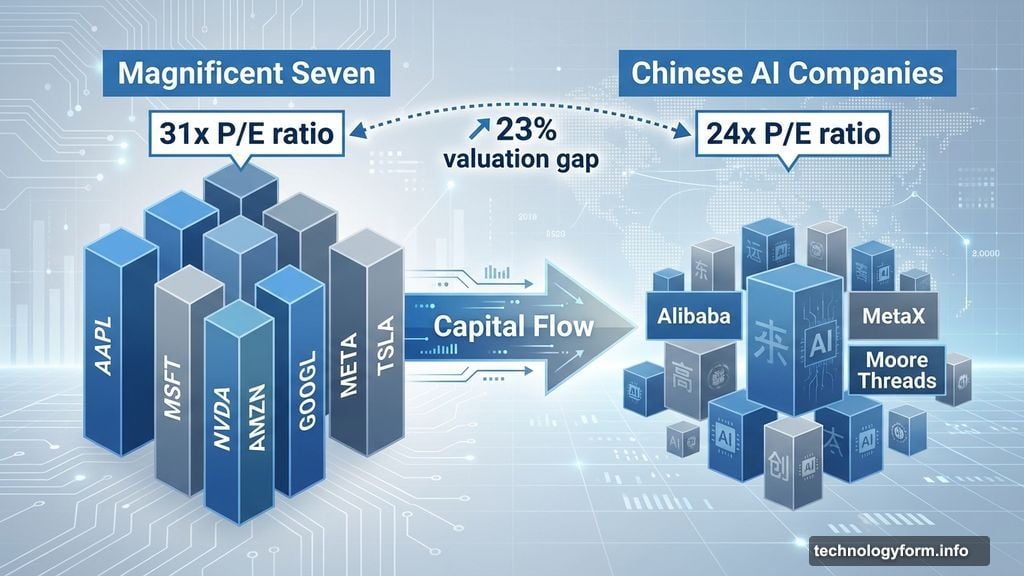
U.S. AI stocks became expensive and concentrated. The Magnificent Seven—Apple, Microsoft, Nvidia, Amazon, Alphabet, Meta, and Tesla—dominate portfolios worldwide. But that concentration creates risk.
Nasdaq trades at roughly 31 times earnings. Hong Kong’s Hang Seng Tech index sits at 24 times. That 23% valuation gap matters when you’re managing billions.
Moreover, margins for error have disappeared. Miss one earnings estimate and your entire position takes a hit. So diversification stopped being optional for large funds.
China’s tech sector offers an alternative. Lower multiples, broader company selection, and Beijing’s explicit commitment to technology independence. That combination attracts capital searching for asymmetric upside without Western valuations.
Two IPOs Changed the Conversation
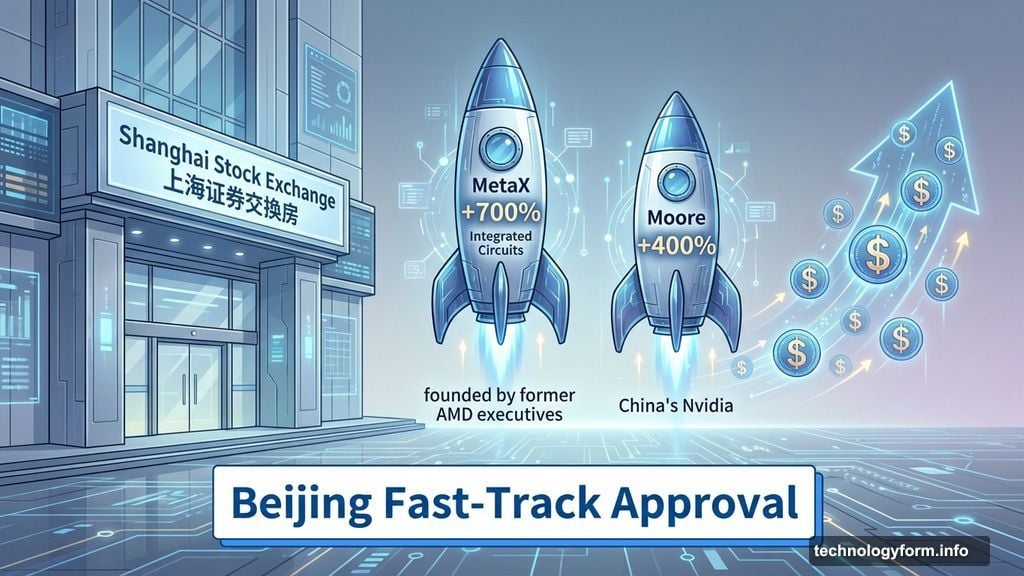
MetaX Integrated Circuits and Moore Threads both listed this month in Shanghai. Their debuts weren’t just successful—they were explosive.
MetaX, founded by former AMD executives, surged roughly 700% on its first day. Moore Threads, often called “China’s Nvidia,” jumped nearly 400%. Those aren’t normal IPO pops. They’re statements about investor demand.
Beijing fast-tracked both listings intentionally. The government wants domestic chipmakers visible, funded, and competitive. IPOs became policy tools, signaling that China’s semiconductor ambitions have official support at the highest levels.
For global investors, those gains created proof points. China’s AI chip sector isn’t theoretical anymore. Real companies are attracting real capital at valuations that still leave room for growth.
DeepSeek Sparked the Comparison
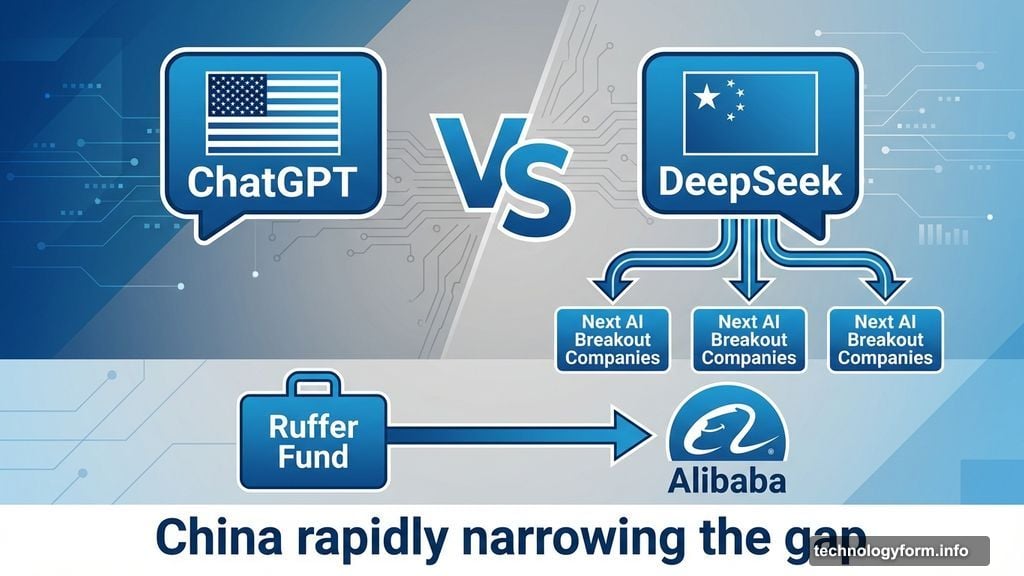
DeepSeek emerged as China’s answer to ChatGPT, demonstrating that Chinese firms can compete in frontier AI development. The startup’s rapid rise gave investors a narrative: if DeepSeek succeeded this quickly, what comes next?
That question drives allocation decisions now. Asset managers are scanning China’s AI ecosystem for the next breakout winner, hoping to capture early-stage momentum before valuations stretch.
Ruffer, a U.K.-based fund, made the thesis explicit. The firm deliberately limited exposure to the Magnificent Seven and added positions in Chinese AI companies, including Alibaba.
“While the U.S. remains the leader in frontier AI, China is rapidly narrowing the gap,” said Gemma Cairns-Smith, an investment specialist at Ruffer. “The competitive landscape is shifting.”
Alibaba Becomes the Safe Entry Point
Alibaba offers scale, revenue, and AI exposure wrapped into one familiar name. The company runs its own chip unit, develops the Qwen large language model, and invests heavily in cloud infrastructure.
For funds cautious about pure-play Chinese startups, Alibaba provides diversified exposure. You get AI upside without betting the entire position on unproven companies.
Plus, Alibaba trades at multiples well below U.S. peers despite comparable cloud and AI investments. That valuation discount creates room for re-rating if execution improves and sentiment shifts.
KraneShares’ KWEB ETF, which holds Alibaba, Tencent, and Baidu, has surged this year. Assets under management now sit near $9 billion. Flows into China-focused tech funds accelerated throughout 2025, driven partly by DeepSeek’s success and partly by valuation concerns in U.S. markets.
New Funds Target China’s AI Ecosystem
Investment vehicles are multiplying to meet demand. Rayliant Global Advisors launched a Nasdaq-listed fund giving U.S. investors access to what it describes as China’s equivalents of Google, Meta, Tesla, Apple, and OpenAI.
The pitch leans into familiarity. Frame Chinese tech exposure in Western terms and it becomes easier for institutional allocators to justify positions.
KraneShares runs a separate fund focused on onshore Chinese tech names, including chipmakers Cambricon and Advanced Micro-Fabrication Equipment. That fund has grown alongside KWEB, signaling appetite for both offshore and onshore exposure.
Brendan Ahern, chief investment officer at KraneShares, points to rapid progress among Chinese AI chipmakers as evidence of ecosystem scale. “The element of this race narrative, this urgency, is to the benefit of the companies,” he said. “When you make it an emergency, you get a lot of attention.”
The Tech War Accelerates Innovation
U.S. export restrictions forced China to build domestic alternatives from scratch. That created short-term pain but long-term capability.
Chinese chipmakers can’t access cutting-edge lithography equipment from ASML. So they optimize older nodes, develop workarounds, and invest heavily in talent. Progress comes slower but it comes steadily.
Jason Hsu, founder of Rayliant Global Advisors, frames it as complementary strengths. The U.S. leads in innovation. China excels in execution, manufacturing scale, and reliable power supply.
That balance matters for investors. You don’t need China to leapfrog the U.S. overnight. You need enough progress to justify current valuations and deliver returns over three to five years.
Skeptics Question Sustainability
Not everyone buys the thesis. Some fund managers argue that listed Chinese chipmakers trade purely on hype, not fundamentals.
“None of the chip companies that are currently listed have any sort of valuation support and are almost entirely driven by hype,” said Kamil Dimmich, partner and portfolio manager at North of South Capital. His fund holds Alibaba and Baidu but avoids pure-play chip startups.
That tension defines the current moment. Optimists see China closing the technology gap through engineering strength and policy support. Skeptics see inflated valuations disconnected from revenue and profit.
Both views contain truth. The question is timing. If you wait for perfect fundamentals, you miss the early gains. If you buy too early, you overpay for years of execution risk.
UBS Calls China Tech Most Attractive
UBS Global Wealth Management recently labeled China tech as “most attractive,” citing rising demand for geographic diversification and Beijing’s policy support for domestic innovation.
The firm points to valuation gaps and momentum shifts as key drivers. Hong Kong’s Hang Seng Tech index offers exposure to Baidu, Tencent, and SMIC at multiples below Western peers.
Carol Fong, group CEO of CGS International Securities, advises selectivity. She expects capital to flow toward companies aligned with China’s self-reliance goals in AI and semiconductors while also offering exposure to established global leaders.
That means avoiding speculative names trading on narrative alone. Focus on companies with revenue, market share, and clear paths to profitability. Accept lower initial upside in exchange for lower risk.
The Shift Isn’t About Picking Sides
The move from Nvidia to DeepSeek isn’t zero-sum. Investors aren’t abandoning U.S. tech. They’re recalibrating risk across geographies, systems, and political environments.
China’s AI companies offer a different mix of risk and reward. Lower valuations, government backing, and engineering talent balanced against regulatory uncertainty and geopolitical tension.
For large funds managing billions, that trade-off makes sense. Concentration in U.S. tech created vulnerability. Adding China exposure reduces that vulnerability without exiting profitable U.S. positions.
The geopolitical competition between the U.S. and China won’t end soon. But for investors, that competition creates opportunity. Two systems racing to dominate AI means more companies, more innovation, and more ways to capture returns.
Capital flows where risk-adjusted returns look best. Right now, that calculation is pulling money east. The trend is quiet, deliberate, and likely just beginning.