AI Glasses That Swap Between ChatGPT and Gemini. Why Aren’t More Doing This?
Rokid’s smart glasses let you switch between two major AI models. It’s a great idea. So why does it still feel like half a solution?
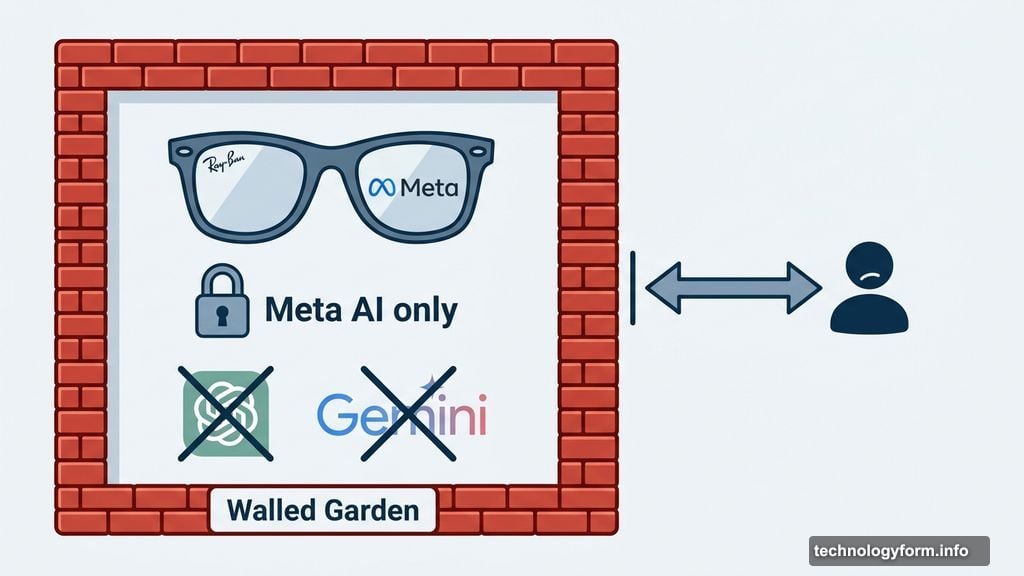
Meta’s Ray-Bans dominate the AI glasses market right now. But they lock you into Meta AI with zero flexibility. You can’t touch ChatGPT, Gemini, or anything else. That limitation bugs me more than most people realize, because real AI versatility is exactly what these wearables need to survive.
Rokid has a different answer. And it’s worth talking about.
Meta Ray-Ban Lock-In Feels Like a Walled Garden
Meta’s glasses are popular. They’re also weirdly restrictive for a device that’s supposed to make AI more accessible.
You’re stuck with Meta AI. Full stop. No switching, no alternatives, no customization. For a company that built its empire on connecting people across platforms, this feels surprisingly closed off.
And honestly? Meta AI isn’t exactly winning awards for deep personalization. Despite your activity across Instagram, Threads, WhatsApp, and Facebook, Meta’s on-glasses AI still feels generic. It doesn’t pull meaningful context from your existing digital life. So you get a locked system that isn’t even particularly smart about who you are.
That’s a frustrating combination.
Rokid AI Glasses Switch Models. Here’s What That Looks Like
![Rokid AI glasses resting on a surface next to a smartphone showing the Rokid companion app with ChatGPT and Gemini toggle options]
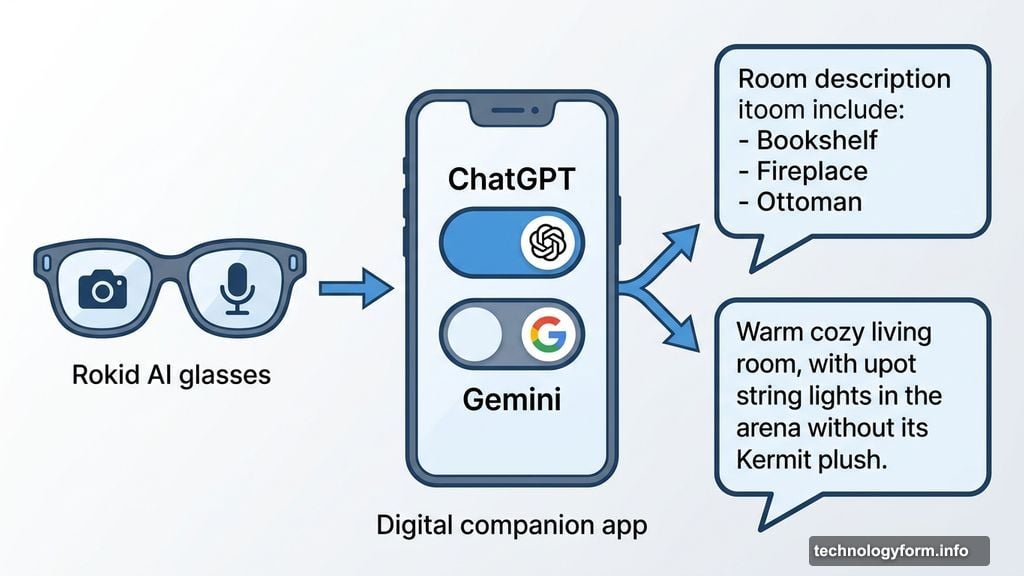
Rokid’s glasses retail for $379, though they’ve been on sale recently for $279. They look nearly identical to Meta Ray-Bans. Camera, speakers, microphones — same basic recipe. No display, just audio and visual capture, powered by whichever AI you pick.
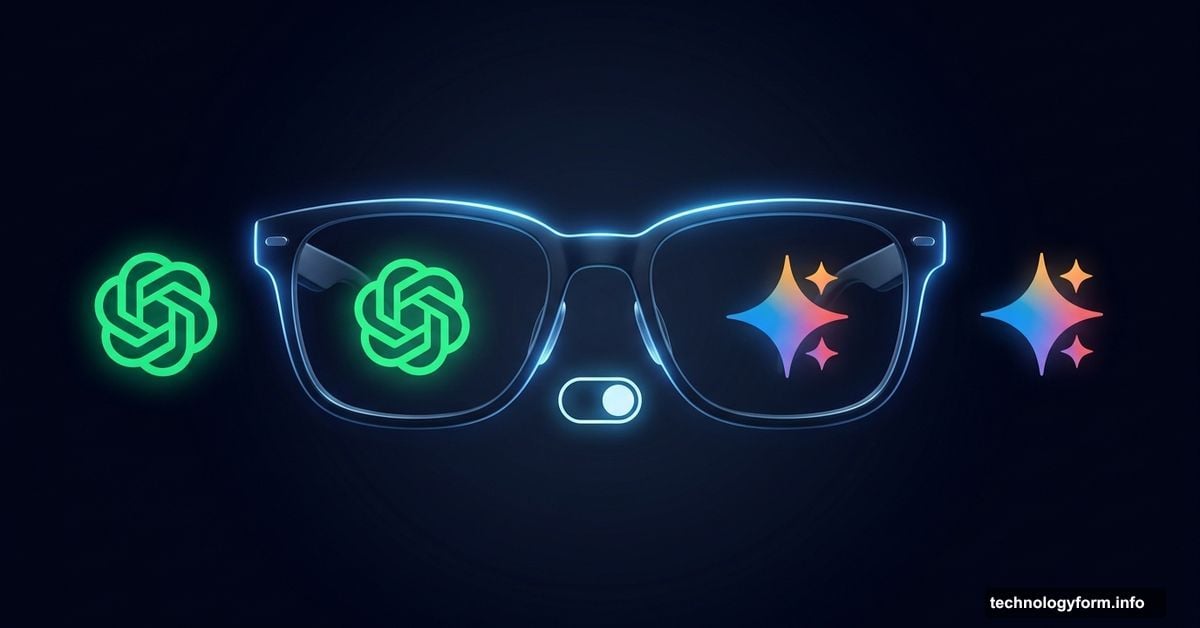
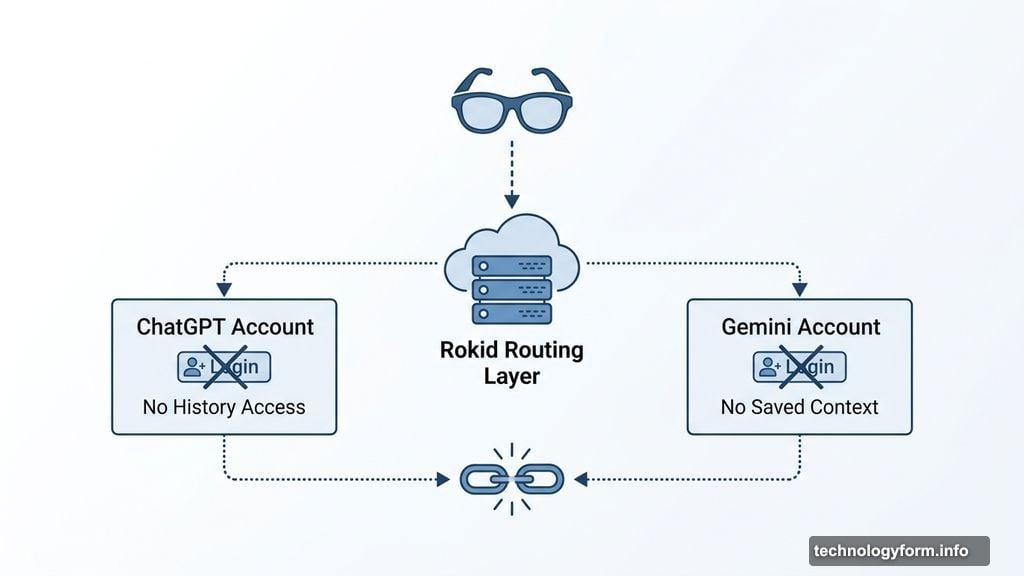
The Rokid companion app lets you toggle between ChatGPT and Gemini. In the US, those are your two options. Other regions also get DeepSeek and Qwen. Behind the scenes, Rokid’s software routes your questions and camera images through whichever model you’ve selected.
To actually test the difference, Scott Stein at CNET pointed the glasses at a messy living room and asked both models to describe what they saw. The results were genuinely interesting.
Gemini painted a warmer, more atmospheric picture. It noticed “a cozy living room area” and lingered on details like string lights and a Kermit the Frog plush on the bookshelf. ChatGPT went more methodical. It itemized each element with bullet precision — the bookshelf, the fireplace, the ottoman cluttered with cables, even a small folding table with snacks.
Same room. Same 12-megapixel photo from the glasses. Two different personalities describing it.
The Big Catch: No Personal Account Access
Here’s where the excitement gets a reality check.
Switching between Gemini and ChatGPT sounds powerful. But Rokid’s glasses can’t log into your actual accounts. Nothing from your existing ChatGPT history carries over. Your Gemini conversations, your saved context, your personalized AI setup — none of it transfers to the glasses experience.
It’s similar to how Apple Intelligence can tap into ChatGPT without actually accessing your personal account or data. You’re starting fresh every single time, with an AI that has no idea who you are.
So the multi-model flexibility is real. But the depth isn’t there yet. You’re choosing between two impersonal AI voices rather than two versions of your own AI assistant.
Google and Apple Are About to Raise the Bar
![Diagram comparing AI glasses ecosystems showing Meta’s single-model approach versus Rokid’s multi-model switching versus Google’s upcoming personalized account integration]
This is where things get genuinely exciting for the near future.
Google’s upcoming Gemini-powered glasses are expected to tap directly into your personal Google account. That means NotebookLM content, Google app history, and personalized AI context could all show up natively on the glasses. They’re designed to feel like extensions of your phone rather than a separate, amnesiac device.
Apple is reportedly developing its own glasses too, possibly announced this year. Given the existing Siri and Gemini AI partnership, Apple could take a similar personalized approach — glasses that actually know you because they’re connected to your digital life.
Both approaches would solve the core problem Rokid exposes. Multi-model access is step one. Personal account integration is step two. Right now, most glasses are stuck at step one, or haven’t even reached it.
OpenAI and Anthropic Still Haven’t Figured Out Wearables
Rokid isn’t alone in this half-baked middle ground.
Even Realities’ G2 glasses technically use OpenAI. But they have the same fundamental limitation — no real account login, no continuity from your existing sessions. It’s a fresh-start AI, disconnected from your actual history with the platform.
The broader issue is that OpenAI and Anthropic haven’t built proper integrations for wearable hardware yet. There’s no direct path for their software to work seamlessly on glasses. So hardware makers like Rokid improvise, offering model switching without the account depth that would make it truly meaningful.
Until the AI platforms themselves treat wearables as first-class citizens, smart glasses will keep living in this awkward in-between state.
Is Rokid Worth It Right Now?
If you genuinely want AI glasses and genuinely don’t want Meta anywhere near your face, Rokid is a legitimate alternative. The multi-model flexibility is a real differentiator. Switching between ChatGPT and Gemini gives you at least a taste of what open AI wearables could become.
But manage your expectations. The lack of personal account access makes both models feel impersonal and disposable. You’re not getting your AI — you’re getting a generic version of a popular AI.
What Rokid is doing points in exactly the right direction. More AI models, more flexibility, less vendor lock-in — these are the right goals. The execution just isn’t all the way there yet.
When Google and Apple launch glasses that actually know who you are, the bar will shift dramatically. Until then, Rokid sits in an interesting spot: better than Meta for flexibility, but still waiting for the AI platforms to catch up and make that flexibility mean something.