Human Creators Want an “AI-Free” Label. Nobody Can Agree on One.
“This looks like AI.”
If you’ve ever shared your creative work online, those four words probably sting. And honestly? They should worry all of us. As generative AI gets better at mimicking human creativity, platforms are failing to label AI-generated content clearly. So a growing number of people are flipping the script entirely — instead of flagging AI work, why not certify the human stuff?
It sounds simple. It’s really, really not.
The Case for Labeling Human Work Instead
Instagram head Adam Mosseri put it plainly back in December. He said it will be “more practical to fingerprint real media than fake media” as AI improves. That’s a significant shift in thinking from one of the biggest social platforms on the planet.
The original plan was to use something called C2PA content credentials — a standard already supported by Meta, Adobe, Microsoft, and Google — to authenticate human-made works. But despite broad industry backing, C2PA has largely flopped in practice.
Why? Because the people profiting from AI content have zero motivation to label it. Clicks, chaos, and cash flow better when audiences can’t tell the difference. A recent Reuters Institute survey found widespread perception that news sites, social feeds, and search results are overflowing with AI-generated material. And the data backs that feeling up.
Too Many Badges, Not Enough Agreement
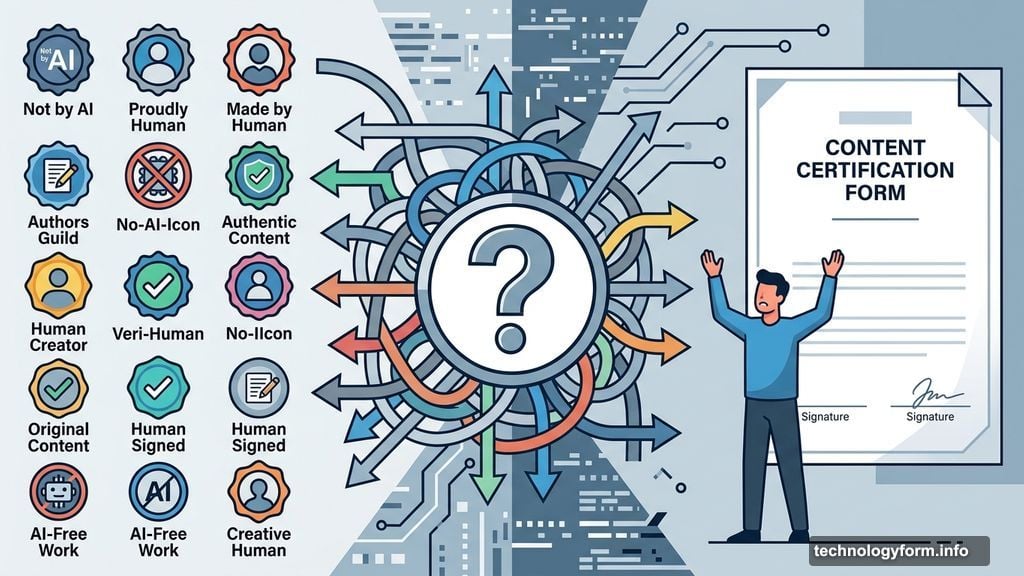
Here’s where things get messy. Right now, at least 12 different “AI-free” labeling systems exist, all trying to solve the same problem in different ways.
Some are narrow in scope. The Authors Guild offers a “human authored certification” for books and written works specifically. Others like Proudly Human and Not by AI aim to cover everything — text, visual art, video, and music. But broader coverage doesn’t automatically mean better verification.
The approaches vary wildly:
- Made by Human simply makes badges publicly available for anyone to download. No verification. Pure honor system.
- No-AI-Icon says it visually inspects works and runs them through AI detection tools — which, to be fair, are notoriously unreliable.
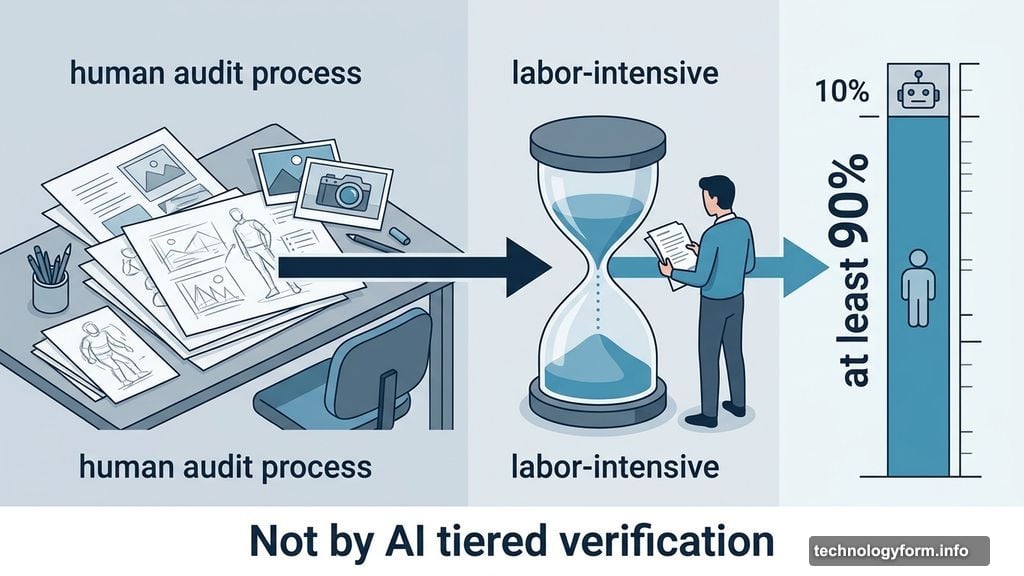
- Not by AI offers tiered badges with a threshold rule: at least 90 percent of the work must be human-made to qualify. Creative but voluntary.
- Most other services take the labor-intensive route, requiring creators to show their working process to a human auditor — think sketches, drafts, reference photos.
That last method is slow and expensive. But without better technology, it’s currently the most reliable way to confirm human authorship.
What Even Counts as “Human-Made” Anymore?
This is the question nobody has cleanly answered yet.
AI is now embedded in Photoshop, Google Docs, music production software, and writing tools. Creative educators are encouraging students to use it. So where exactly is the line?
Jonathan Stray, senior scientist at the UC Berkeley Center for Human-Compatible AI, framed it well. “Does chatting with an LLM about the idea before executing it manually count as using AI?” he told The Verge. “And how could the creator prove no AI was involved? Other consumer labels, such as ‘Organic,’ have regulations and agencies that enforce them.”
Nina Beguš, a lecturer at UC Berkeley’s School of Information, thinks we’ve already crossed into hybrid territory. “Any creative output today can be touched by AI in one way or another without us being able to prove it,” she told The Verge. “Authorship is disintegrating into new directions, becoming more technologically enhanced and more collective.”
That’s not a pessimistic take — it’s just honest. Our definitions of creativity are genuinely struggling to keep up.
Blockchain Might Actually Help Here
One approach gaining traction leans on blockchain technology to create a permanent, tamper-proof record of human authorship. Services like Proof I Did It store verification data on the blockchain, giving creators an unforgeable digital certificate tied to their work.
Thomas Beyer, an executive director at the University of California’s Rady School of Management, sees real promise here. He told The Verge that Web3 and blockchain technology shift the fundamental question from “does this look like AI?” to “can this account prove its human history?”
“By issuing ‘Made by Human’ tokens to verified creators, the market creates a ‘premium tier’ of art where authenticity is mathematically guaranteed,” Beyer said.
Beguš agrees that human and biological creativity could become genuinely more valuable as synthetic media floods every platform. Scarcity tends to drive up worth. And right now, authentic human work is becoming scarcer by the day in the digital space.
The Fraud Problem Nobody Has Solved
Even the best certification system runs into the same wall: bad actors.
Trevor Woods, CEO of Proudly Human, was refreshingly candid about this. “Like other certification marks and company logos, we cannot prevent fraudulently displaying the Proudly Human certification mark,” he told The Verge. “However, we make it easy for consumers to verify it. If a bad actor identified by us refuses to stop using the label, we will take legal action against them.”
That’s a reasonable response. But legal action is slow, expensive, and mostly reactive.
Consider Coral Hart, a romance author who told The New York Times she earned a six-figure sum producing more than 200 AI-generated novels last year. She hasn’t labeled any of them as AI-generated, citing fears it would “damage her business” because of the “strong stigma” around the technology. That stigma — often expressed as calling AI content “slop” — is real, and it’s exactly why transparency is so rare from people profiting off the technology.
Scammers selling AI-generated products on platforms like Etsy aren’t rushing to disclose their methods either. Neither are AI influencers selling fantasy lives that don’t exist, or social media accounts using synthetic imagery to sow discord. Disclosure kills the illusion. And the illusion is the product.
What Needs to Happen Next
A patchwork of 12 competing badges won’t fix this. What the human-made labeling movement desperately needs is the same thing C2PA already has: unification.
That means governments and regulatory bodies need to get involved — not just creators and platforms. Right now, those conversations are “few and far between,” as Proudly Human’s Woods acknowledged. His organization has “occasionally briefed government and industry associations” but isn’t involved in any formal negotiations about a unified standard.
The urgency is real, though. Woods put it bluntly: “The rapid evolution of AI capabilities and AI-generated content will outpace government and regulator responses.”
So here’s where things stand. There’s genuine demand for human-made certification. There are motivated creators ready to adopt a trusted standard. There’s even technology — blockchain-based verification, manual auditing — that could make it work. But without one agreed-upon symbol carrying the weight of something like the Fair Trade or Organic label, the confusion benefits exactly the people it shouldn’t.
The creators most at risk of being displaced by AI are also the most motivated to solve this. That’s a real foundation to build on. Someone just needs to get everyone in the same room — and fast.