Nvidia Quietly Built an AI Empire Through Strategic Startup Bets
Nvidia didn’t just sell chips during the AI boom. The company systematically invested billions across 50 startups in 2025 alone, extending its influence far beyond hardware sales.
Most people know Nvidia as the GPU maker powering ChatGPT and similar AI models. But the chipmaker has been quietly assembling an investment portfolio that touches nearly every corner of the AI industry. From autonomous vehicles to nuclear fusion energy, Nvidia’s venture capital activity reveals its strategy to dominate AI infrastructure from multiple angles.
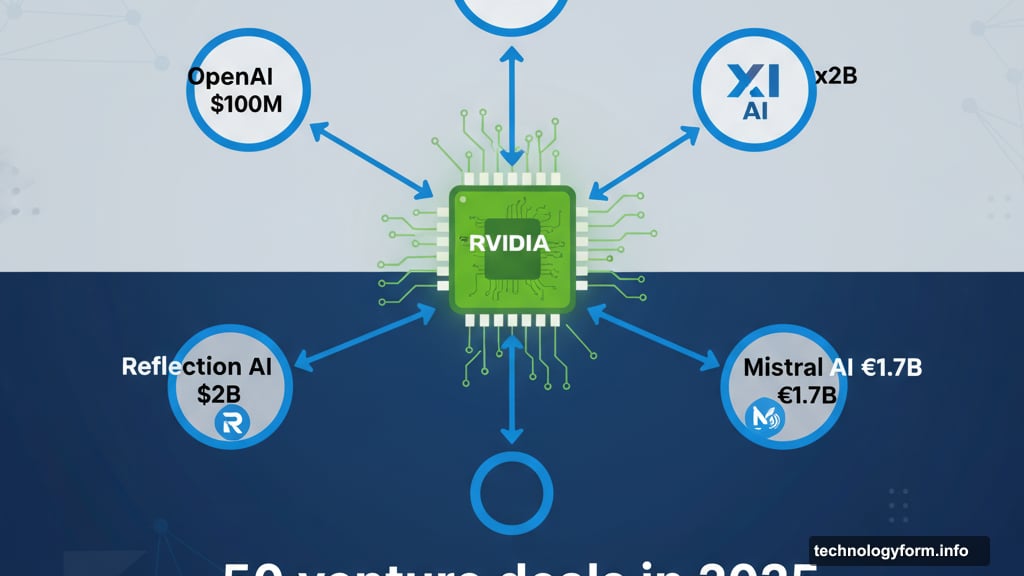
The numbers tell a striking story. Nvidia completed 50 venture deals in 2025, surpassing the 48 deals from all of 2024. Plus, those figures exclude investments from NVentures, its formal corporate VC arm, which ramped up from just one deal in 2022 to 21 deals this year.
The Billion-Dollar Bets
Nvidia wrote checks exceeding $100 million to several of the AI industry’s most prominent players. These aren’t small strategic investments. Instead, they represent major commitments to shape the future of artificial intelligence.
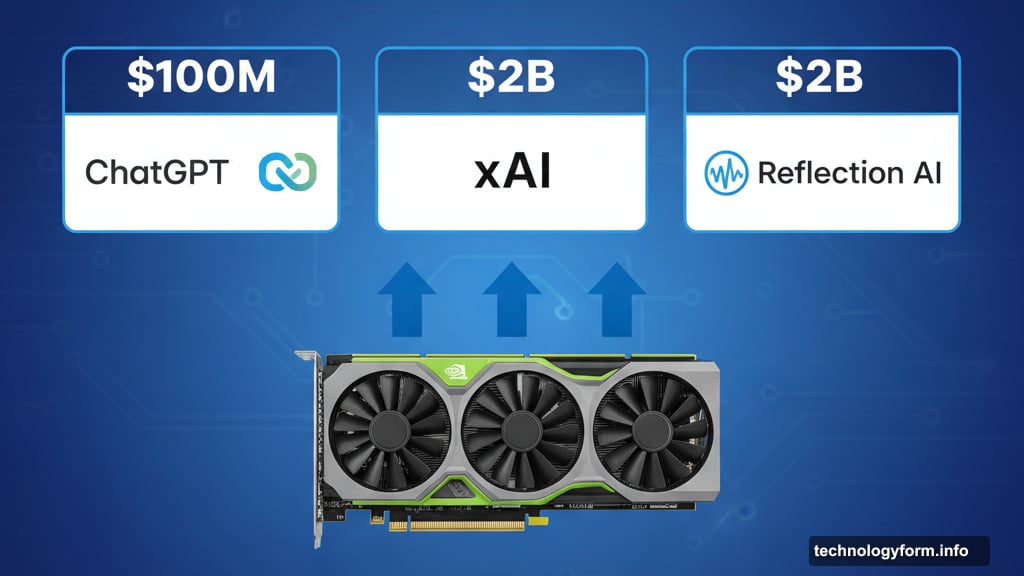
OpenAI received $100 million from Nvidia in October 2024 as part of a massive $6.6 billion funding round. That investment pales compared to what came next. In September, Nvidia announced plans to invest up to $100 billion in OpenAI over time, structured as a partnership to deploy AI infrastructure at unprecedented scale.
xAI, Elon Musk’s AI venture, attracted Nvidia’s attention despite OpenAI’s attempts to discourage investors from backing competitors. Nvidia participated in xAI’s $6 billion December 2024 round and committed up to $2 billion more in xAI’s planned $20 billion fundraise. That deal essentially gives xAI funding to buy more Nvidia hardware.
Reflection AI landed a $2 billion investment led by Nvidia in October, valuing the one-year-old startup at $8 billion. Reflection positions itself as a US-based alternative to Chinese DeepSeek, whose open-source models undercut pricing from OpenAI and Anthropic.
The pattern becomes clear. Nvidia backs companies that will consume massive amounts of its GPUs while simultaneously spreading its influence across competing AI platforms.
European and International Plays
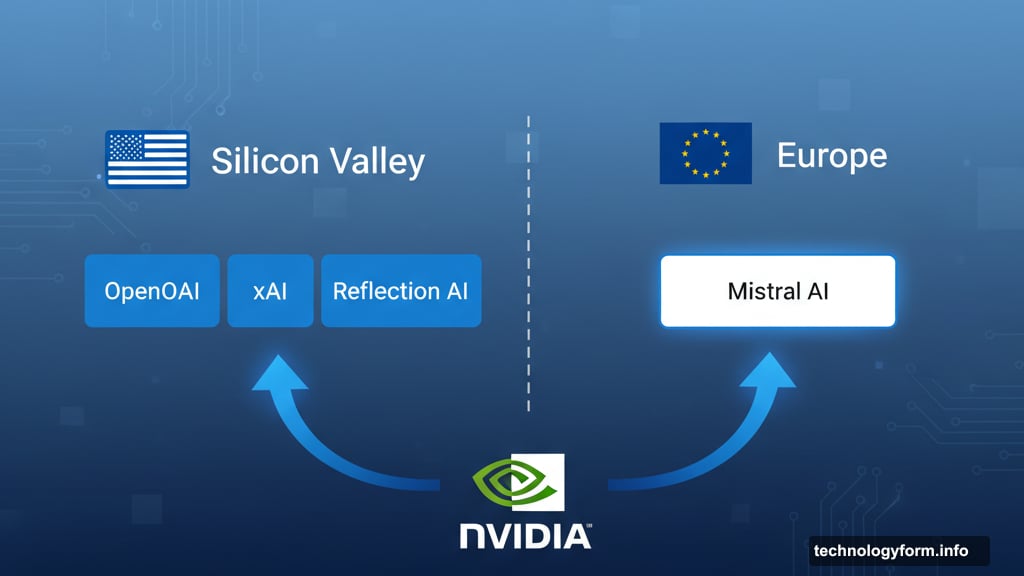
Nvidia hasn’t limited its strategy to Silicon Valley startups. The chipmaker invested heavily in international AI companies, particularly those building alternatives to US-based models.
Mistral AI, the French LLM developer, received Nvidia backing for a third time in September when it raised €1.7 billion ($2 billion) at a €11.7 billion valuation. European governments have pushed for domestic AI alternatives to US tech giants. So Nvidia’s repeated investments in Mistral position the chipmaker as a key enabler of European AI ambitions.
Nscale, which spun out of an Australian cryptocurrency mining company, raised $1.1 billion in September with Nvidia participation. Then Nvidia joined a $433 million SAFE round in October. Nscale builds data centers in the UK and Norway specifically for OpenAI’s Stargate project. That’s essentially Nvidia funding the infrastructure that will host Nvidia-powered AI workloads.
Sakana AI, based in Japan, raised about $214 million in its Series A with Nvidia backing. The startup focuses on training low-cost generative AI models using smaller datasets. That approach could open new markets where massive compute budgets aren’t available.
Beyond Language Models
While most attention focuses on large language models, Nvidia spread investments across diverse AI applications. The strategy reveals the company’s bet that AI will transform multiple industries, not just chatbots and text generation.
Figure AI, developing humanoid robots, raised over $1 billion in September at a $39 billion valuation with Nvidia participation. The chipmaker first backed Figure in February 2024 during a $675 million Series B at a $2.6 billion valuation. That massive valuation jump in just months shows investor appetite for AI robotics.
Wayve, building self-learning systems for autonomous driving, secured $1.05 billion in May 2024 with Nvidia involvement. Then Nvidia committed another $500 million in September. Wayve tests vehicles in the UK and San Francisco Bay Area, competing against better-funded rivals like Waymo and Tesla.
Commonwealth Fusion, working on nuclear fusion energy, attracted $863 million in August with Google, Breakthrough Energy Ventures, and Nvidia participating. AI’s massive power consumption has become a critical constraint. So investing in revolutionary energy sources makes strategic sense for Nvidia’s long-term positioning.
The Cloud Infrastructure Layer
Nvidia’s investments in cloud providers create a vertically integrated ecosystem. These companies rent Nvidia-powered servers to AI developers, creating a flywheel effect that drives GPU demand.
CoreWeave raised $221 million in April 2023 with Nvidia participation. The GPU cloud provider went public while Nvidia remained a significant shareholder. CoreWeave’s business model depends entirely on renting access to Nvidia hardware.
Lambda secured $480 million in February at a reported $2.5 billion valuation. The AI cloud provider focuses on model training services. A significant portion of Lambda’s revenue comes from renting Nvidia GPU-powered servers.
Together AI received $305 million in February with Nvidia backing. The startup offers cloud-based infrastructure for building AI models. Again, Nvidia benefits from increased GPU demand as Together AI scales.
This strategy locks customers into Nvidia’s ecosystem at multiple levels. Companies using these cloud providers can’t easily switch to alternative chips because the entire infrastructure stack revolves around Nvidia architecture.
The Scale AI Situation
Not every Nvidia investment worked out perfectly. Scale AI raised $1 billion in May 2024 with Nvidia, Amazon, Meta, and Accel participating. The deal valued the data-labeling company at nearly $14 billion.
But in June, Meta invested $14.3 billion for a 49% stake in Scale. More importantly, Meta hired away Scale’s co-founder and CEO Alexandr Wang plus several key employees. That’s a massive disruption for a company Nvidia backed just weeks earlier.
The Scale situation highlights risks in Nvidia’s investment strategy. Big tech companies with deeper pockets can acquire startups or poach talent, potentially undermining Nvidia’s strategic positioning.
What This Means for AI Competition
Nvidia’s investment spree creates complex competitive dynamics. The company backs multiple AI model developers who compete directly with each other. OpenAI, xAI, Mistral, Anthropic, and others all receive Nvidia funding while fighting for market share.
Some view this as smart hedging. Nvidia wins regardless of which AI platform dominates because all use its chips. However, the strategy also gives Nvidia unusual influence over the AI industry’s direction.
Regulators might scrutinize this arrangement eventually. If one company supplies chips to all major AI developers AND invests in those same companies, questions about market concentration become inevitable.
Meanwhile, competitors like AMD and Intel face an even steeper challenge. They’re not just competing on chip performance. Instead, they’re fighting against Nvidia’s embedded position across the entire AI ecosystem through these strategic investments.
Nvidia turned its AI windfall into a self-reinforcing advantage. The more money the company makes from GPU sales, the more it invests in startups that will buy more GPUs. That’s a powerful flywheel that competitors will struggle to break.