Amazon AWS Nova: New Enterprise AI Platform Challenges Microsoft Azure and Google Cloud
Amazon Web Services dropped a bombshell today. Their new Quick Suite workspace directly challenges Microsoft Copilot and Google Gemini in the enterprise AI market.
This isn’t just another cloud service announcement. AWS built Quick Suite specifically to solve problems that plague consumer AI tools in corporate settings. Think data security nightmares, integration headaches, and compliance concerns that keep CIOs awake at night.
The stakes? Control of the rapidly expanding enterprise AI market, where companies spend billions automating workflows and supercharging employee productivity.
What Quick Suite Actually Does
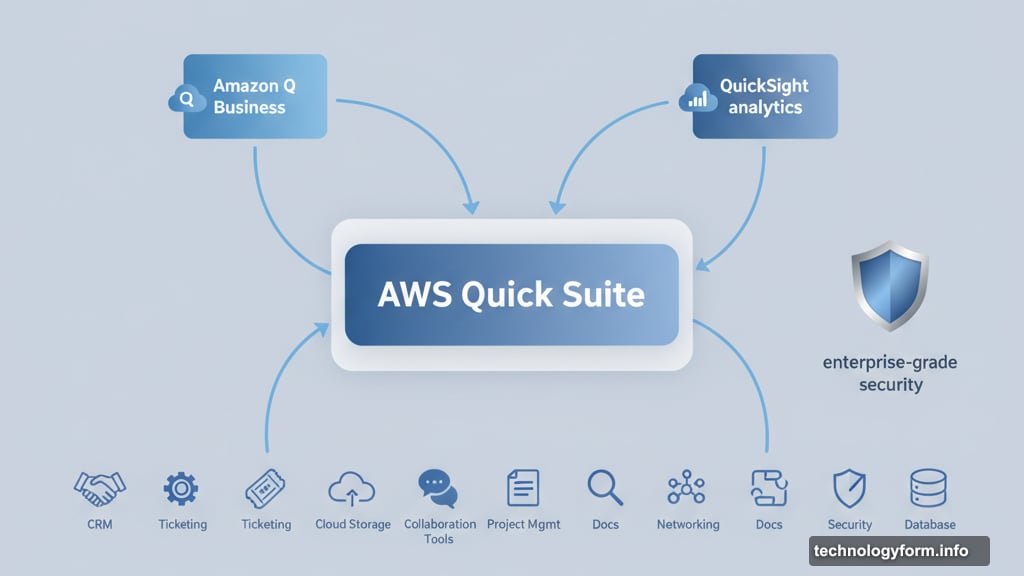
Quick Suite consolidates AWS’s scattered AI services into one unified platform. It combines Amazon Q Business, QuickSight analytics, and several new capabilities into a workspace that business users can actually navigate without a computer science degree.
The core promise sounds simple. Automate repetitive tasks, conduct deep research, and extract insights from your company’s data fortress. All while maintaining enterprise-grade security that consumer tools can’t match.
But here’s where it gets interesting. Quick Suite connects to over 1,000 business applications through 50 built-in connectors and two open protocols. That means your CRM, ticketing system, cloud storage, and collaboration tools all feed into one AI brain.
Plus, it supports multiple AI models through Amazon Bedrock. So you’re not locked into one provider’s approach to machine learning. That flexibility matters as models evolve and improve.
The Features That Matter Most
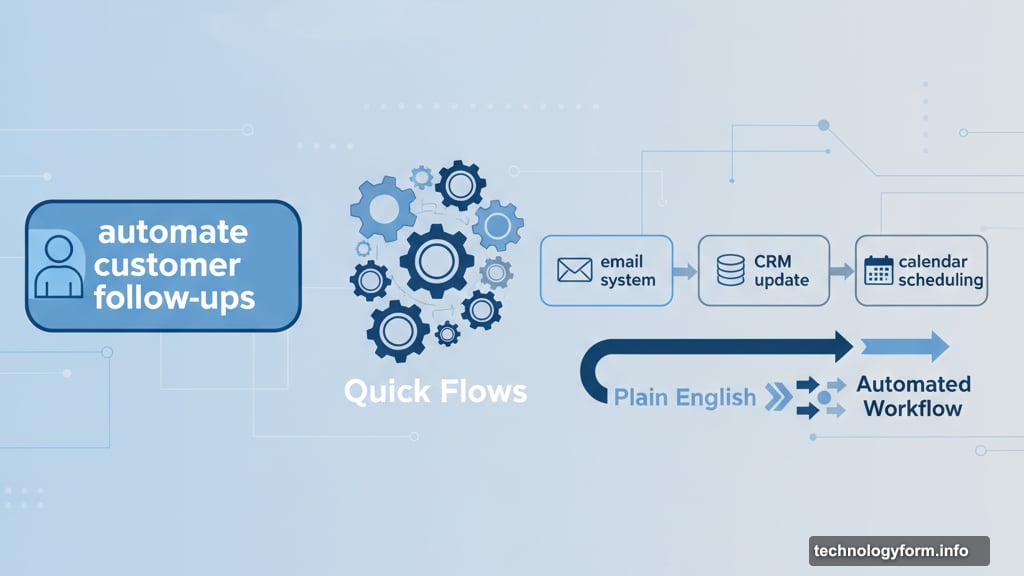
Quick Flows lets non-technical employees build automated workflows using plain English. No coding required. Just describe what you need, and the system creates repeatable processes.
For complex automation across departments, Quick Automate handles multi-agent deployments. These AI agents work together, coordinating tasks that span different systems and teams.
The Deep Research Agent stands out as particularly powerful. It synthesizes information from internal databases, external sources, and the web to produce comprehensive reports. More importantly, it cites sources, so you can verify every claim.
Custom Agents allow businesses to create specialized AI assistants for specific functions. Sales forecasting, customer support escalation, inventory optimization—whatever your operation needs.
The UI Agent interacts directly with applications, clicking buttons and filling forms like a human employee would. That capability unlocks automation for legacy systems that lack modern APIs.
Pricing Puts Pressure on Rivals
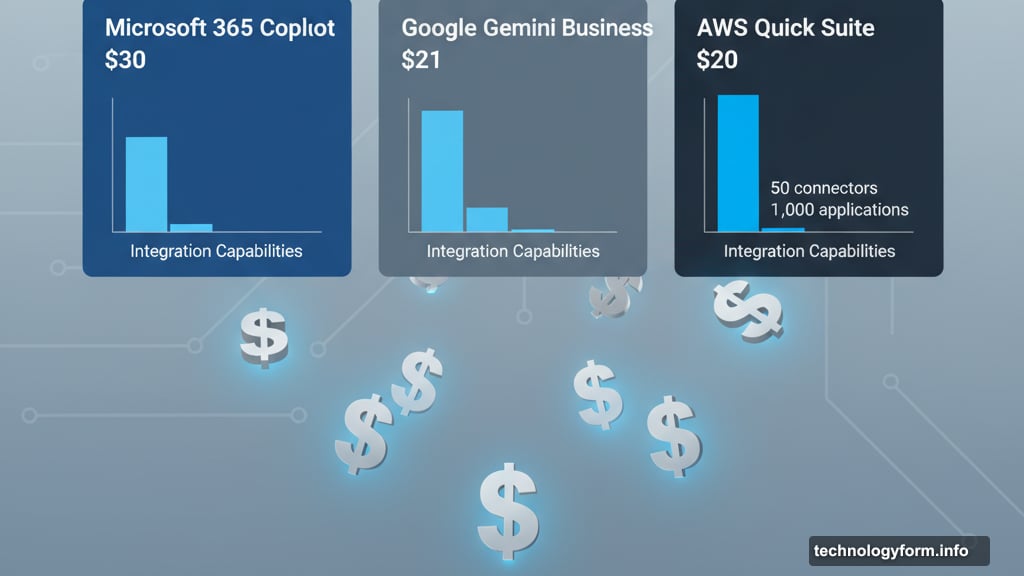
AWS set Quick Suite’s base subscription at $20 per user monthly. Plus consumption charges for compute resources, storage, and API calls.
Compare that to Google’s Gemini Business at $21 monthly or Microsoft 365 Copilot at $30 monthly. AWS undercuts the competition while offering more integration options and flexibility.
Microsoft must feel the heat. Copilot became a major revenue driver for Office 365, and now AWS threatens that growth trajectory with aggressive pricing and superior connectivity.
Google faces similar pressure. Gemini’s enterprise adoption lagged behind consumer enthusiasm, partly due to limited business tool integration. Quick Suite’s 1,000+ application connections directly address that weakness.
Security Makes the Sale
Consumer AI tools scare enterprise IT departments for good reason. Data leakage, compliance violations, and lack of audit trails create unacceptable risks.
AWS designed Quick Suite with these concerns front and center. User queries never train models. Data stays within your AWS environment. Full audit logs track every interaction and decision.
These guarantees matter more than flashy features for most CIOs. ChatGPT might be brilliant, but it’s also a black box that could accidentally expose sensitive information or violate industry regulations.
The Model Context Protocol integration deserves attention too. It standardizes how AI agents access and interact with data sources, reducing the security surface area that IT teams must monitor.
Microsoft and Google Fight Back
Neither Microsoft nor Google will surrender this market without a fight. Both have advantages AWS can’t easily replicate.
Microsoft owns the productivity suite most businesses already use. Copilot integrates natively with Word, Excel, and Teams, creating a seamless experience that Quick Suite must work harder to match.
Google built search and knowledge management into its DNA. Gemini’s ability to surface relevant information across Google Workspace represents years of accumulated expertise.
However, both companies lag in cloud infrastructure depth. AWS’s decades of enterprise cloud experience give it credibility in areas like data governance, compliance, and global deployment that consumer-focused companies struggle to match.
Expect rapid feature announcements from both rivals. Price cuts seem likely too, as the battle for enterprise AI subscriptions intensifies.
Smaller Players Get Squeezed
Niche automation tools and specialized AI vendors face an existential threat. Why pay for separate workflow automation, business intelligence, and research tools when Quick Suite bundles everything?
Companies like UiPath, Automation Anywhere, and various business intelligence platforms must differentiate fast. Deep vertical specialization might save some. Integration partnerships with AWS could help others.
But consolidation seems inevitable. Enterprise buyers prefer fewer vendors and simpler stacks. All-in-one platforms from trusted cloud providers win over best-of-breed approaches when the quality gap narrows.
Some smaller vendors might get acquired. Others will pivot to serving mid-market customers that AWS doesn’t prioritize. The lucky few will carve out defensible niches that Quick Suite can’t easily replicate.
What Happens Next Month
Initial adoption will concentrate among existing AWS customers. They face minimal friction integrating Quick Suite with current infrastructure and can start testing immediately.
Early case studies will prove crucial. If major enterprises report significant productivity gains and cost savings, adoption accelerates. If implementation proves painful or benefits disappoint, competitors gain breathing room.
Microsoft and Google will respond quickly, possibly with enhanced features or temporary pricing promotions. Neither can afford to lose enterprise AI momentum at this critical juncture.
Independent software vendors will scramble to build Quick Suite integrations, hoping to ride AWS’s wave rather than get crushed by it. Those with unique capabilities or vertical expertise stand the best chance.
The Longer View
This launch accelerates the shift toward agentic AI—systems that perform complex tasks autonomously rather than just answering questions. That trend will reshape how businesses operate and compete.
Data privacy regulations will intensify scrutiny. As AI agents access sensitive information across multiple systems, regulators will demand stronger safeguards and clearer accountability frameworks.
The enterprise AI market will likely consolidate around three or four major platforms. AWS, Microsoft, and Google seem positioned as the survivors, with Anthropic, OpenAI, and others potentially carving out specialized roles.
Success ultimately depends on developer ecosystems and partner networks. The platform that attracts the most third-party integrations, custom agents, and implementation expertise will dominate long-term.
Why This Announcement Matters
AWS just validated enterprise AI as the next major software battleground. When Amazon commits resources at this scale, competitors must respond or risk irrelevance.
The focus on security and integration addresses real enterprise pain points that consumer AI tools ignore. That practical approach could finally unlock widespread AI adoption in risk-averse industries like finance, healthcare, and government.
For investors, watch adoption metrics closely over the next two quarters. Revenue per user, customer retention rates, and enterprise win rates will indicate whether Quick Suite can convert technical capabilities into business success.
The AI wars just entered a new phase. Consumer chatbots were the opening act. Enterprise productivity tools represent the main event, where real money and market power reside.
AWS fired the first major salvo. Microsoft and Google must answer decisively, or watch their enterprise AI ambitions crumble against Amazon’s cloud infrastructure and aggressive pricing.