AI Agents Could Crash the Economy. Here’s the Scenario Nobody Wants to Think About
A new research report just painted one of the scariest economic pictures we’ve seen in years. And the villain isn’t a rogue robot. It’s just math.
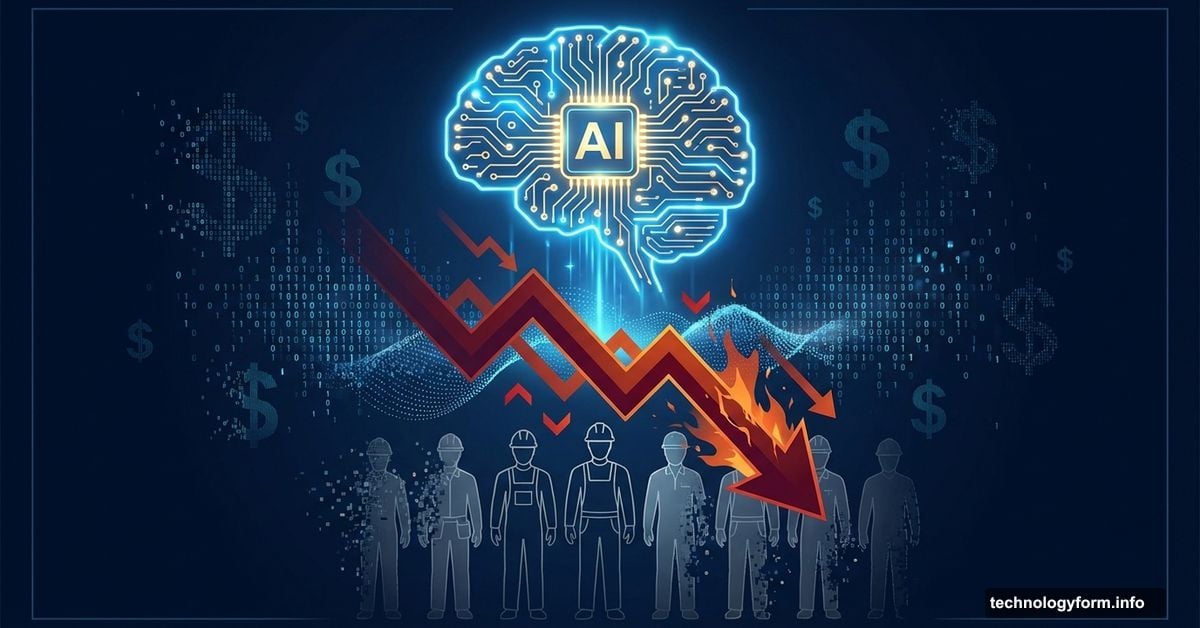
On Sunday, an analyst group called Citrini Research published a scenario imagining what the economy might look like two years from now. The short version? Unemployment doubles. The stock market loses more than a third of its total value. And the whole thing unravels not from some dramatic tech failure, but from a slow, grinding feedback loop that nobody managed to stop.
The Feedback Loop That Scares Economists
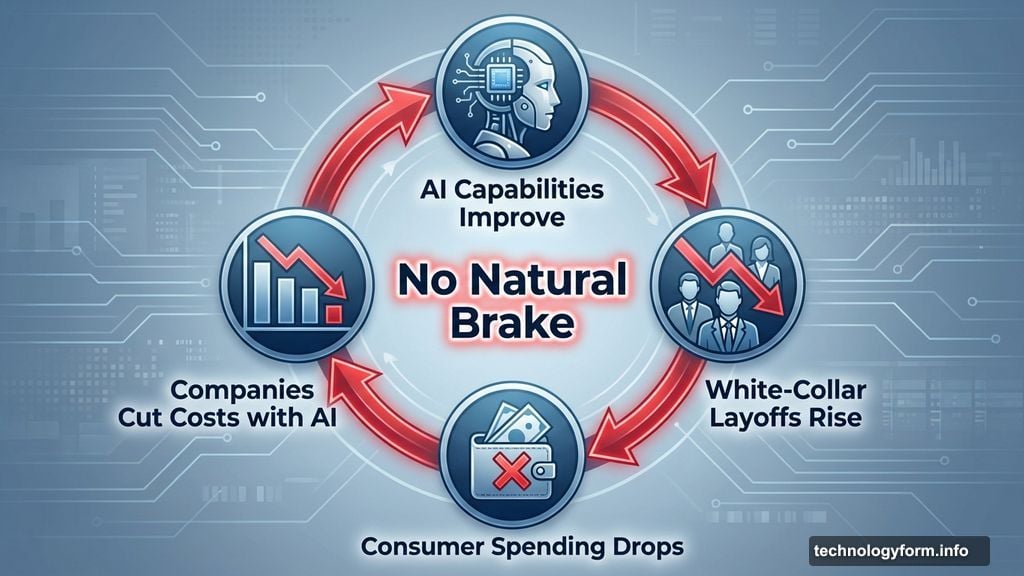
Here’s how Citrini describes the chain of events. AI capabilities improve, so companies need fewer workers. White-collar layoffs rise. Displaced workers spend less money. That squeezes profit margins at other companies. So those companies invest even more in AI to cut costs. And then AI capabilities improve again.
Round and round it goes.

As Citrini puts it directly: “It was a negative feedback loop with no natural brake. The system turned out to be one long daisy chain of correlated bets on white-collar productivity growth.”
That phrase, “correlated bets,” is doing a lot of heavy lifting here. When every company makes the same bet at the same time, the downside hits everyone simultaneously. There’s no cushion, no counterbalance, no industry that escapes untouched.
This Isn’t Your Standard AI Doom Story
Forget Skynet. Forget killer robots. This scenario has nothing to do with artificial intelligence going rogue or developing sinister intentions.
Instead, Citrini is focused on something far more mundane and arguably more plausible. What happens when AI agents get good enough to replace outside contractors? What happens to entire business models built around optimizing transactions between companies?
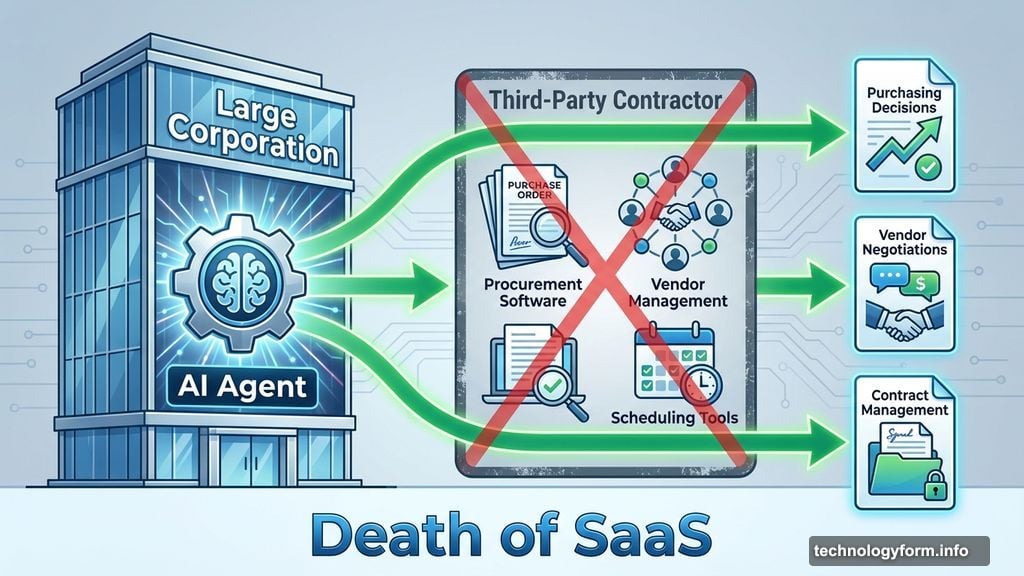
This connects directly to what some analysts call the Death of SaaS scenario. Many software companies exist specifically to help businesses talk to each other more efficiently. Think scheduling tools, procurement platforms, supplier management software, and the armies of consultants who manage those relationships.
But Citrini goes further than the SaaS argument. If an AI agent can handle purchasing decisions, vendor negotiations, and contract management internally at a fraction of the cost, why pay an outside firm at all?
The Third-Party Contractor Problem
Here’s where the scenario gets genuinely uncomfortable.
Most critiques of AI taking over important business decisions land on the same rebuttal. Surely companies won’t hand serious purchasing power to an AI agent. Surely humans stay in the loop for anything consequential.
And that’s a fair pushback. But Citrini sidesteps it neatly.
In many large companies, those consequential decisions have already been handed off to third-party contractors. A human is technically involved, but it’s often a vendor’s employee, not your own team. So the leap from “outsourced to a contractor” to “handled by an AI agent” is actually much smaller than it first appears.
That’s the part of this scenario that sticks with me. It’s not asking companies to trust AI with sensitive decisions that humans currently own. It’s asking whether AI can replace external vendors who already handle those decisions at arm’s length.
Is This a Prediction or a Warning?
To their credit, Citrini is careful about framing. They describe this as a scenario, not a forecast. It’s a stress test, a way of asking: if this chain of events started today, where exactly would it break down?
And that’s the uncomfortable part of the online reaction the report has generated. Plenty of skeptics are pushing back. But nobody seems to have a clean, specific answer for where the chain breaks.
The scenario is spreading because it feels coherent. Every link in the chain follows logically from the one before it. That’s rarer than it sounds in economic forecasting.
Personally, I think the most likely friction point is that AI agents aren’t quite ready to own complex procurement decisions at scale. Business relationships are messy, political, and full of context that current AI systems handle poorly. But “not ready yet” is a very different argument from “this can’t happen.”
The gap between those two positions might be smaller than two years. Or it might be much larger. Nobody knows. And that uncertainty, more than any specific prediction, is probably why this report hit such a nerve.
Citrini didn’t write a horror story. They wrote a question that nobody has a comfortable answer to yet.