Microsoft Just Locked Down 116,000 Nvidia GPUs Through Nscale Deal
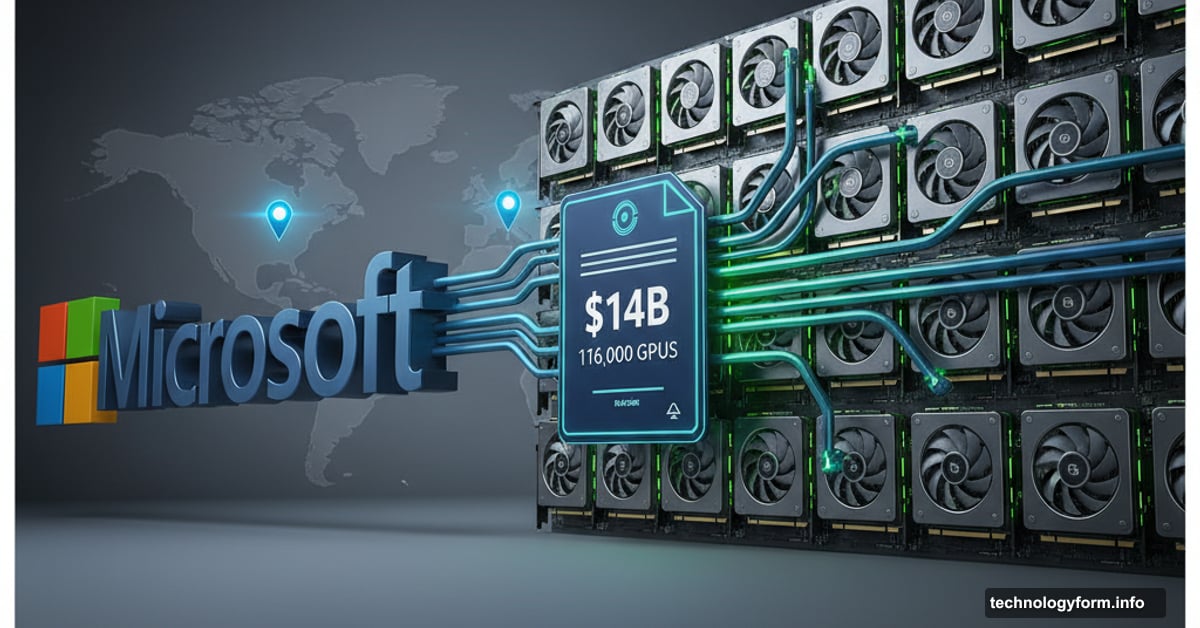
Microsoft isn’t slowing down its AI infrastructure buildout. The tech giant just signed a massive $14 billion deal with Nscale to access 116,000 additional Nvidia GB300 GPUs across the US and Europe.
This marks a significant expansion of Microsoft’s partnership with the UK-based infrastructure provider. Plus, it signals how seriously hyperscalers are racing to secure GPU capacity for AI workloads. The deployment spans two continents with staggered timelines starting in 2026.
Texas Gets the Lion’s Share
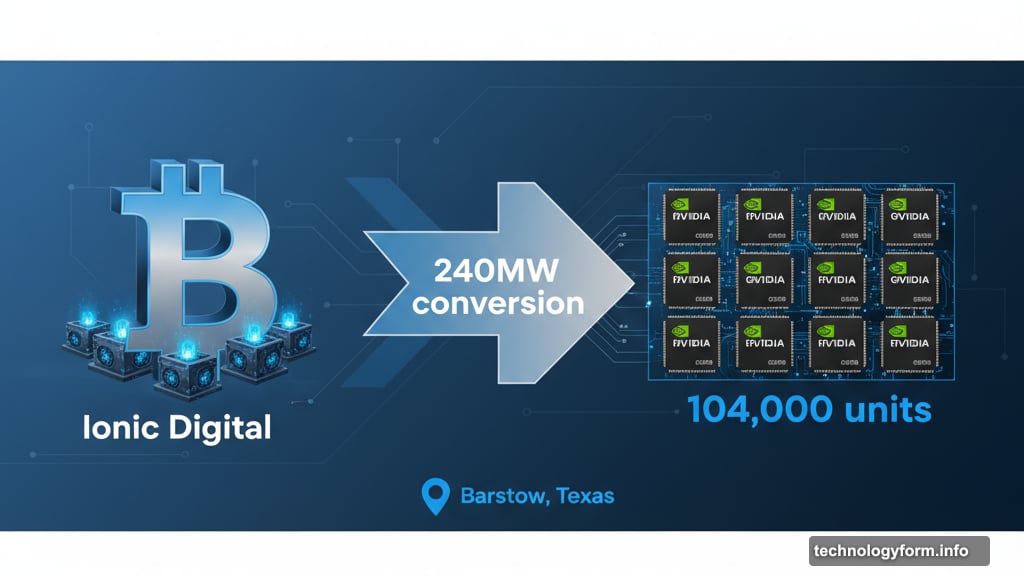
The bulk of this deal centers on a 240MW data center in Barstow, Texas. Nscale is leasing the facility from Bitcoin miner Ionic Digital, converting what was once a cryptocurrency operation into an AI powerhouse.
That Texas site will eventually house 104,000 GB300 GPUs. The first phase delivers capacity in Q3 2026. But here’s the interesting part: Microsoft secured an option for a second phase adding 700MW starting late 2027.
Nscale also plans to scale the Texas location to 1.2GW over time. That’s enormous capacity by any standard. For context, most traditional data centers operate at 50-100MW. So this represents a fundamentally different scale of infrastructure.
Portugal Joins the Party
Meanwhile, 12,600 additional GB300s will land at the Start Campus facility in Sines, Portugal. That deployment goes live in Q1 2026, slightly ahead of the Texas timeline.
Start Campus brings its own complicated history. The project got caught up in a corruption scandal that actually brought down the Portuguese government. Multiple executives faced arrests over allegations of misused funds and political influence peddling.
However, charges against former CEO Afonso Salema were eventually dropped. Robert Dunn now leads Start Campus as permanent CEO after serving as interim chief since November 2023. Under his leadership, the first building (SIN01) launched in January 2025 and quickly reached capacity.
Dunn called the Nscale deal a “defining moment” for the campus. He’s not wrong. Oversubscribed demand for SIN01 already forced expansion plans. Now they’re pushing forward with SIN02, an 180MW facility designed for ultra-dense AI workloads.
Why Microsoft Keeps Partnering With Neoclouds
This deal follows a pattern. Last month, Microsoft signed a $6.2 billion agreement with Nscale for AI compute in Norway. Before that, they announced plans for a UK supercomputer with 23,000 Nvidia GPUs at Nscale’s upcoming Essex data center.
Microsoft is increasingly turning to specialized infrastructure providers rather than building everything itself. CoreWeave became a known customer. Nebius Group signed a $17.4 billion five-year deal in September 2024 for capacity in New Jersey.
So what’s driving this strategy? Speed and specialization. Traditional data center construction takes years. These neocloud providers move faster and focus exclusively on AI-optimized infrastructure. That matters when you’re racing competitors to serve enterprise AI customers.
Josh Payne, Nscale’s founder and CEO, emphasized this advantage. “Few companies are equipped to deliver GPU deployments at this scale,” he said. “But we have the experience and have built the global pipeline to do so.”
From Bitcoin Mining to AI Infrastructure
Nscale’s origin story is wild. The company spun out of a Bitcoin mining operation just last year. Now it’s landed more than $1 billion in funding from backers including Nvidia itself.
That Bitcoin heritage actually provides advantages. Cryptocurrency mining facilities are already designed for massive power consumption and cooling requirements. Converting them for AI workloads makes sense since both use cases share similar infrastructure needs.
Payne told the Financial Times that Nscale aims to go public in 2026. “We have public market ambitions, and execution is an enormous focus of mine,” he said. Given the scale of contracts they’re winning, that IPO timeline seems plausible.
The GB300 GPU Makes Its Debut
These deployments mark major production rollouts for Nvidia’s GB300 GPU. Part of the Grace Blackwell architecture, the GB300 targets AI training and inference workloads requiring extreme computational density.
Microsoft clearly believes in the hardware. Jon Tinter, president of business development and ventures at Microsoft, praised the partnership. “Together with Nscale, Microsoft is delivering cutting-edge AI infrastructure for our customers,” he said.
The phased deployment approach makes sense. Rolling out over 100,000 GPUs simultaneously would stress supply chains and installation capacity. Staggering the timeline from 2026 through 2027 allows for smoother execution and testing.
What This Means for AI Compute Availability
These massive deals reveal how constrained GPU supply remains. If Microsoft needs to lock down capacity years in advance through multiple providers, that signals ongoing scarcity.
For enterprises trying to access AI infrastructure, this creates challenges. Hyperscalers are reserving enormous amounts of compute for their own needs and cloud customers. Companies building proprietary AI systems face tougher competition for available GPUs.
However, it also validates the neocloud business model. Specialized providers like Nscale can move fast, secure hardware allocations, and build facilities optimized for AI workloads. That creates opportunities for new entrants willing to take execution risk.
The sustainability angle matters too. Both Microsoft and Nscale emphasized efficiency and environmental considerations. AI infrastructure consumes enormous power. Locating facilities where renewable energy is abundant helps address that concern.
Microsoft’s strategy is becoming clear. Rather than build everything internally, they’re partnering with specialized providers across multiple regions. That provides flexibility, speeds deployment, and reduces capital risk. For Nscale, these deals establish them as a serious player capable of hyperscale execution.
The race for AI infrastructure just got more expensive and more competitive. And based on these contracts, that trend won’t reverse anytime soon.