Quantum Computers Are Making AI Smarter. Here’s What That Means
AI predictions are already everywhere. Doctors use them to spot diseases early. Weather forecasters rely on them for storm tracking. Financial analysts lean on them to read market trends.
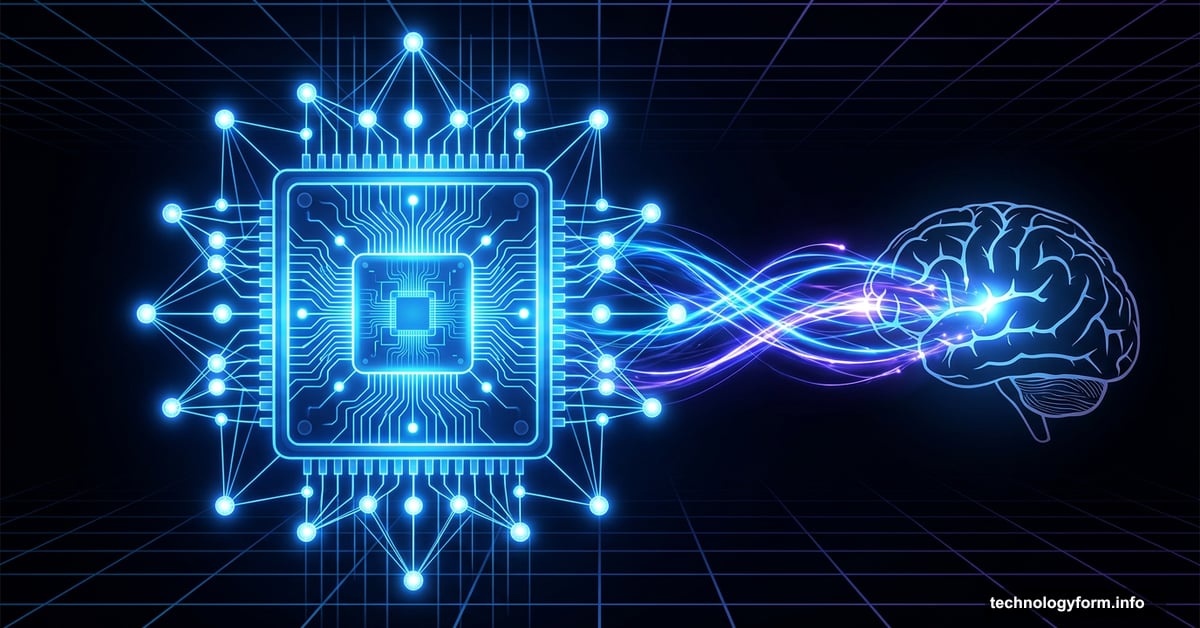
But those predictions have limits. Some calculations are simply too complex for regular computers to handle fast enough. Now, researchers think quantum computers could change that equation entirely.
A team from University College London just published findings in the journal Science Advances showing exactly how this could work. And the results are pretty exciting.
Supercomputers Meet Quantum Computing
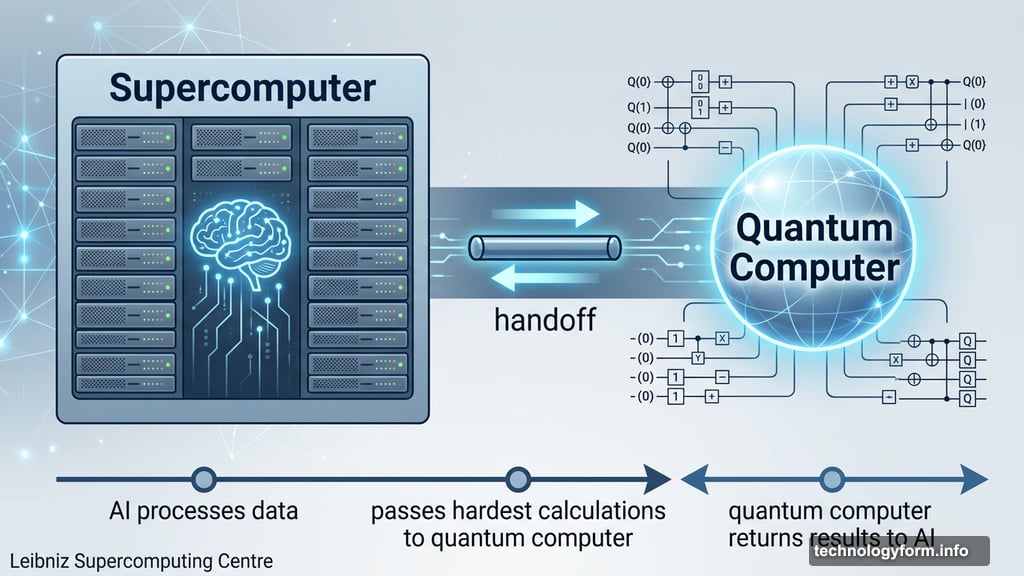
The experiment ran at the Leibniz Supercomputing Centre in Germany. Researchers connected an AI model, housed on a supercomputer, directly to a quantum computer.
Their goal was to predict how gases and liquids move and interact over long periods of time. That kind of modeling sounds niche, but it matters enormously. Climate scientists use it. So do medical researchers and city planners designing infrastructure.
The setup worked like a relay race. The AI handled most of the data processing on the supercomputer. Then, for the hardest calculations, it handed off to the quantum computer. Once that step was done, the quantum computer passed control back to the AI to finish the job.
Simple in concept. Incredibly powerful in practice.
Why Quantum Computers Are So Different
Here’s a quick way to think about the difference. A regular computer solves problems one step at a time, like reading a book page by page. A quantum computer can essentially read every page at once.
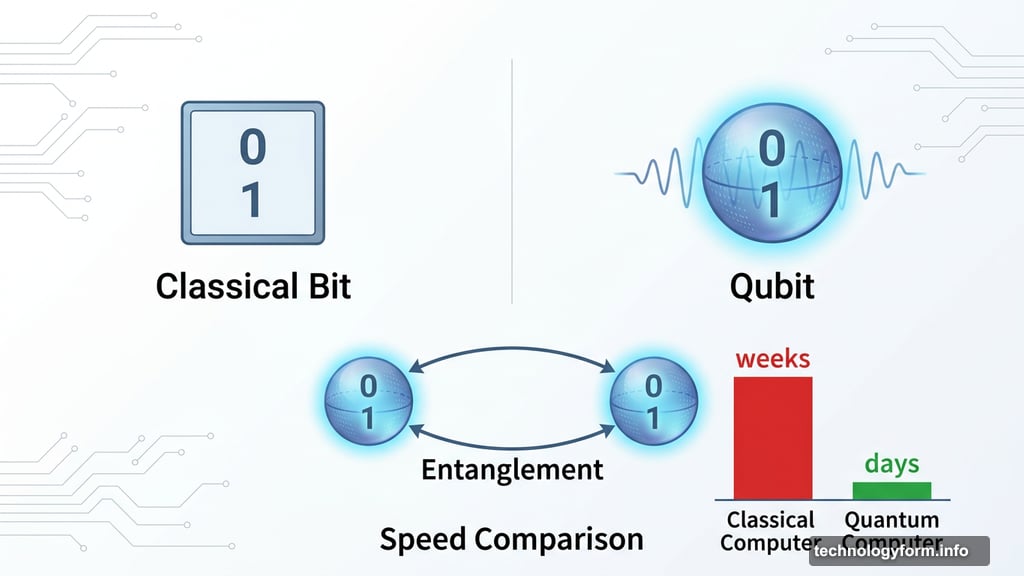
That’s because quantum computers use qubits instead of traditional bits. A standard bit stores either a zero or a one. A qubit can hold both values simultaneously, a property called superposition. Two qubits can also link together through a process called entanglement, letting them share and process information in ways classical bits simply cannot.
Together, superposition and entanglement let quantum computers tackle complex problems dramatically faster than traditional machines.
Quantum Advantage Is Real
The research team used a specific term to describe their findings: “quantum advantage.” Basically, it means the quantum computer did something classical computing alone couldn’t match.
“Our new method appears to demonstrate quantum advantage in a practical way,” said Maida Wang, a PhD student at UCL and coauthor of the study. “The quantum computer outperforms what is possible through classical computing alone.”
That’s a bold claim. And it’s backed by results that would have taken a regular computer weeks to produce.
Peter Coveney, UCL professor and co-author of the study, put it plainly. “Even today’s noisy and error-prone quantum devices can enhance the performance of conventional machine-learning algorithms trained on data from modern supercomputers.”
This Isn’t Science Fiction Anymore
![Close-up view of a quantum computer circuit used in AI research experiments at a supercomputing facility]
You might think connecting AI to a quantum computer sounds like something out of a sci-fi film. But real-world examples already exist.
In 2025, Google announced its Quantum Echoes algorithm could calculate molecular structures, potentially opening new doors for drug discovery. Around the same time, the University of Toronto and Insilico Medicine used a quantum-AI combination to design molecules targeting a previously “undruggable” form of cancer.
These aren’t lab curiosities. They’re early signs of a broader shift in how we solve hard scientific problems.
The Big Catch
Quantum computers are extraordinarily delicate. They must be kept at near absolute zero temperatures. Even the tiniest environmental disturbance can throw off calculations. That’s why they live in specialized research labs and aren’t exactly sitting on office desks.

So there’s still a long road ahead. Ensuring reliable predictions at scale remains a challenge. So does managing the sheer volume of data these systems need to process.
But here’s the thing. The UCL team didn’t need a perfect quantum computer to show results. They used today’s imperfect, limited quantum devices and still demonstrated measurable improvements. That’s the part worth paying attention to.
“The paper demonstrates that for these kinds of studies, even today’s relatively small and unreliable quantum devices can enhance the predictions of conventional AI models,” Coveney told CNET.
What Comes Next
The UCL team isn’t stopping at lab experiments. Coveney confirmed they’re already working on real-world applications, though specifics weren’t shared.
The broader picture is becoming clear, though. Quantum computing won’t replace classical computers or AI models anytime soon. Instead, it’ll act as a powerful add-on for the hardest problems. Think of it less as a replacement engine and more as a turbocharger.
For fields like climate modeling, medicine, and materials science, that turbocharger could speed up breakthroughs by years. Calculations that would take weeks on traditional hardware might become routine. And that means better predictions, faster discoveries, and solutions to problems we haven’t cracked yet.
The quantum-AI partnership is still young. But this study shows it’s already delivering real results. That’s worth watching closely.