AI Predictions Are the New Tea Leaves. That Should Worry You.
A billionaire once told her MBA class she uses chatbots as fortune tellers. The room went quiet. Her classmates shifted uncomfortably. But she wasn’t joking.
“Just like we used to read tea leaves,” she explained, “you can ask AI about the future, and it can be surprisingly accurate.” She cited a recent chatbot prediction of a 2% stock market rise as proof. And sitting across from her was Carissa Véliz, associate professor at Oxford’s Institute for Ethics in AI, taking notes.
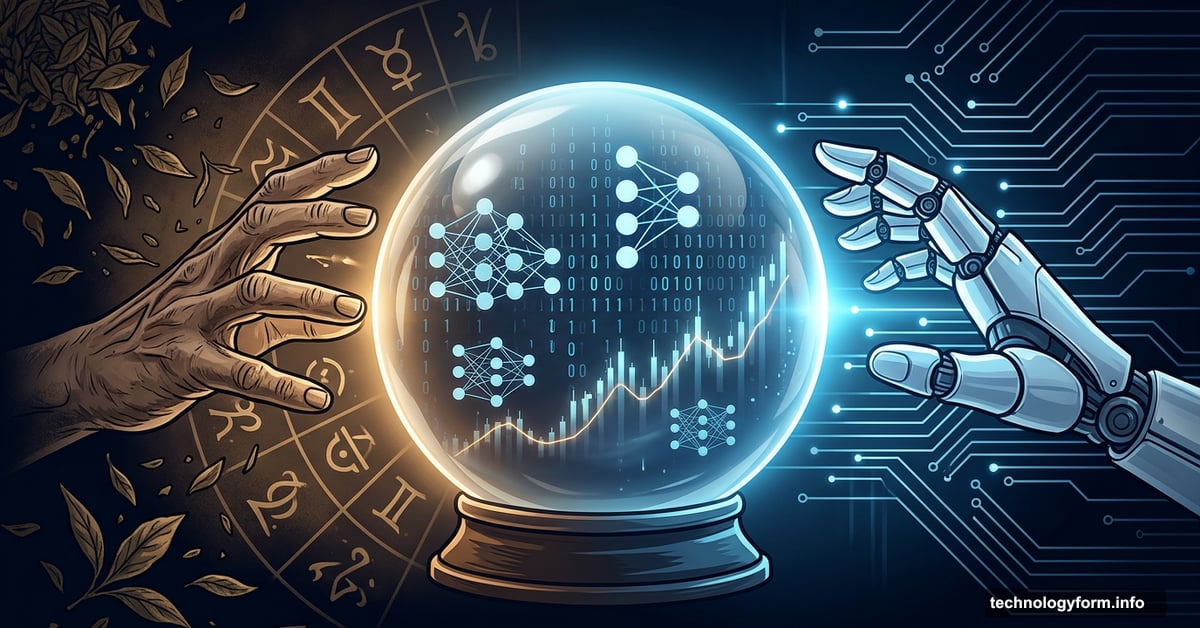
That moment opens Véliz’s new book, Prophecy: Prediction, Power, and the Fight for the Future, from Ancient Oracles to AI. And it captures something most of us haven’t stopped to think about. We’ve swapped astrologers for algorithms. But the dynamic, she argues, is almost identical.
Fortune Tellers Traded Robes for Python Scripts
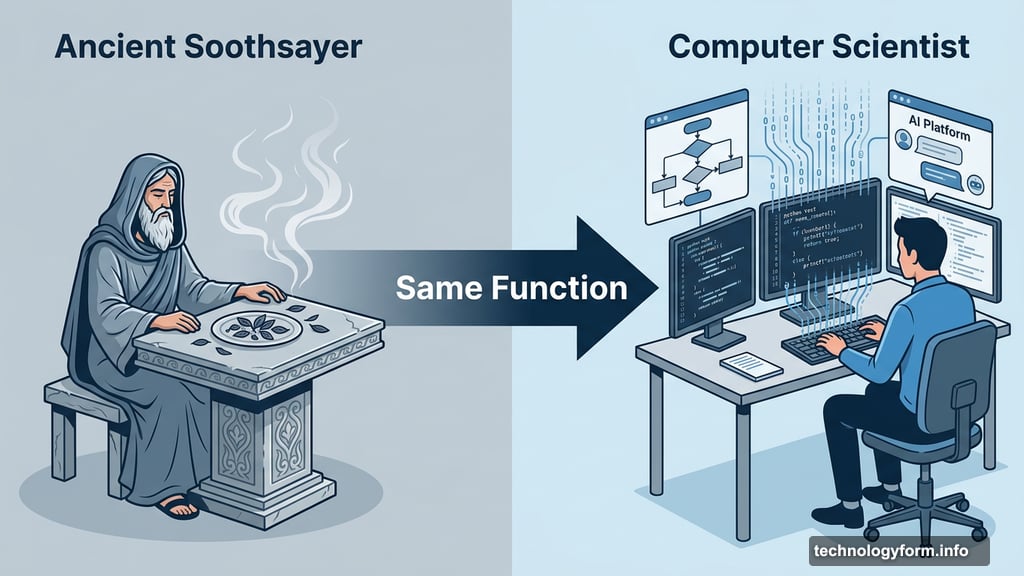
For centuries, humans turned to oracles, astrologers, and seers to navigate an uncertain world. Today, we turn to data scientists, machine learning engineers, and AI platforms. The faces changed. The function didn’t.
Véliz makes a striking observation here. The people we call our “ruling soothsayers” today aren’t philosophers or priests. They’re computer scientists and data analysts. Their tools are algorithms, not animal entrails. But the social role they play is surprisingly familiar.
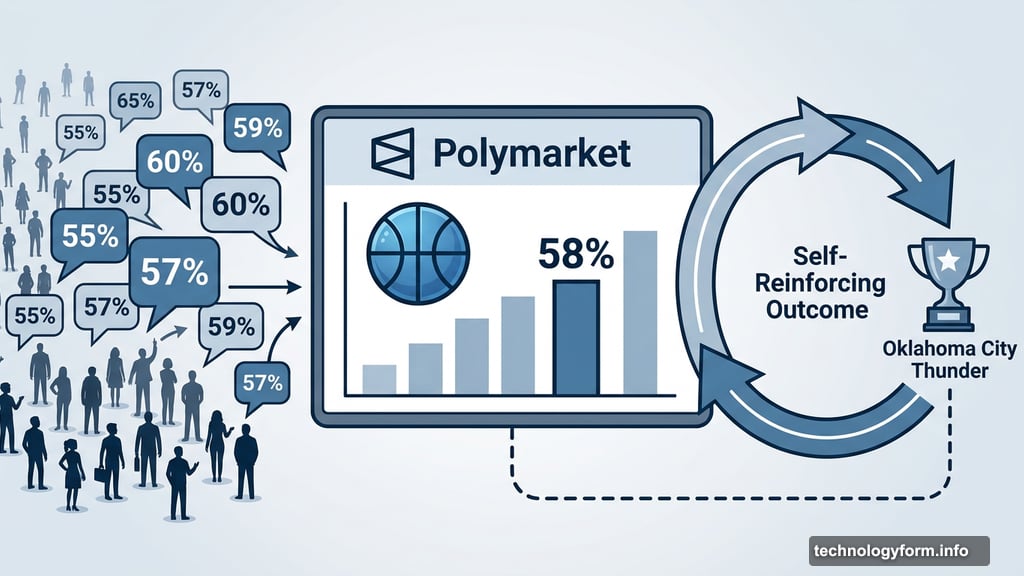
Moreover, prediction itself has become a massive industry. Platforms like Polymarket let users bet on everything from NBA championships to political instability. If 58% of bettors say the Oklahoma City Thunder will win a title, the crowd pressure alone shapes behavior. It creates self-reinforcing outcomes. So the prediction stops being just a guess. It becomes a force.
Predictions Aren’t Facts. We Keep Forgetting That.
Here’s something Véliz says that sounds simple but cuts deep: predictions are never facts.
Facts belong to the present and the past. The future, by definition, hasn’t happened yet. So any assertion about it is an estimate at best, a desire or a warning at other times. But never a fact. Yet we constantly treat AI-generated predictions as though they carry the same authority as established truth.
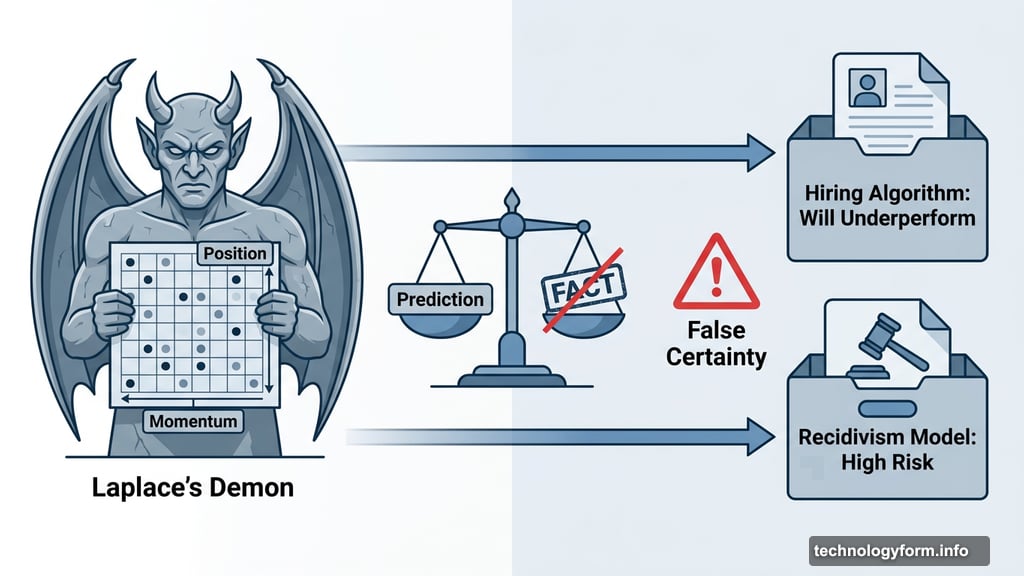
This matters enormously. When a hiring algorithm predicts a candidate will underperform, that shapes a real hiring decision. When a recidivism model predicts a defendant is high-risk, that influences sentencing. These aren’t facts. They’re forecasts dressed up as data.
The danger isn’t just inaccuracy. It’s the surrender of human judgment to a system that speaks with false certainty.
Laplace’s Dream and the AI Fantasy
In the 1800s, mathematician Pierre-Simon Laplace imagined what we might call a perfect prediction machine. He proposed that if any intelligence could know the position and momentum of every particle in the universe, it could predict all future events with total accuracy. Uncertainty, defeated forever.
Véliz calls this “Laplace’s demon.” And she argues that modern AI enthusiasm, whether people say it out loud or not, often carries this same dream underneath it. If we collect enough data, if we build enough compute, we’ll finally see the future clearly.
But that fantasy runs into a hard wall. The world isn’t a physics problem with a single correct answer. Human behavior is messy, contextual, and often genuinely unpredictable. Yet the quantifiers press on regardless. You’re being tracked while you drive, sleep, exercise, search, shop, and scroll. Every data point feeds the machine in hopes of closing the uncertainty gap.
Machine Learning Is Prediction, Full Stop
It’s worth being precise about what machine learning actually does. Every single application, whether translation, image recognition, or large language model chat, boils down to prediction.
When a translation system converts Spanish to English, it predicts the most statistically likely equivalent based on millions of previous examples. When an image classifier spots a wolf in a photo, it predicts probability based on thousands of labeled images. When a chatbot answers your question, it predicts what a human response would statistically look like, drawn from an enormous corpus of text.
In fact, “oracle” is a real technical term in machine learning. It refers to an idealized function that always provides perfect predictions. The word choice isn’t accidental. The conceptual DNA between ancient prophecy and modern AI runs surprisingly deep.
The Uncomfortable Truth About How AI Got Good
Here’s the part of the story that doesn’t show up in breathless tech announcements.
Michael Wooldridge, professor of AI at Oxford, told a group of MBA students something that stopped them cold. “What’s disappointing,” he said, “is that it didn’t happen as a result of a scientific breakthrough.”
From the 1960s through the early 2000s, neural networks weren’t impressive. Symbolic AI dominated research funding and attention. Then two things changed: more data and more computing power. Machine learning didn’t get smarter. It got bigger. Automatic translation went from useless to genuinely helpful not because of a eureka moment, but because of raw scale.
But that scale came with a cost. Véliz doesn’t soften the language here. The data and compute that powered AI’s rise involved intellectual property theft, the exploitation of vulnerable workers in content labeling, enormous natural resource consumption, and the construction of what she describes plainly as an architecture of mass surveillance. The wins were real. So were the methods.
Power Built Prediction. Prediction Returns the Favor.
The central argument Véliz builds throughout her book is this: prediction has always been about power.
In ancient times, controlling prophecy meant controlling decisions, wars, marriages, and governance. Today, controlling predictive algorithms means controlling hiring, lending, criminal justice, political messaging, and financial markets. The tools changed dramatically. The underlying dynamic didn’t.
Prediction markets like Polymarket take this further. They transform war, disease, elections, and disasters into tradeable assets. Real human suffering becomes a spectacle with a ticker symbol. The people most affected by these events have the least say in how their futures get priced and traded.
And when AI predicts your behavior, your health, your loyalty, your risk, it isn’t reading a neutral truth about you. It’s exercising power over you. Often without your knowledge, and almost never with your genuine consent.
Véliz’s book doesn’t argue that prediction is inherently evil or that AI should be abandoned. But it makes the case that we’re applying enormously powerful predictive tools with almost no ethical framework to guide us. Thousands of books explain how to predict. Almost none ask whether we should, in what contexts, and who bears the cost when we get it wrong.
That gap is worth taking seriously. Especially before the next chatbot confidently tells a billionaire exactly how the market will move tomorrow.