AI Just Made Dinosaur Tracking Way Easier. Here’s How It Works
Paleontologists spent decades squinting at ancient footprints, arguing over which dinosaur left them. Now an AI tool settles the debate in seconds.
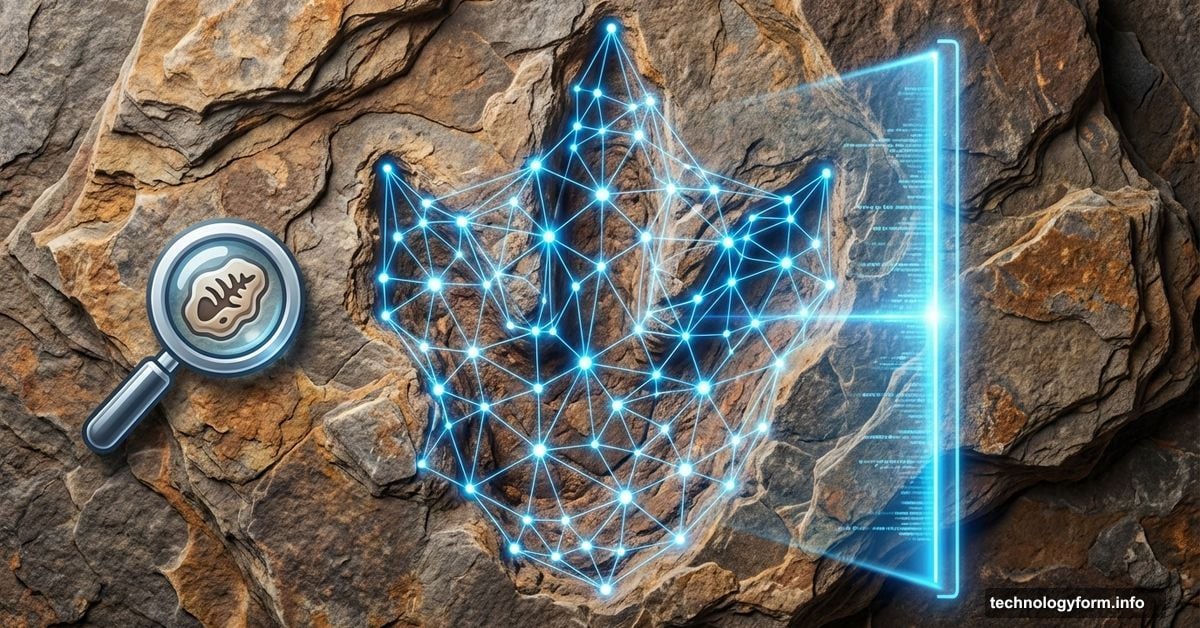
Dinotracker, a new app from researchers in Berlin and Edinburgh, identifies dinosaur species from fossilized tracks with 90% accuracy. That’s as good as human experts. Plus, it removes the bias and guesswork that plagued fossil identification for years.
The team published their findings in the Proceedings of the National Academy of Sciences this week. And the implications go way beyond faster identification.
Why Footprint ID Was So Hard
Identifying dinosaur footprints isn’t like matching shoe prints at a crime scene. These tracks are 200 million years old. The rock shifted. The mud compressed. Erosion wore down edges.
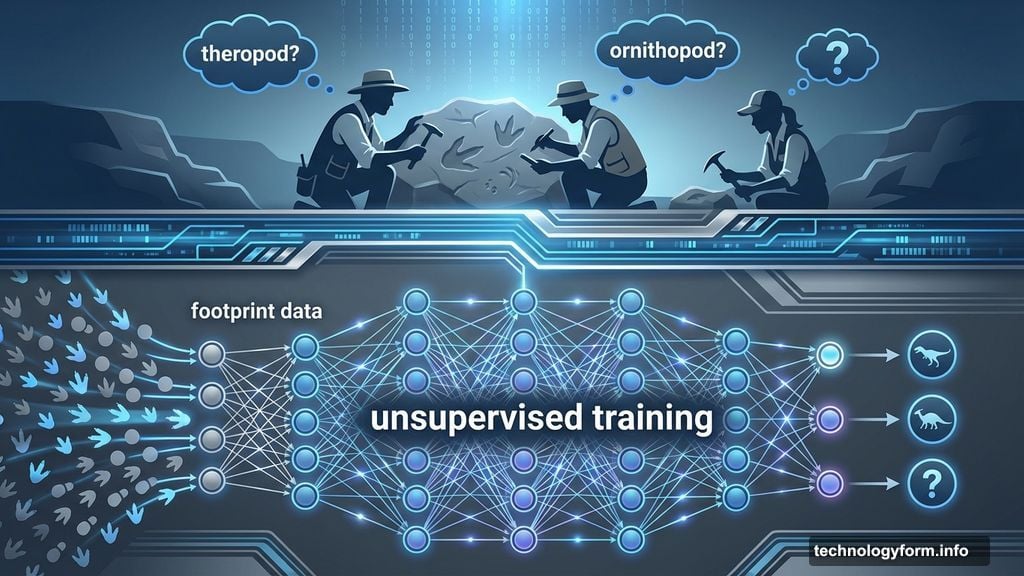
Moreover, we’re still learning which dinosaurs had which feet. Scientists often disagree about species assignments. Personal bias creeps in. One expert sees a theropod. Another insists it’s an ornithopod.
Gregor Hartmann from Helmholtz-Zentrum research center led the project. He told CNET the team wanted objectivity. “We bring a mathematical, unbiased point of view to the table,” Hartmann said.
So they built an algorithm that doesn’t care about academic reputations or preconceived theories. It just analyzes shapes.
Eight Traits That Matter
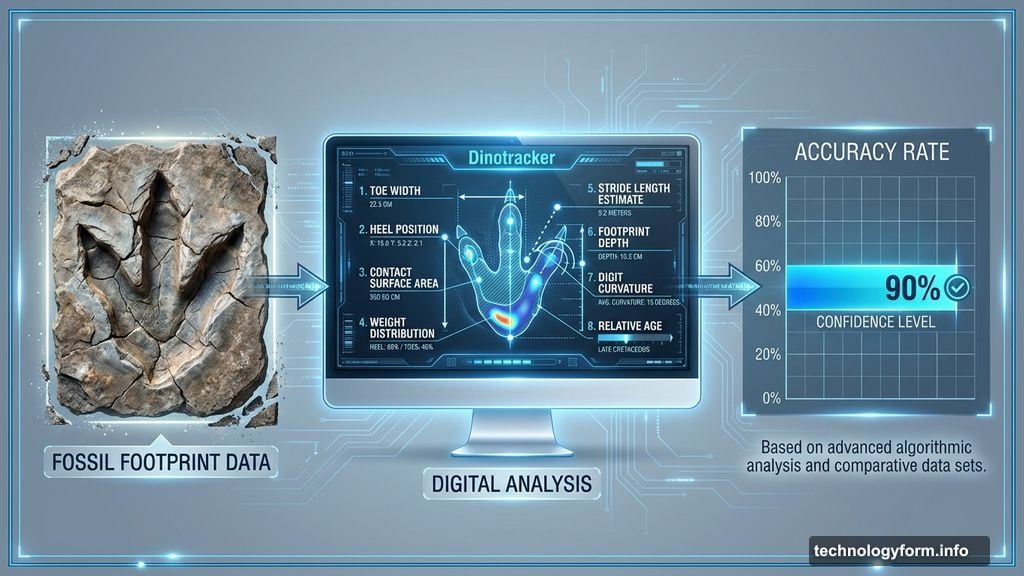
The AI focuses on eight key characteristics of dinosaur footprints. Toe width. Heel position. Contact surface area. Weight distribution across the foot.
Plus, the system accounts for natural distortions. Rock compression over millions of years. Shifting edges from geological movement. Moisture levels when the track was made.
Researchers trained the algorithm on thousands of real fossil footprints. Then they added millions of simulated versions with realistic distortions. That gave the AI a massive reference library.
Here’s what makes it clever. The system is completely unsupervised during training. It doesn’t know what a theropod or ornithopod is. It just learns patterns in foot shapes.
Only after training do researchers compare the AI’s groupings with human classifications. And the agreement rate? 90%.
Birds Might Be Way Older Than We Thought
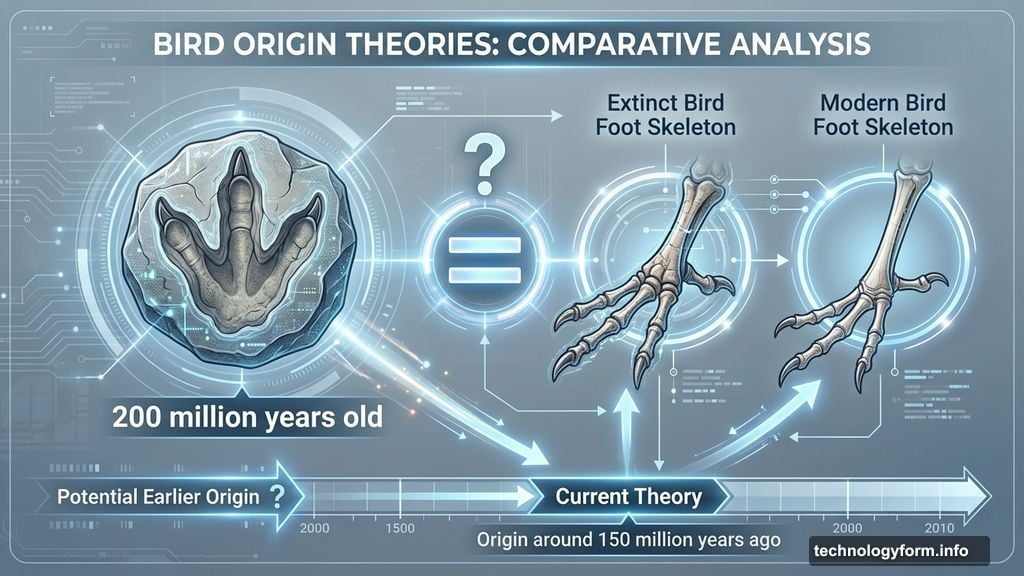
The researchers tested Dinotracker on footprints over 200 million years old. They found something shocking. Strong similarities with bird foot structures, both extinct and modern species.
That suggests two possibilities. Either birds originated tens of millions of years earlier than current theories suggest. Or early dinosaur feet just happened to look remarkably like bird feet.
Hartmann stays cautious about rewriting bird evolution. “It is essential to keep in mind that over these millions of years, lots of different things can happen to these tracks,” he said.
Moisture levels. Substrate composition. Erosion patterns. All these factors change footprint shapes. So footprints alone aren’t enough to prove earlier bird origins.
A skeleton would be the “true evidence,” Hartmann noted. But the AI findings definitely raise interesting questions about the dinosaur-to-bird transition.
How Paleontologists Can Use It
Dinotracker is free and available on GitHub right now. But there’s a catch. You need some software knowledge to get it running. It’s not a simple download-and-click app yet.
Still, the team hopes paleontologists worldwide will start using it. And here’s why that matters. Every time an expert uses Dinotracker, the system learns from more data.
The AI’s reference library grows. Its pattern recognition improves. Eventually, it could identify footprints that stump human experts. Or spot patterns across different dig sites that reveal migration routes.
Plus, removing human bias means more consistent classifications across research teams. That’s huge for building accurate databases of fossil discoveries.
What This Means for Fossil Research
AI tools like Dinotracker don’t replace paleontologists. They amplify their work. An expert can now process dozens of footprints in the time it used to take for one.
That frees up time for higher-level analysis. Understanding ecosystem dynamics. Mapping dinosaur behavior patterns. Testing theories about extinction events.
And the bird evolution question shows how AI can surface new research directions. By analyzing patterns humans might miss, these tools push science forward in unexpected ways.
The technology also democratizes expertise. A researcher at a remote dig site can get instant species identification. No need to wait months for peer review or expert consultation.
This approach could extend beyond dinosaurs too. Any field dealing with pattern recognition in degraded historical samples could benefit. Ancient human artifacts. Fossil plants. Geological formations.
The core innovation isn’t just the AI. It’s using machine learning to remove subjective interpretation from scientific analysis. That’s a principle with far-reaching applications.
Dinotracker shows us something important. AI works best when it complements human expertise rather than replacing it. Paleontologists bring context, theory, and creative thinking. The AI brings speed, consistency, and pattern detection.
Together, they’re rewriting what we know about life millions of years ago. And that’s just the beginning.