AI Predictions Feel Like Magic. They’re Actually About Power.
A classroom full of executives. Someone raises her hand and announces she uses chatbots as fortune tellers. The room goes quiet.
“Just like we used to read tea leaves,” she explains, “you can ask AI about the future, and it can be surprisingly accurate.” The woman, it turns out, has built a billion-dollar empire. Her classmates stare at the floor.
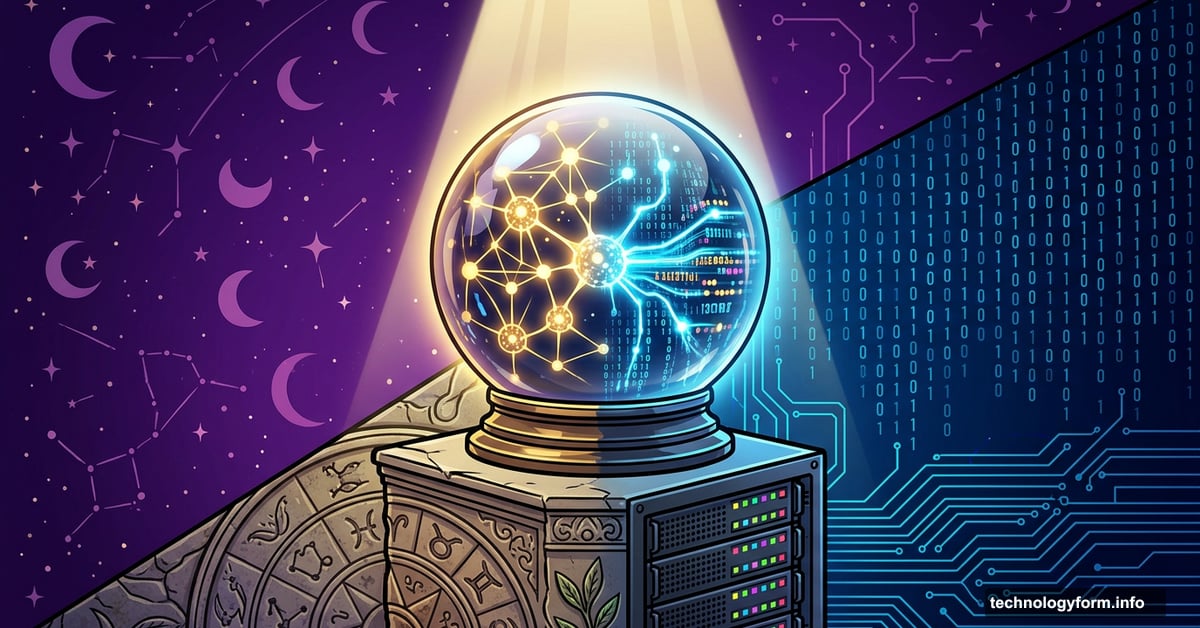
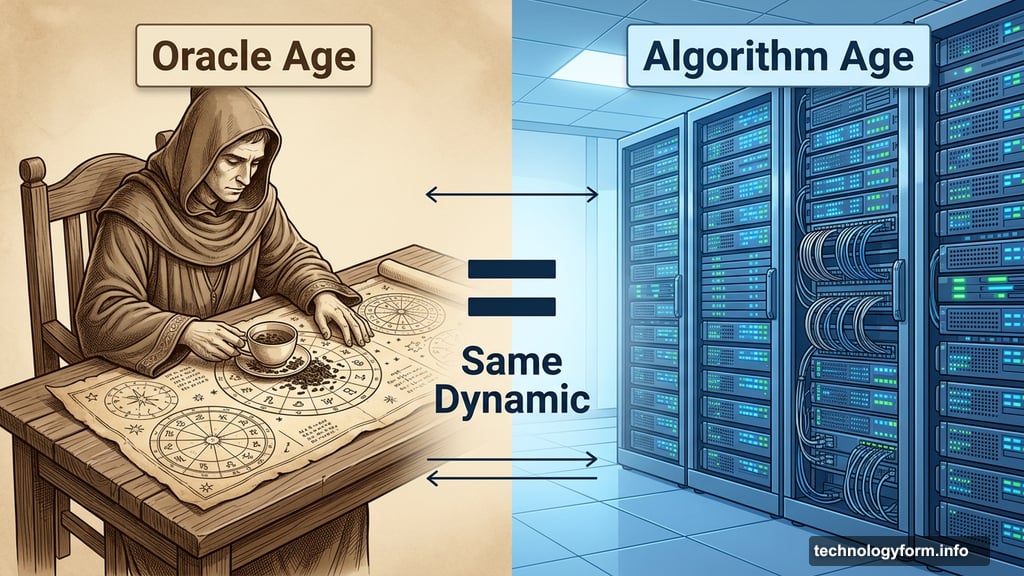
That moment, described by Oxford professor Carissa Véliz in her new book Prophecy: Prediction, Power, and the Fight for the Future, captures something important about where we are right now. We haven’t left the age of oracles behind. We’ve just replaced the robes with server racks.
We Swapped Astrologers for Algorithms
For centuries, people turned to seers, astrologers, and soothsayers when they wanted a glimpse of what was coming. Today, we turn to data scientists, engineers, and machine learning systems. The tools changed completely. The dynamic, Véliz argues, barely changed at all.
Algorithms are the new tea leaves. And that comparison isn’t meant to be flattering.
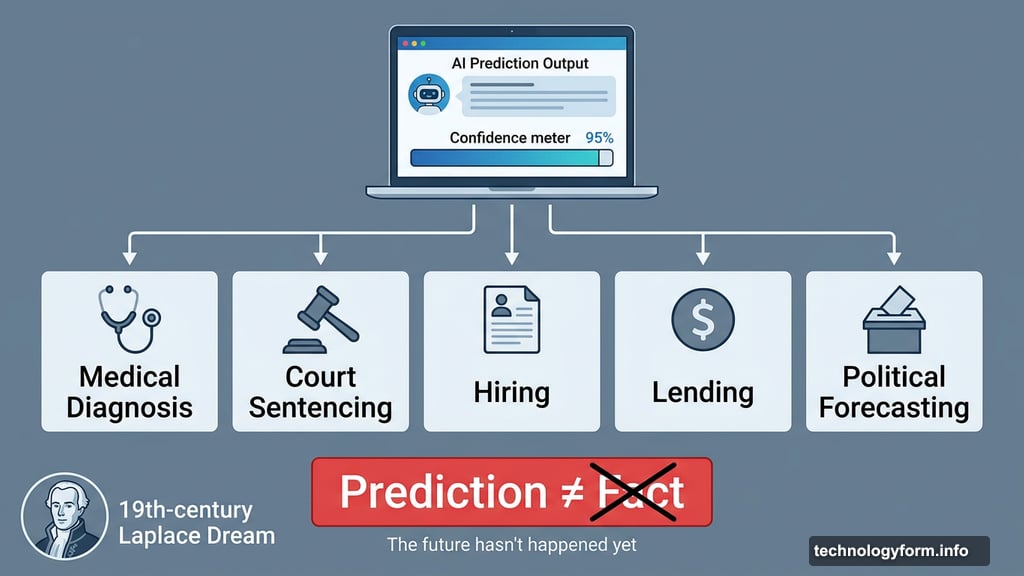
The core problem is this: we treat predictions like facts. But they aren’t. Facts belong to the present and the past. An assertion about the future can be an estimate, a desire, or a warning — but never a fact. What makes the future the future is that it hasn’t happened yet.
Yet we’re using AI predictions to make some of the most consequential decisions imaginable: medical diagnoses, court sentencing, hiring, lending, political forecasting. The confidence we place in these outputs often far outpaces what the technology actually delivers.
The Dream of Defeating Uncertainty
The intellectual root of today’s AI optimism traces back to a 19th-century mathematician named Pierre-Simon Laplace. He imagined an intelligence so vast, with access to the exact location and momentum of every particle in the universe, that it could predict the future with perfect accuracy. Uncertainty, finally defeated.
Supporters of modern machine learning don’t quote Laplace at press conferences. But when they enthuse about massive datasets and ever-growing compute power, they’re essentially describing the same dream. Collect enough data. Build enough processing power. Make the future visible.
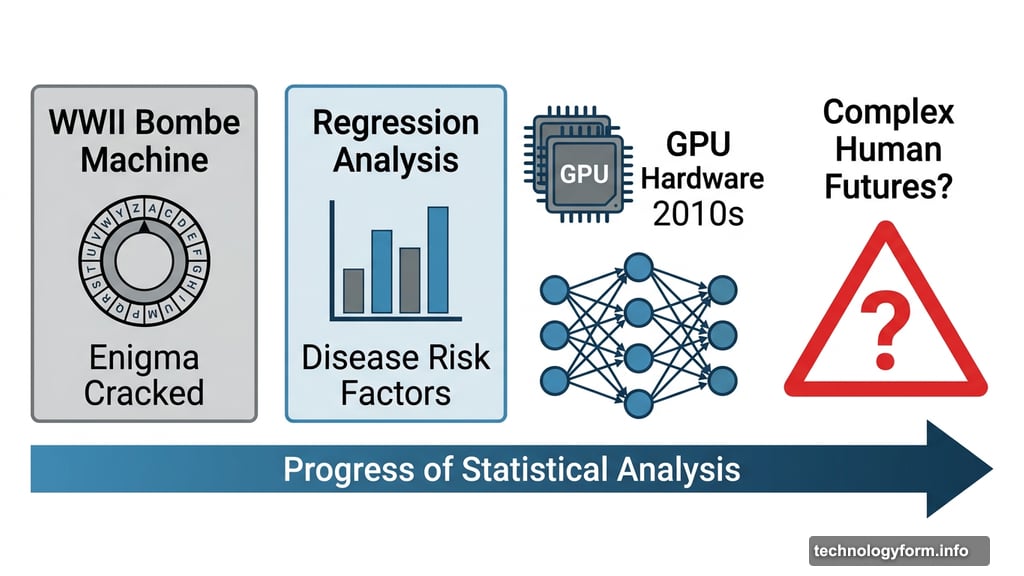
That optimism isn’t entirely misplaced. Computers and statistical analysis delivered real breakthroughs. The Bombe cracked the Nazi Enigma cipher during World War II. Regression analysis identified disease risk factors that changed medicine. Supply chains became measurable. Transactions became real-time. Deep learning, fueled by big data and GPU hardware in the 2010s, produced results that genuinely surprised even its creators.
So the enthusiasm makes sense. The problem is the leap from “impressive results in specific domains” to “AI can reliably predict complex human futures.”
What Machine Learning Is Actually Doing
Here’s the technical reality, explained plainly. Machine learning systems are prediction engines. That’s the full job description.
When a translation system converts Spanish to English, it predicts the most likely translation based on millions of previous examples. When an image classifier spots a wolf in a photo, it predicts the probability that the image matches patterns learned from thousands of labeled images. When a large language model answers your question, it predicts what a human would statistically say next, based on an enormous sample of text from books, forums, and social media.
That last one is worth sitting with for a moment. These systems aren’t reasoning from first principles or understanding context the way humans do. They’re performing extremely sophisticated pattern matching at scale. An Oxford AI professor, Michael Wooldridge, put it plainly to a group of MBA students: “What’s disappointing is that it didn’t happen as a result of a scientific breakthrough.” More data plus more compute. That’s largely the story.
One executive in Véliz’s class experienced this limitation firsthand. Their company tried using AI to take meeting notes, then abandoned it when the system confabulated — confidently generating content that had no basis in what was actually said.
Prediction Markets Made It Worse
The prediction problem doesn’t stop with AI tools you use at work. It extends into platforms like Polymarket, which aggregate public expectations about future events, collecting massive behavioral data and concentrating influence.
These markets started with sports and entertainment. They’ve expanded to cover political instability, natural disasters, and human suffering. When 58% of users believe a particular outcome will happen, the crowd’s belief starts shaping behavior. People don’t bet against the majority. And the majority’s weight starts pulling reality in a particular direction.
Véliz describes this as predictions becoming weapons of power — decisions dressed up as facts. The pretense of objectivity gives enormous influence to whoever controls the predictive system. When someone forecasts the world will be a certain way, they’re often commanding that others bring that world into existence.
That’s not neutral. That’s power.
The Surveillance Cost Nobody Mentions
Building the data infrastructure behind modern prediction systems required something significant. Véliz doesn’t let this pass without naming it directly.
The means of acquiring the data and compute power behind machine learning involved what she describes as theft, the exploitation of vulnerable people, enormous resource consumption, and the construction of a mass surveillance architecture. Every time you drive, search, sleep, exercise, visit a doctor, or scroll social media, that data feeds the predictive machine.
We manage our fears in quantified terms now: the probability of cancer, of being robbed, of climate change, of another pandemic. Tracking is constant. Analysis is continuous. The promise is better predictions. The cost is agency.
And that tradeoff rarely appears in the headlines alongside the impressive benchmark scores.
Why This Comparison to Ancient Oracles Stings
The parallel Véliz draws between ancient prophecy and modern AI prediction isn’t just clever framing. It carries a specific warning.
Historically, prophecies weren’t just forecasts. They were power moves. An oracle’s pronouncement shaped behavior, redirected resources, and justified decisions made for political reasons. The person who controlled the prediction controlled the narrative.
Today’s ruling soothsayers are computer scientists and data analysts. Their predictions carry the authority that numbers and models convey. But the underlying dynamic — prediction as an exercise of power, not just knowledge — runs through all of it.
Véliz writes that we’ve dedicated remarkably little thought to the deeper ethics of prediction. Thousands of books explain how to predict better. Essentially none examine whether we should predict certain things, or who benefits from particular forecasts, or what we lose when we outsource judgment to algorithms.
The Loss Nobody Talks About
There’s something subtle happening alongside all this predictive capability. Agency erodes quietly.
When an algorithm tells a judge that a defendant has a high recidivism score, the prediction exerts pressure even if the judge knows it’s probabilistic. When a hiring system flags a resume, recruiters face friction in overriding it. When a medical AI highlights a scan, the weight of its output shapes the doctor’s attention.
This isn’t unique to AI. Astrologers shaped the decisions of kings. Oracles justified wars. Predictions have always bent human behavior toward their conclusions. The difference now is scale, speed, and the illusion of scientific objectivity.
The student in Véliz’s classroom wasn’t wrong that AI can sometimes produce accurate-seeming predictions. But she was doing what humans have always done — finding patterns, finding comfort, finding an external authority to reduce the discomfort of uncertainty. The chatbot is the new tea leaf. The loss of agency, Véliz argues, is the same.
What you do with that observation is worth thinking about. Carefully.