Google’s Gemini 3 Flash Just Beat OpenAI at Its Own Game
Google dropped Gemini 3 Flash yesterday. And it’s trading punches with GPT-5.2 in benchmarks while costing way less to run.
That’s a big deal. OpenAI rushed out GPT-5.2 specifically to counter Google’s Gemini 3 Pro last month. Now Google’s more efficient model matches or beats it in several tests. Plus, it’s rolling out free to everyone through the Gemini app and AI Mode in Search.
Let’s break down what this actually means for the AI arms race.
The Performance Numbers Tell an Interesting Story
Gemini 3 Flash scored remarkably close to GPT-5.2 across major benchmarks. In Humanity’s Last Exam, a notoriously difficult test suite, it landed less than one percentage point behind OpenAI’s flagship model.
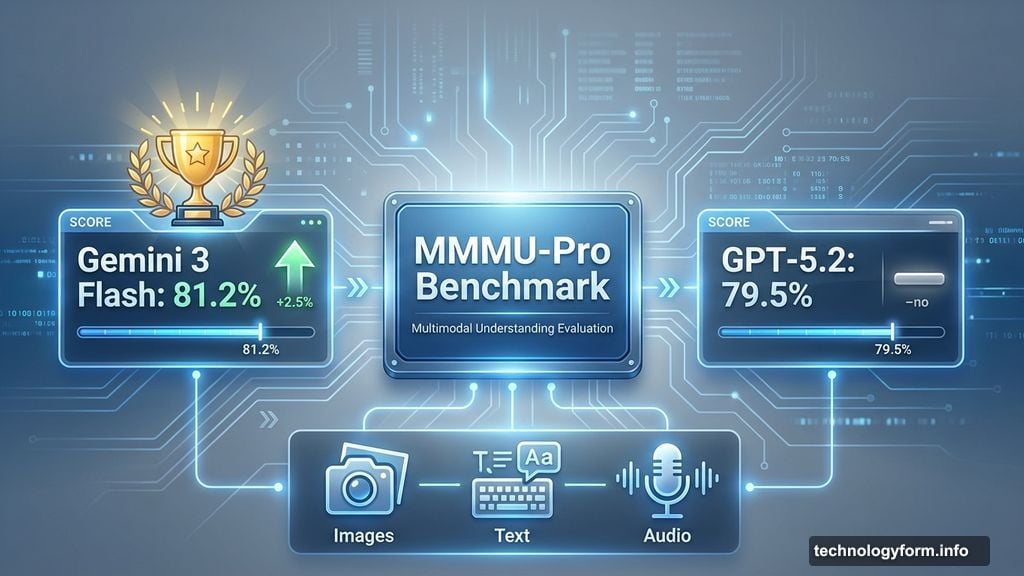
But here’s where it gets interesting. In MMMU-Pro, which tests multimodal understanding and reasoning, Gemini 3 Flash actually won. It scored 81.2 percent compared to GPT-5.2’s 79.5 percent.
That’s not supposed to happen. Remember, Google positioned Flash as the efficient, everyday-use version of Gemini 3. Yet it’s outperforming OpenAI’s top-tier model in specific tasks.
Moreover, these results came without web search or external tools. Both models operated in isolation. So the performance gaps reflect pure reasoning capabilities, not clever tool integration.
Benchmarks Don’t Tell the Whole Story
Sure, Gemini 3 Flash looks impressive on paper. But benchmarks only capture specific capabilities under controlled conditions.
Real-world performance matters more. How does it handle complex coding tasks? What about creative writing or nuanced conversation? Does it maintain consistency across long interactions?
We won’t know until people actually use both systems extensively. Early benchmark leaders sometimes disappoint in practice. Plus, different models excel at different tasks regardless of overall scores.
Still, the fact that Google’s efficiency-focused model even competes with GPT-5.2 raises eyebrows. OpenAI designed their latest system for maximum performance, not cost optimization. Yet here’s Google matching it with a budget-friendly alternative.
Free Access Changes the Equation
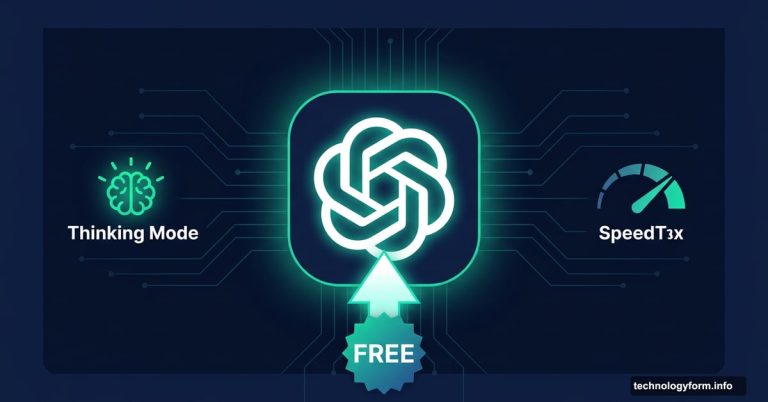
Here’s what really matters: Gemini 3 Flash is free. Not freemium with limits. Not trial access. Actually free through the Gemini app globally.
Compare that to GPT-5.2. OpenAI gates their best models behind paid tiers. You need ChatGPT Plus or enterprise access to use advanced reasoning modes. That creates a barrier most casual users won’t cross.
Google just handed everyone professional-grade AI capabilities at no cost. That democratizes access in ways OpenAI’s approach doesn’t. And it puts pressure on their business model.
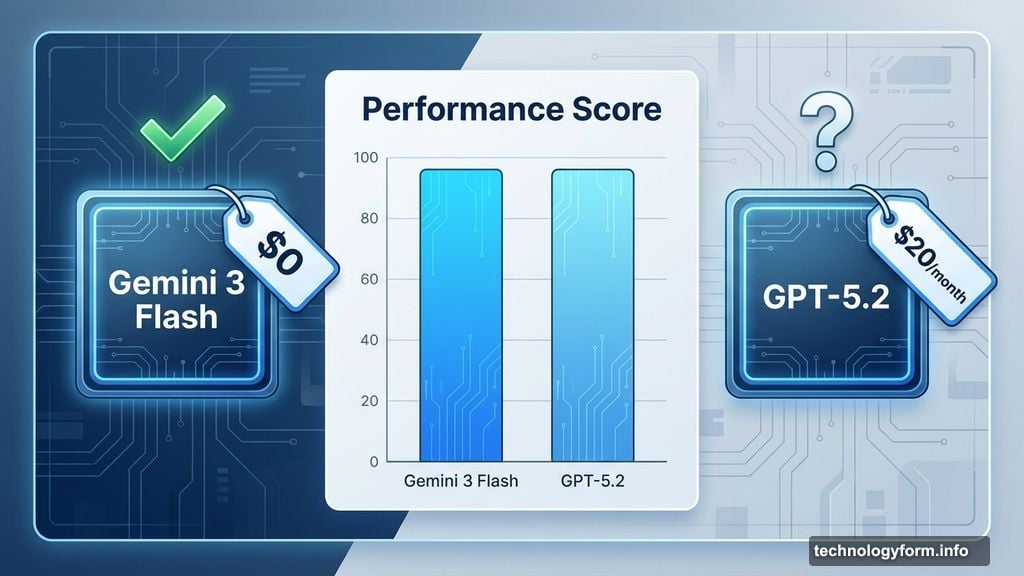
Think about it. Why pay $20 monthly for ChatGPT Plus when Gemini 3 Flash offers comparable performance for free? Sure, some users prefer OpenAI’s interface or specific capabilities. But many will switch for similar quality at zero cost.
The AI Image Generator Gets Easier Access
Google also integrated their Nano Banana Pro image generator directly into AI Mode. US users can now create images by selecting “Thinking with 3 Pro” followed by “Create Images Pro” from the model picker.
This matters because image generation remains a killer feature for AI chatbots. People love creating visuals quickly. But many services separate text and image capabilities across different interfaces.
Google’s making it seamless. One conversation can now include both text reasoning and image creation without switching tools. That improves workflow compared to jumping between ChatGPT and DALL-E or similar combinations.
However, this feature currently only works in the US. International users will have to wait, which limits its immediate impact on global competition with OpenAI.
What This Means for OpenAI
OpenAI rushed GPT-5.2 out the door to counter Gemini 3 Pro. Now Google’s cheaper, more efficient model matches or beats it in several benchmarks barely a month later.
That’s a concerning pattern. OpenAI spent significant resources developing their latest system. Google responded with something comparable that costs far less to run and reaches more users.
Plus, Google’s release cadence is accelerating. Gemini 3 Pro launched in November. Flash arrived in December. They’re iterating faster than OpenAI while maintaining competitive quality.
The cost advantage matters too. Running AI models at scale requires massive compute resources. If Google achieves similar performance with more efficient architectures, they can undercut OpenAI on pricing while maintaining margins.
The Bigger Picture
We’re watching two different AI strategies collide. OpenAI pursues maximum capability at premium prices. Google optimizes for efficiency and broad access.
Right now, Google’s approach seems to be working. They’re matching flagship performance with budget models. They’re offering professional-grade AI free to consumers. And they’re releasing new versions faster than competitors can respond.
But benchmarks only measure what they’re designed to measure. Real innovation often happens in areas tests don’t capture. OpenAI might have advantages in reasoning depth, consistency, or other qualities that simple metrics miss.
Still, this competition benefits users. Both companies are racing to improve their models while cutting costs. That means better AI capabilities reaching more people at lower prices.
The AI war isn’t ending anytime soon. But Google just proved they can compete with OpenAI’s best while spending less and reaching more users. That shifts the balance of power in ways we’re only beginning to understand.