Google’s Willow Quantum Chip Just Measured Something Classical Computers Can’t Touch
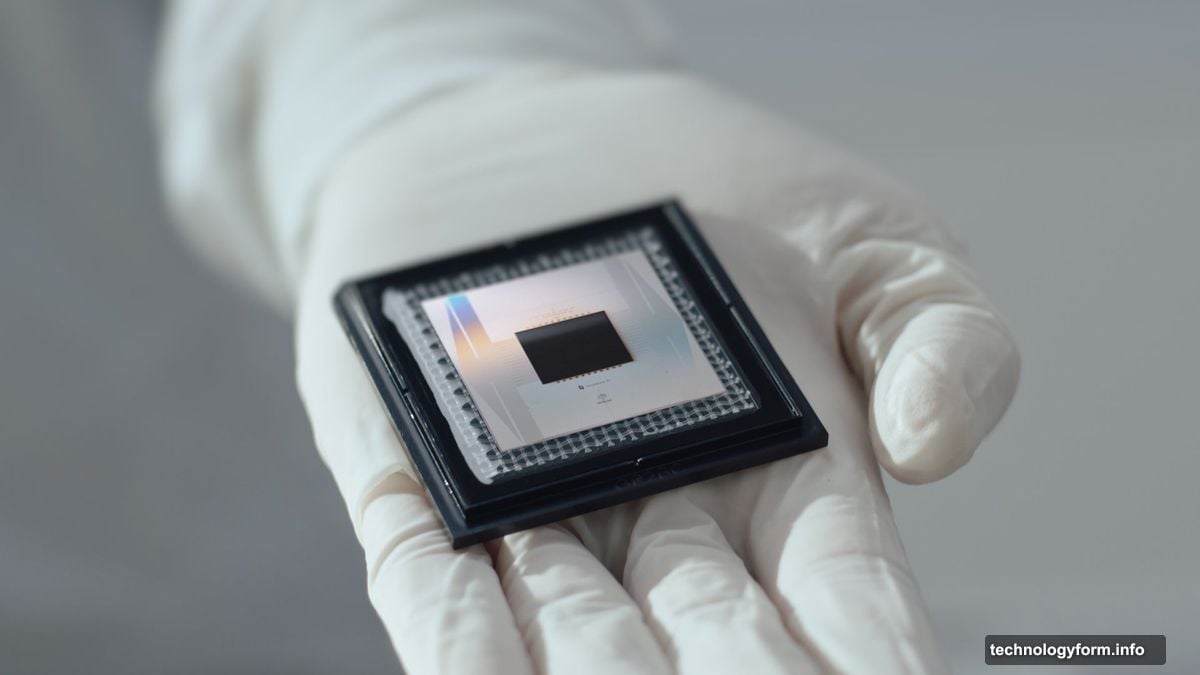
Google’s quantum researchers pulled off something wild. They measured how information scrambles inside their Willow quantum chip with such complexity that a classical supercomputer would need three years to replicate what Willow did in two hours.
This isn’t just a speed benchmark. The technique reveals fundamental physics that could crack open molecular chemistry simulations and maybe even solve mysteries about black holes. Plus, it pushes quantum computing closer to practical applications beyond theoretical demonstrations.
Quantum Information Scrambles Like a Broken Telephone Game
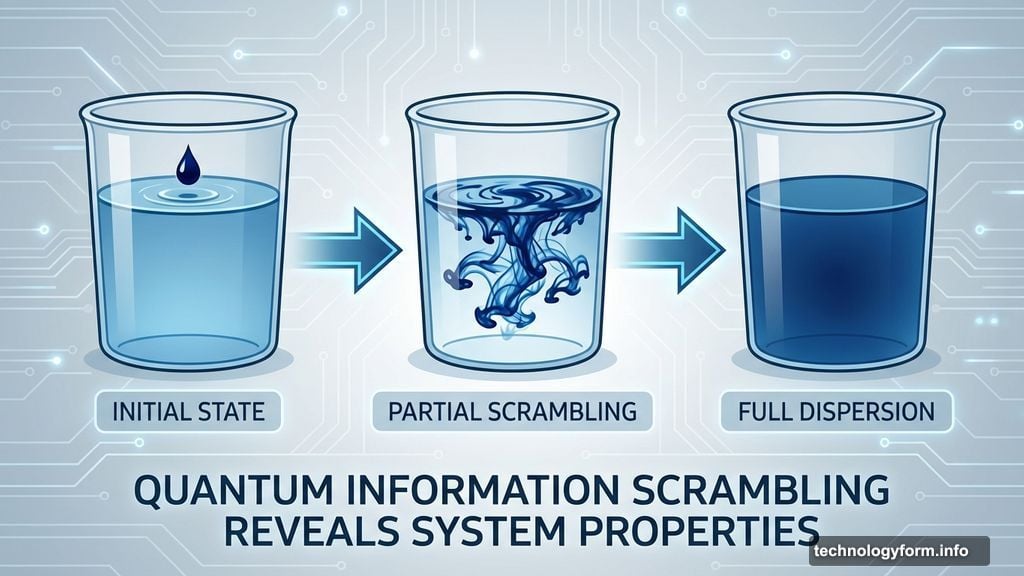
Quantum information doesn’t stay neat and organized. It spreads out and becomes disordered over time, similar to how a shouted word loses clarity over distance.
“Different systems scramble things in different ways,” explains Shenglong Xu, a quantum information theorist at Texas A&M University who wasn’t involved with the research. “How the information gets processed tells us about the nature of the system.”
Think of it like dropping ink into water. The ink disperses in patterns that reveal properties of the liquid itself. So quantum scrambling patterns expose fundamental characteristics of quantum systems.
Understanding this scrambling could unlock precise molecular simulations. That’s the holy grail for quantum computers—modeling chemical reactions with perfect accuracy.
The Quantum Echo Protocol Doubles Down on Complexity
Google’s team used a technique called an out-of-time-order correlator, or OTOC for short. The process works like a quantum Rubik’s cube trick.
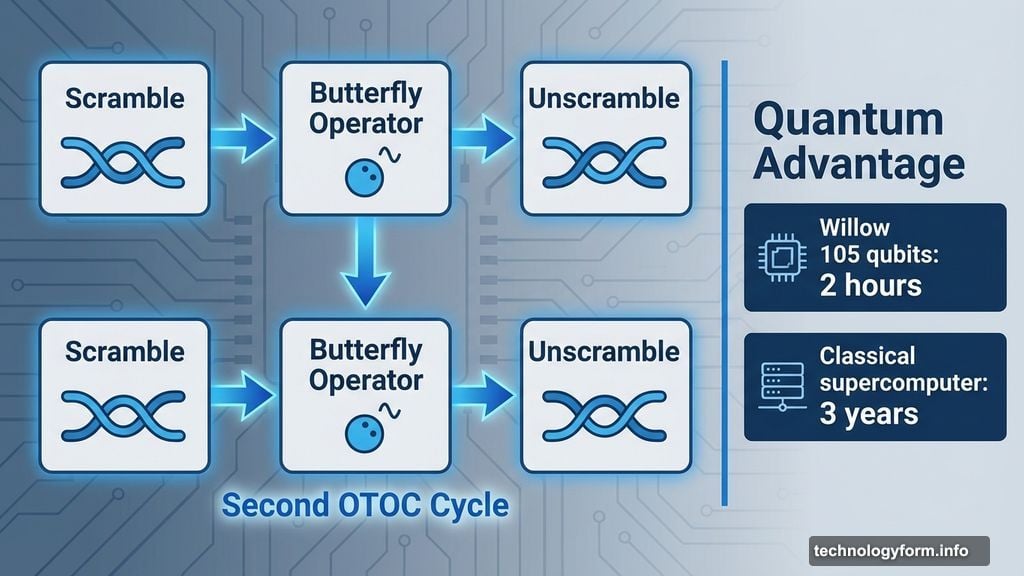
First, scramble the quantum information with a set sequence of operations. Then add one small change—the “butterfly operator.” Finally, reverse the original scrambling sequence to unscramble everything.
The scrambling and unscrambling cancel out. That leaves only the effects of the middle butterfly operator visible. It’s not time reversal, despite what some descriptions suggest. You’re just running operations backward, like saying the alphabet in reverse.
Here’s where Google got ambitious. Instead of one OTOC cycle, they ran two complete cycles: scramble, butterfly, unscramble, scramble, butterfly, unscramble again.
This doubled protocol cranked up the complexity massively. Classical computers struggle exponentially more with each added cycle. Meanwhile, Willow’s 105 qubits and improved error correction handled the task in two hours.
Classical Supercomputers Would Need Three Years to Match It
Google estimates that current classical algorithms would require three years to simulate what Willow accomplished. That’s a genuine quantum advantage over today’s best supercomputers.
However, peer reviewers urged caution. Previous quantum advantage claims have crumbled as classical algorithms improved. Google’s 2019 quantum supremacy demonstration got surpassed within months by better classical approaches.
One reviewer called the work “truly impressive” for “experimentally accessing such subtle quantum interference effects.” Yet another noted uncertainty about whether this advantage would hold up long-term.
Still, Xu sees real progress. “It seems like it is beyond what we can do right now using classical methods,” he says. “It’s a very interesting contribution to the field.”
From Abstract Physics to Practical Chemistry Simulations
Google didn’t stop at demonstrating quantum advantage. They teased practical applications in their Nature paper, promising molecular simulation results in future work.
Today they delivered the first steps. A new preprint shows Google using OTOC protocols on Willow to estimate molecular properties—specifically, the distance between two hydrogen atoms in organic molecules.
The simulation technique isn’t faster than classical methods yet. But it agrees with experimental results, which validates the approach. Plus, it opens a pathway toward quantum computers accurately modeling complex chemical reactions.
That matters enormously. Drug discovery, materials science, and battery development all depend on understanding molecular behavior. Classical computers struggle with these simulations because quantum mechanics governs molecular interactions.
So quantum computers might finally provide an advantage where it actually counts: solving real-world chemistry problems.
The Black Hole Connection Nobody Expected
OTOCs reveal more than just molecular properties. They offer clues about one of physics’ biggest mysteries: what happens to information inside black holes?
“People have started thinking about information scrambling and information dynamics in the context of black hole physics,” says Laura Cui, a quantum information Ph.D. student at Caltech.
Black holes scramble information incredibly fast—potentially at the theoretical speed limit. Studying how Willow scrambles quantum information could illuminate how black holes process information at their event horizons.
This connection between quantum computers and black hole physics sounds bizarre. Yet it stems from deep theoretical work linking quantum entanglement, information theory, and gravity.
Researchers like Cui believe quantum computers might help resolve the black hole information paradox. That’s the puzzle of whether information falling into a black hole gets destroyed or preserved in some scrambled form.
Willow Builds on Sycamore’s Earlier Scrambling Experiments
Google first demonstrated OTOC protocols in 2021 on Sycamore, Willow’s predecessor. Sycamore had only 53 qubits and higher error rates.
The 2021 experiment showed how information rippled across Sycamore’s qubit grid, spreading outward from an initial state. Fascinating results. But classical supercomputers could easily simulate that single-cycle OTOC.
Willow changes the game with doubled qubit count and roughly doubled qubit fidelity. Those improvements enabled the doubled OTOC protocol that classical computers can’t match.
Hartmut Neven, who leads Google’s quantum computing effort, describes OTOCs as a “measure of how quickly information travels in a highly entangled system.”
That measurement precision matters. Quantum advantage doesn’t come from raw qubit numbers alone. It requires low error rates combined with complex operations that classical computers struggle to simulate.
Quantum Chaos Differs from Classical Butterfly Effects
Classical chaos theory famously involves butterflies. A butterfly flaps its wings in Brazil, and atmospheric perturbations cascade into a tornado in Texas.
Small changes in initial conditions lead to wildly different outcomes. That’s classical chaos—deterministic but unpredictable.
Quantum systems also experience sensitivity to initial conditions. But quantum fluctuations are fundamentally different from classical perturbations.
“There’s always going to be small quantum fluctuations,” explains Pieter Claeys, a physicist at the Max Planck Institute for the Physics of Complex Systems in Dresden. Like classical butterflies, these quantum fluctuations affect how information scrambles.
However, quantum scrambling involves entanglement—correlations between quantum states that have no classical analog. So quantum chaos reveals physics that classical chaos can’t access.
The Roadmap from Lab Demos to Useful Applications
Google’s Willow results represent incremental progress, not a quantum revolution. We’re still years from quantum computers solving practical problems faster than classical supercomputers.
Current quantum computers max out around 100 qubits with significant error rates. That’s nowhere near the thousands of error-corrected qubits needed for truly useful quantum algorithms.
Yet each step matters. The 2021 Sycamore experiment proved single-cycle OTOCs work. The 2025 Willow experiment demonstrated doubled OTOCs. Future experiments will likely triple or quadruple the cycles.
Each multiplication makes classical simulation exponentially harder while quantum computers maintain performance. That’s how quantum advantage emerges—not suddenly, but through steady accumulation of complexity.
Meanwhile, the molecular simulation work shows researchers actively connecting abstract quantum protocols to real-world applications. Even early-stage chemistry simulations validate the approach.
Skepticism Remains Warranted Despite Technical Achievements
Three peer reviewers evaluated Google’s Nature paper. All praised the technical accomplishment. One called it “truly impressive.”
But they split on whether Google definitively demonstrated quantum advantage. The history of quantum computing contains many “quantum supremacy” claims that collapsed under scrutiny.
Better classical algorithms keep emerging. Google’s 2019 supremacy claim got overtaken within months. IBM and other researchers found classical approaches that matched or beat Google’s quantum results.
So cautious optimism makes sense. Willow’s doubled OTOC protocol looks beyond current classical capabilities. Yet declaring permanent quantum advantage feels premature.
Xu strikes the right balance: “It seems like it is beyond what we can do right now using classical methods.” That hedging acknowledges both the achievement and the uncertainty.
The Race Between Quantum Hardware and Classical Algorithms Continues
Quantum advantage isn’t a finish line. It’s a moving target in an ongoing race between quantum hardware improvements and classical algorithm innovations.
Every quantum demonstration inspires classical computer scientists to find better simulation methods. Sometimes they succeed. Other times the quantum advantage holds.
Google’s strategy involves finding problems where quantum computers have structural advantages. OTOCs fit that category because they probe quantum entanglement directly—something classical computers struggle to simulate.
The doubled protocol amplifies that advantage. But tripled or quadrupled protocols might be necessary to create insurmountable leads over classical approaches.
For now, the race continues. Quantum hardware advances. Classical algorithms improve. Both push each other forward, which ultimately benefits science regardless of which approach wins specific battles.
Google’s Willow chip represents genuine progress in quantum computing’s slow march toward usefulness. The doubled OTOC protocol demonstrates capabilities beyond current classical methods. Plus, early molecular simulations show pathways to practical applications.
But quantum computers won’t replace classical supercomputers anytime soon. They’ll complement them, solving specific problems where quantum mechanics provides advantages.
The black hole physics connection adds theoretical intrigue. Yet the real test comes from chemistry simulations and other practical applications. Can quantum computers actually solve problems that matter to industries and researchers?
Willow moves us closer to answering that question. Not with definitive proof, but with incremental evidence that quantum advantage might survive long enough to become useful.