RAMageddon Is Here. Your Next Phone, Laptop, and Console Will Cost More
Memory prices have tripled. In some cases, they’ve gone up six times. And if you think this only affects people who build their own PCs, think again.
The RAM shortage is coming for your next phone upgrade, your laptop replacement, and even the game console you’ve been waiting to buy. Everything with a computer inside needs memory, and right now, AI companies are hoarding it. The rest of us are left to pay whatever’s left over.
This isn’t a brief blip. Intel’s CEO says there’s no relief until 2028. Let’s break down what’s actually happening and what it means for your wallet.
Why AI Ate All the RAM
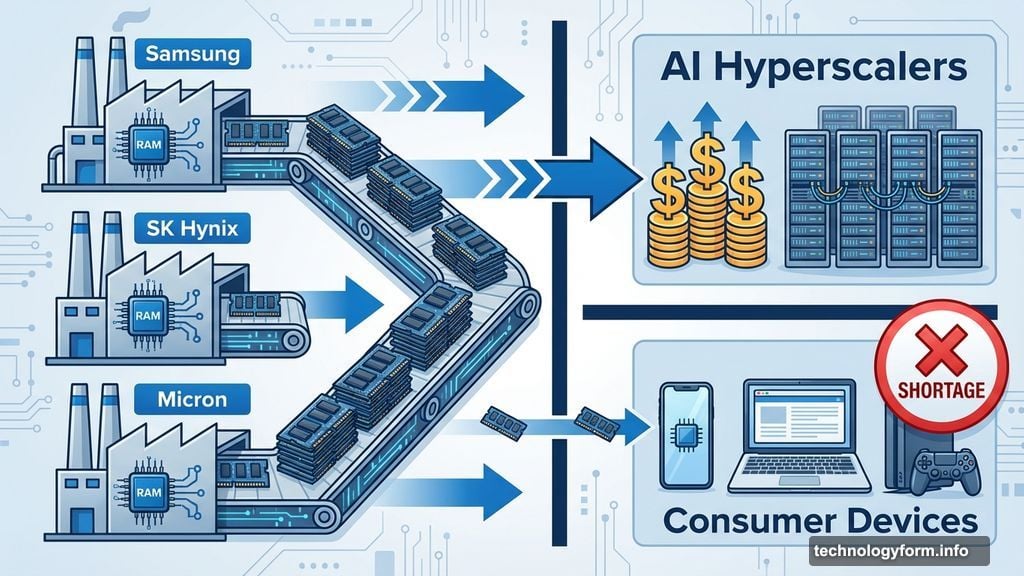
Three companies control about 95 percent of the world’s DRAM supply: Samsung, SK Hynix, and Micron. Right now, all three are happily selling their memory to AI companies at prices that dwarf what consumer device makers can offer.
That’s the core problem. AI workloads need enormous amounts of RAM to juggle all the data they process. So when a hyperscaler writes a massive check for memory, Samsung doesn’t exactly rush to prioritize your next smartphone.
The result? A global shortage that hits everything with a chip inside.
Even household items you’d never think about depend on RAM. Farm tractors, hospital equipment, TV set-top boxes, home routers. All of them are now competing for a shrinking slice of available memory production.
Your Next Phone Will Cost More
Smartphone analysts from IDC, Omdia, and Counterpoint all agree: 2025 was one of the best years ever for phone sales, with roughly 1.25 billion phones shipped worldwide. Apple reported record iPhone sales in January.
Then the RAM crunch hit.
Qualcomm CEO Cristiano Amon said on the company’s February 4th earnings call that a big dip in smartphone business will be “100 percent” because of the memory shortage. He also noted that phone makers “will prioritize premium and high-tier” models, meaning budget and midrange buyers take the biggest hit.
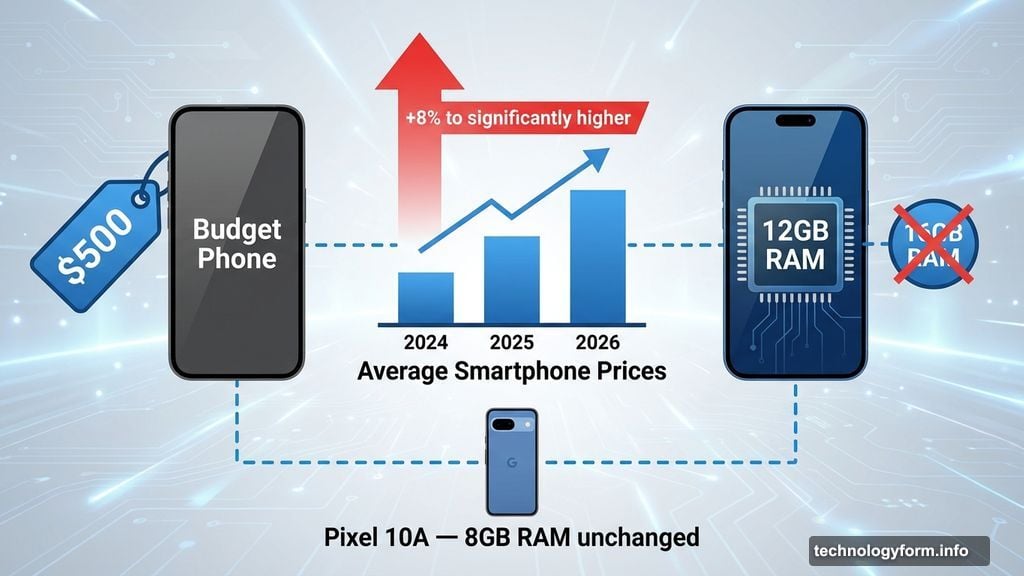
So how much more will you pay? IDC now predicts average smartphone prices could rise as much as 8 percent. For cheaper phones, the increases will be “significantly higher” because manufacturers simply have to pass those costs along. That $500 phone you’re eyeing? Budget closer to $600.
Even flagship buyers won’t escape. IDC expects that new flagship phones in 2026 will stick to 12GB of RAM rather than upgrading to 16GB. Google’s Pixel 10A landed with the same mediocre 8GB as its predecessor and no meaningful chip upgrade.
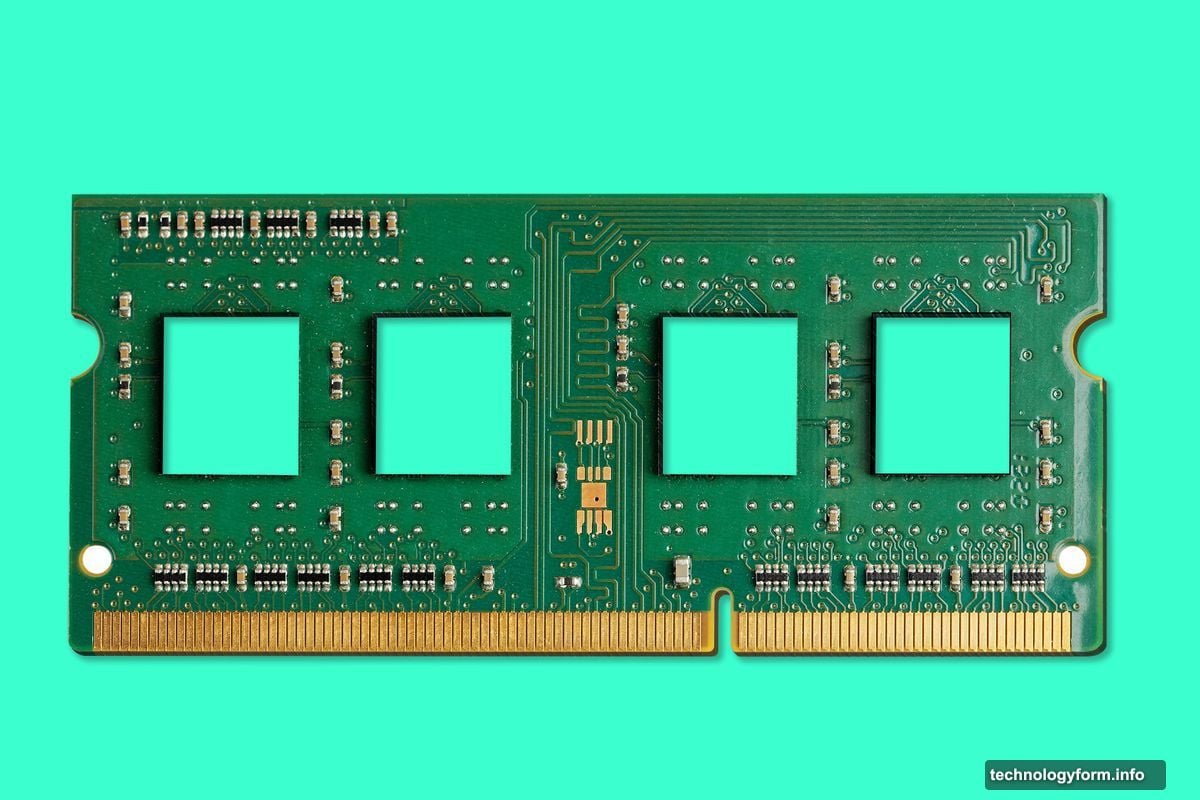
Apple, which usually strong-arms suppliers on pricing, is feeling real pressure too. The Wall Street Journal reports that AI companies writing enormous checks for memory supplies are squeezing Apple’s supply chain. Industry sources told ZDNet Korea that Apple may pay 80 to 100 percent more for memory this quarter after renegotiating with Samsung and SK Hynix. CEO Tim Cook told analysts he’ll “look at a range of options” to protect the company’s margins. That almost certainly means higher iPhone prices ahead.
Game Consoles Are Caught in the Crossfire
The era of subsidized game consoles was already struggling before the memory crisis hit. Now it’s getting actively worse.
Bloomberg reports that the Nintendo Switch 2 faces an incoming price hike directly tied to the RAM shortage. Sony’s PS6 could reportedly be pushed back to 2028 or even 2029. And there are early signs that the next Xbox might arrive as a $1,000 PC-style device rather than a traditional console.
PC gaming handhelds are getting squeezed even harder. Valve quietly killed the $399 Steam Deck in late December, raising the entry price to $549. Then in early February, Valve confirmed that its upcoming Steam Machine is delayed specifically because of the memory shortage and that expectations on pricing need to be “reset.” Even the $549 Steam Deck OLED is now intermittently out of stock because of the memory crisis.
Other handhelds are following the same painful path upward. The MSI Claw 8 AI Plus, which was already considered pricey at $999, now lists between $1,099 and $1,199 depending on where you shop. The Lenovo Legion Go 2 will get SteamOS this year but is being hit by what analysts are calling “memory shrinkflation” — less storage and RAM at a higher price than the Windows version launched with.
Laptop Price Hikes Are Already Happening
PCs need even more RAM than phones, and laptop makers have been slower to stockpile inventory ahead of shortages. That’s a painful combination.
Lenovo, Dell, HP, Asus, and Acer are all reportedly planning price increases of 10, 20, or even 30 percent. Dell has already started raising laptop prices, with increases ranging from $55 to $765 depending on the configuration. Framework, the modular laptop company, reports its own RAM costs have surged from roughly $10 per gigabyte to as much as $16 per gigabyte. Their new laptops and mainboards now cost 6 to 16 percent more than before.
“We are again only increasing pricing enough to cover the increases in cost from our suppliers,” Framework CEO Nirav Patel said.
Lenovo, which is the world’s largest PC manufacturer and has actually been stockpiling memory to protect its supply, still paid 40 to 50 percent more for memory last quarter. CEO Yang Yuanqing told Bloomberg that prices could double soon.
SSD prices aren’t helping either. Storage costs have surged 90 percent in a single quarter, which means even the basic components of a laptop are getting dramatically more expensive all at once.
IDC now predicts the overall PC market could shrink between 4.9 and 8.9 percent in 2026. TrendForce, which previously expected laptop growth, is now forecasting a 2.4 percent decline. Apple hasn’t announced MacBook price increases yet, but the company has a scheduled event on March 4th where we might find out firsthand.
When Will This Actually End?
Here’s the part nobody wants to hear. This isn’t a short-term blip you can wait out with a few months of patience.
Intel CEO Lip-Bu Tan said in early February that “there’s no relief until 2028,” after speaking directly with two of the three major memory manufacturers. Micron confirmed its new Idaho fab won’t be fully operational until mid-2027, with meaningful production output not expected until 2028. SK Hynix has similarly predicted the shortage will persist through late 2027.
The three memory giants control about 95 percent of global DRAM supply. And while they’re making record profits and have the money to expand production, they’re deliberately building out slowly. There’s a good reason for that caution. As SemiAnalysis founder Dylan Patel explained in December, memory companies have gone bankrupt before from overbuilding when demand collapsed. The memory industry has painful institutional memory about what overproduction does to prices and balance sheets.
So Samsung is only expected to increase memory wafer supply by about 5 percent this year. Not exactly a surge that’s going to fix a global shortage.
The unfortunate reality is that Micron, Samsung, and SK Hynix will maximize profits for as long as this shortage lasts. And those profits ultimately come from your wallet, whether you’re buying a phone, a laptop, a gaming handheld, or anything else that needs memory to run.
If you’re planning a major device purchase, buy sooner rather than later. Prices are moving in one direction for the foreseeable future, and waiting for a better deal in six months is likely to leave you disappointed.