Your VPN’s Home Country Matters More Than You Think
Most people shopping for a VPN focus on speed, price, and whether it works with Netflix. Makes total sense. But there’s one factor that arguably matters more than all of those combined — and most people completely ignore it.
That factor is jurisdiction. It’s the country where your VPN is legally registered, and it determines exactly which laws your VPN has to follow. Get this wrong, and your VPN might be legally required to spy on you. That’s not an exaggeration.
After nearly a decade testing and reviewing VPNs, jurisdiction is one of the first things I check. Here’s what you actually need to know.
Why VPN Jurisdiction Shapes Your Privacy
Every VPN company operates under the laws of its home country. And those laws vary wildly.
Some countries have mandatory data retention laws that force VPN providers to log your internet activity. Others have strong data protection frameworks that actively prevent government overreach. The difference between those two situations is enormous for your privacy.
Here’s the blunt truth: using a VPN based in a country that legally requires user data logging is arguably worse than using no VPN at all. You’re trusting a service that might be legally obligated to record and share exactly what you’re doing online.
The 14 Eyes Alliance: Overhyped and Misunderstood
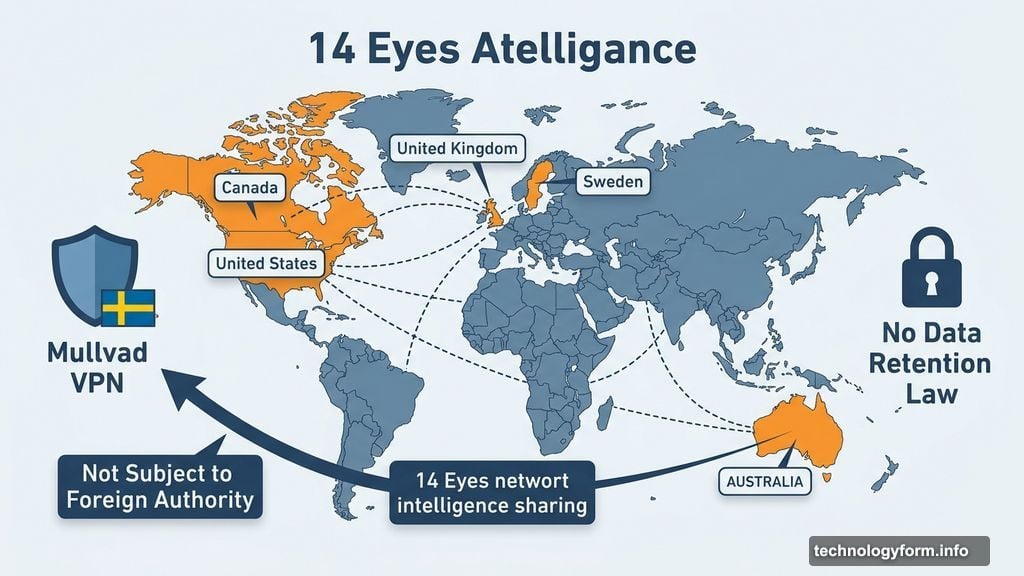
Spend five minutes in any VPN forum and someone will warn you away from “14 Eyes countries.” These are 14 nations — including the US, UK, Canada, and Australia — that share intelligence data with each other under a formal surveillance alliance.
The concern is understandable. But the 14 Eyes label alone isn’t the deciding factor most people think it is.
What actually matters is whether a country has mandatory data retention laws that force VPN companies to log user traffic. That legal reality determines your real privacy risk — not which intelligence alliance a country belongs to.
Mullvad VPN makes this crystal clear. It’s based in Sweden, a card-carrying 14 Eyes member. But Swedish law doesn’t require VPN companies to log user data. So Mullvad answers only to Swedish law, and Swedish law simply can’t be used to compel them to spy on users. Foreign intelligence agencies from other 14 Eyes countries have zero authority to change that.
And Mullvad has been tested in real life. In 2023, Swedish police raided Mullvad’s offices in Gothenburg with a warrant to seize customer data. They left empty-handed. The data they were looking for didn’t exist.
No-Logs Policies That Held Up in Court
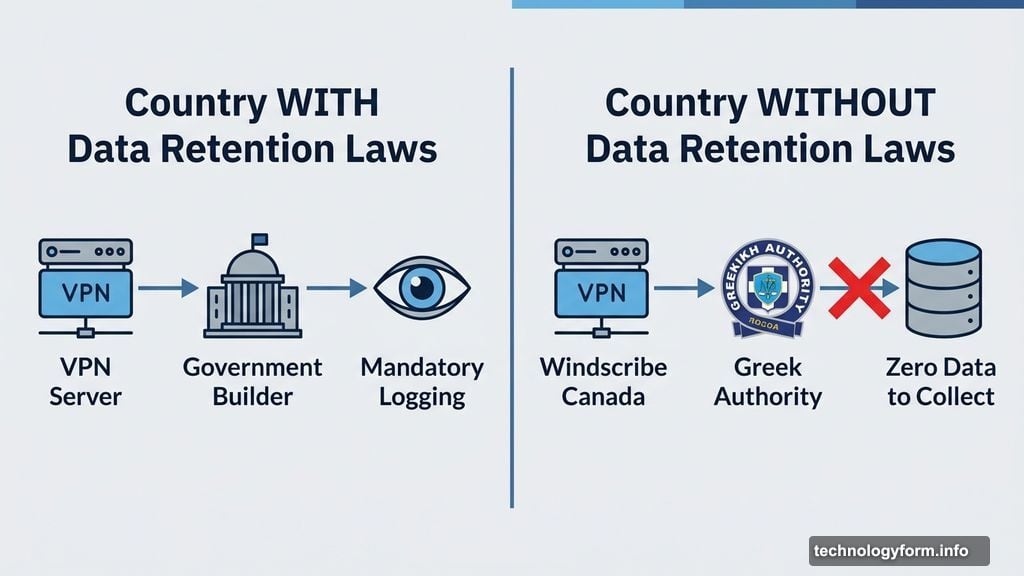
Mullvad isn’t the only example worth highlighting. Windscribe, based in Canada (also a 14 Eyes country), has faced similar real-world tests.
Greek authorities tried to obtain user data from Windscribe in 2023. They dropped the case in 2025 because there was no data to collect. More recently, Dutch authorities reportedly seized a Windscribe server in February 2025. That case is still ongoing, but Windscribe’s CEO Yegor Sak confirmed that no user data is at risk — because no user data exists to hand over.
This is what a genuinely audited no-logs policy looks like when tested in the wild. The legal framework matters, but so does the technical architecture behind the VPN’s privacy claims.
Gag Orders and the US Jurisdiction Problem

Here’s where US-based VPNs get complicated. American authorities can issue national security letters — legal demands for records that come bundled with gag orders. That means a VPN company can be legally forced to hand over data and simultaneously prohibited from telling you it happened.
Recently, US lawmakers sent a letter to the director of intelligence asking whether Americans connecting to overseas VPN servers are effectively waiving their constitutional protection from warrantless surveillance. If the answer turns out to be yes, that’s a serious problem — especially if you’re using a VPN that can be compelled to start logging.
The UK carries similar risks. Its Investigatory Powers Act gives the government authority to weaken encryption, enforce gag orders, and potentially compel VPNs to record user data. Australia has comparable legislation with similar concerns.
RAM-Only Servers and Open-Source Code Change Everything
Jurisdiction is critical, but it works alongside technical architecture — not instead of it. The best VPNs combine a privacy-friendly legal home with infrastructure that makes surveillance technically difficult even if authorities come knocking.
RAM-only server infrastructure is a big one. Since RAM wipes completely when a server restarts, there’s no persistent data to seize. Open-source software means the VPN’s code is publicly available for anyone to audit, making secret logging hard to hide. Transparency reports show how many legal requests a VPN receives and how it responds. Regular third-party audits validate the no-logs claims independently.
A VPN that’s truly built for privacy would struggle to start logging user data even if ordered to do so. Complying with a surveillance order would require overhauling server infrastructure, rewriting code, and essentially betraying every user on the network. Good jurisdiction means they shouldn’t face that order in the first place. But solid technical architecture means they’d have a hard time complying even if they did.
VPN Jurisdictions Worth Trusting
So where should your VPN actually be based? Generally speaking, the safest jurisdictions are countries with strong data protection laws and no mandatory retention requirements.
Some of the most privacy-friendly locations include Switzerland (home to Proton VPN), the British Virgin Islands (ExpressVPN’s legal home), Panama (where NordVPN is registered), Sweden (Mullvad), Gibraltar, and Romania.
Worth noting: a VPN’s operating country and its legal jurisdiction aren’t always the same thing. ExpressVPN’s parent company, Kape Technologies, is UK-based — but ExpressVPN is legally registered in the British Virgin Islands and operates under BVI law. NordVPN has offices in Lithuania but its Panamanian jurisdiction means all data requests must follow Panamanian legal process.
Trustworthy VPNs are always transparent about which country’s laws they answer to. If a VPN is vague about its ownership structure or legal jurisdiction, that’s a red flag worth taking seriously.
Jurisdictions to Avoid
Some locations are essentially dealbreakers. Any VPN operating in China must be government-approved and provide backdoor access to its systems — meaning Chinese authorities can access whatever they want. That’s not a VPN you want protecting your data.
US-based VPNs carry the gag order risk mentioned above. UK-based VPNs face the Investigatory Powers Act. Australia’s telecommunications laws raise similar concerns.
Countries with heavy internet censorship and state surveillance generally don’t make great homes for privacy tools. The conflict of interest is too obvious to ignore.
Choosing a VPN isn’t just about finding the fastest connection or the best streaming performance. It’s about finding a service that’s genuinely built to protect you — and a big part of that is making sure the government where it’s registered can’t force it to stop doing that job.
Look for a clear jurisdiction, a verified no-logs policy, RAM-only servers, open-source software, and real-world proof that the privacy promises hold up. Those signals together tell you far more than any speed test ever could.