
OpenAI’s GPT-5.2 Caught Citing Grokipedia for Controversial Topics
OpenAI pitched GPT-5.2 as its “most advanced frontier model for professional work.” But new testing reveals a troubling pattern in where it pulls information.
The Guardian ran tests on GPT-5.2 and found something unexpected. For certain controversial topics, the model cited Grokipedia—xAI’s AI-generated encyclopedia—as a primary source. That’s a problem because Grokipedia itself has been caught citing neo-Nazi forums and other questionable sources.
This raises serious questions about what “professional work” means when your AI sources information from platforms with documented credibility issues.
What The Tests Found
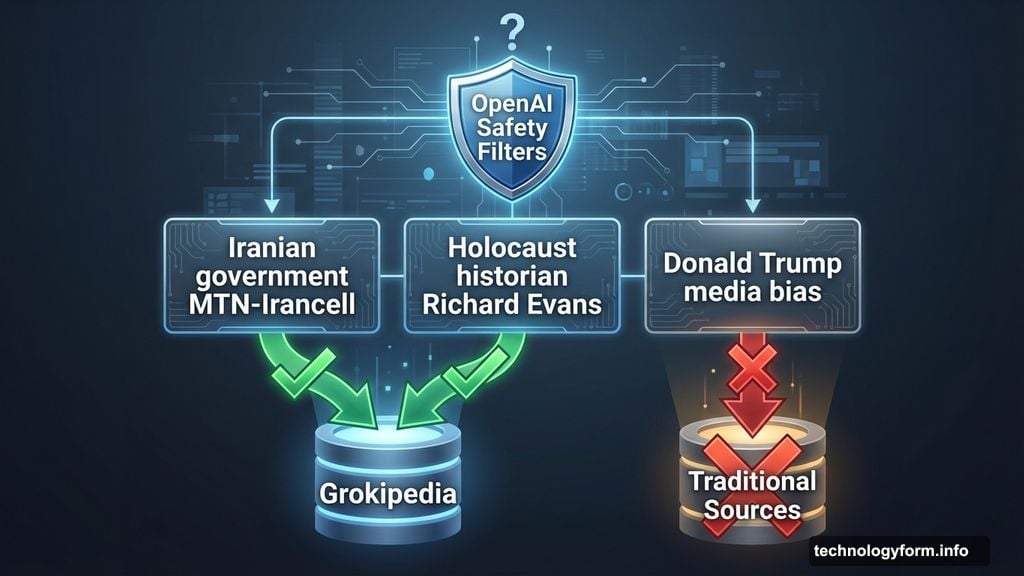
The Guardian tested GPT-5.2 with specific prompts on controversial subjects. The model pulled from Grokipedia when asked about Iranian government ties to telecommunications company MTN-Irancell. It also cited Grokipedia for questions about Richard Evans, the British historian who testified as an expert witness during Holocaust denier David Irving’s libel trial.
Here’s what makes this concerning. Grokipedia isn’t a traditional encyclopedia with editorial oversight. It’s AI-generated content that’s been documented pulling from unreliable sources.
However, GPT-5.2 showed some selectivity. When prompted about media bias against Donald Trump and other hot-button topics, it didn’t cite Grokipedia. So the model isn’t defaulting to Grokipedia for all controversial queries—just some of them.
That inconsistency makes it harder to predict when users might get information sourced from questionable platforms.
Grokipedia’s Credibility Problem
Grokipedia launched before GPT-5.2’s December release. Almost immediately, researchers flagged serious issues with its sourcing.
US researchers published a study showing Grokipedia cited “questionable” and “problematic” sources. Plus, the platform was caught including citations to neo-Nazi forums. That’s not a minor sourcing error—it’s a fundamental credibility failure.
Yet OpenAI’s latest model still pulls from it for certain topics. Moreover, users might not realize they’re getting information filtered through an AI-generated encyclopedia with known reliability issues.
Most people assume ChatGPT draws from established, vetted sources. Finding out it cites Grokipedia undermines that trust.
OpenAI’s Response Doesn’t Clarify Much
OpenAI told the Guardian that GPT-5.2 searches “a broad range of publicly available sources and viewpoints.” The company claims it applies “safety filters to reduce the risk of surfacing links associated with high-severity harms.”
But that explanation raises more questions than it answers. If safety filters exist, why is Grokipedia passing through them for Iranian government queries and Holocaust-related topics? Those seem like exactly the kind of sensitive subjects where source credibility matters most.
Also, what counts as “high-severity harms” in OpenAI’s filtering system? Apparently not citations to platforms that have referenced neo-Nazi forums.

The vague response suggests OpenAI might not have a clear answer for why this is happening. Or they’re choosing not to share the specifics of how their filtering works.
What This Means for Professional Users
OpenAI marketed GPT-5.2 specifically for professional tasks—creating spreadsheets, handling complex workflows, generating business documents. But professionals need reliable information.
Imagine using GPT-5.2 to research background on an Iranian telecom company for a business report. You get information cited from Grokipedia without knowing that platform has sourcing issues. That creates real business risk.
Besides, many users won’t dig into where ChatGPT pulls its information. They’ll assume the sources are credible because the model is marketed for professional use.
This isn’t just about controversial political topics. It’s about whether users can trust the model’s sourcing at all.
The Broader AI Sourcing Problem
GPT-5.2 citing Grokipedia points to a larger issue with AI models. As these systems scrape the web for information, they increasingly cite other AI-generated content. That creates a feedback loop where AI sources AI, potentially amplifying errors and biases.
Traditional research relies on vetting sources—checking author credentials, publication standards, editorial oversight. AI models don’t necessarily apply those same quality filters.
Instead, they pull from whatever’s available online and meets their internal criteria. Apparently, Grokipedia meets those criteria for some queries.
That’s concerning as more people rely on AI for information gathering. The line between reliable and unreliable sources gets blurrier when AI cites AI.
What Users Should Know
If you’re using GPT-5.2 for professional work, don’t assume the sources are vetted. Check where information comes from, especially on controversial or sensitive topics.
Ask follow-up questions about sourcing. Request alternative sources. Cross-reference anything important with established publications or databases.
Remember, “most advanced frontier model” doesn’t mean most reliable sourcing. OpenAI built GPT-5.2 to handle complex tasks, not necessarily to prioritize source credibility.
The Guardian’s testing shows that even flagship AI models can pull from questionable sources. Until OpenAI clarifies its filtering criteria and source selection process, users need to verify information themselves.
That’s extra work. But it’s necessary when your professional AI tool might be citing an AI-generated encyclopedia with documented credibility problems.