Meta’s AI Ambitions Run on One Thing: Everything You’ve Ever Posted
Meta plans to spend up to $135 billion on AI development in 2026. That’s nearly double last year’s budget. But the real story isn’t the money.
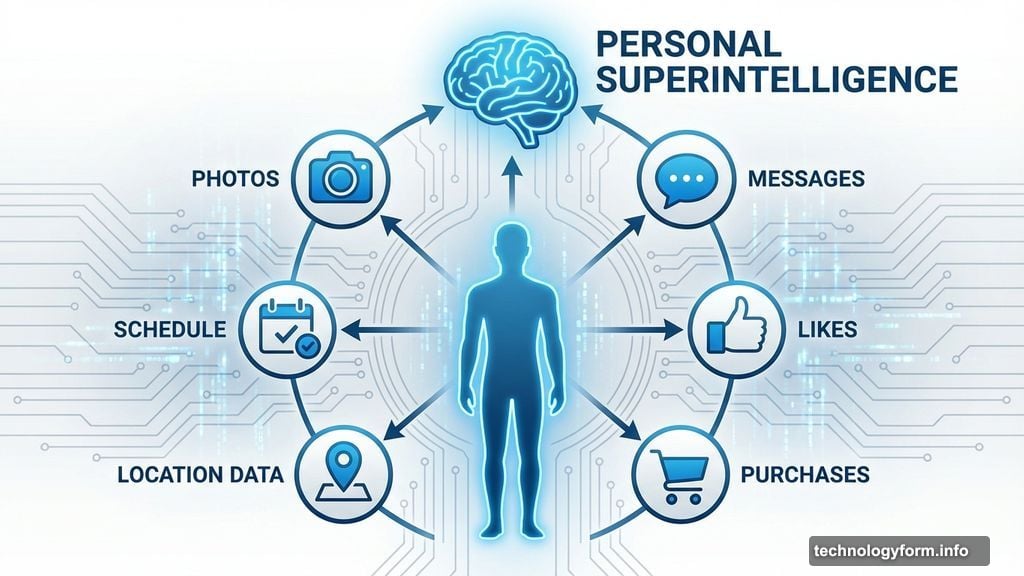
It’s what Meta already owns. Years of your photos, messages, likes, and browsing habits across Facebook, Instagram, and WhatsApp. That data gives Meta a massive edge in the race toward personal AI. While competitors scramble to build smarter chatbots, Meta’s sitting on a goldmine of personal information about billions of users.
Here’s why that matters for the future of artificial intelligence.
Personal Superintelligence Needs Personal Data
Mark Zuckerberg laid out Meta’s vision during the company’s fourth-quarter earnings call. The goal? Personal superintelligence. That means AI that’s smarter than humans and tailored specifically to your life.
Sounds ambitious. But Meta’s already halfway there thanks to its data collection machine.
“We’re starting to see the promise of AI that understands our personal context, including our history, our interests, our content, and our relationships,” Zuckerberg said. Translation? Meta knows what you post, who you talk to, what you buy, and where you go.
That information powers targeted ads today. Tomorrow, it’ll fuel AI agents that handle tasks for you. Book travel. Manage schedules. Shop for groceries. All customized to your preferences because Meta already knows them.
Meta AI Is Already Everywhere You Look
Meta didn’t wait for permission to deploy its AI. The company embedded Meta AI directly into Facebook and Instagram. You can’t turn it off. You can’t opt out of having your data used to train it.
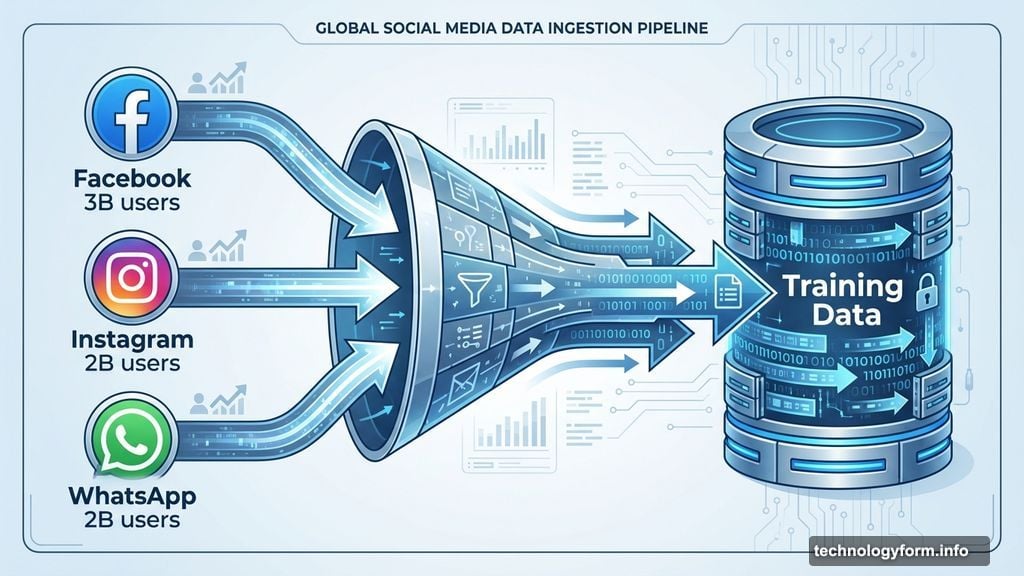
Sure, you can mute Meta AI. But it’s still there, learning from every interaction across the platform. Every like, comment, share, and search feeds the system.
Compare that to competitors. Google and Microsoft collect data through YouTube and LinkedIn. But Meta owns three of the world’s largest social platforms. Facebook has 3 billion users. Instagram has 2 billion. WhatsApp has over 2 billion.
That’s an unprecedented amount of personal information. Plus, Meta’s spent two decades perfecting the art of turning user data into profit. Nobody else in tech has that track record with personalization at scale.
Agentic AI Depends on Context
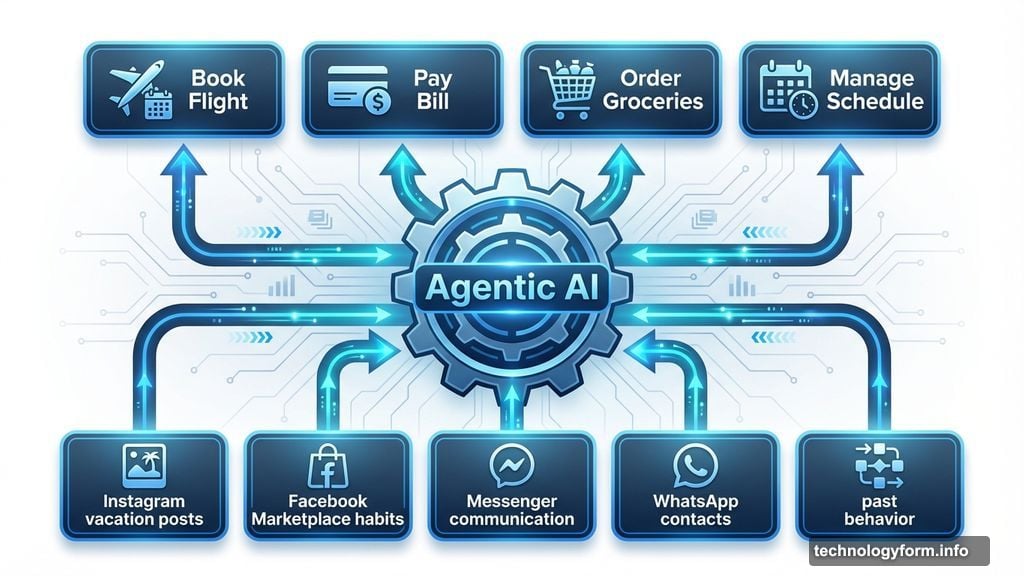
The next frontier is agentic AI. These are systems that can act autonomously on your behalf. Book that flight. Pay that bill. Order those groceries.
But autonomous action requires deep context. An AI agent needs to know your schedule, preferences, budget constraints, and past behavior. Otherwise, it’s just guessing.
Meta already has that context. It knows your vacation patterns from Instagram posts. Your shopping habits from Facebook Marketplace. Your communication style from Messenger and WhatsApp. Your social connections across all three platforms.
That’s why Zuckerberg believes Meta can deliver “a uniquely personal experience.” Competitors start from scratch. Meta starts with a decade of your digital life.
Social Feeds Will Merge With AI Recommendations
Meta’s planning to integrate its large language models with the recommendation algorithms that build your social media feeds. That means AI won’t just chat with you. It’ll shape what content you see.
“Soon, we’ll be able to understand people’s unique personal goals, and tailor feeds to show each person content that helps them improve their lives in the ways that they want,” Zuckerberg explained.
That raises obvious questions. Who decides what counts as “improvement”? Does Meta AI prioritize your actual goals or the ones that keep you scrolling longer?
The company already faced criticism for AI integrations in WhatsApp. Users revolted when Meta announced plans to use AI chat interactions for personalizing ads. Now Meta wants to go further, using AI to curate entire feeds based on inferred goals.
Meta’s Rocky AI Development Year
Despite its data advantages, Meta struggled in 2025. The company hired top AI researchers from OpenAI and Apple over the summer. Then reports surfaced about internal conflicts between new hires and Meta’s existing FAIR lab.
Progress stalled. Meta laid off hundreds of AI employees. Yann LeCun, a legendary AI researcher, left his chief AI scientist role at year’s end.
Meanwhile, competitors pulled ahead. Google released Gemini 3 with breakthrough reasoning capabilities. OpenAI launched GPT-5.2. Anthropic’s Claude impressed developers with its coding abilities.
Meta’s playing catch-up despite having more user data than anyone else. That suggests data alone isn’t enough. Execution matters. So does having a cohesive strategy instead of competing internal factions.
Privacy Concerns Aren’t Going Away
Meta’s business model is built on surveillance. The company tracks your activity, analyzes your behavior, and sells access to your attention. That’s how targeted advertising works.
Now Meta wants to feed all that data into AI systems that will shape your daily decisions. Smart glasses that watch where you look. Chatbots that know your deepest insecurities. Agents that manage your finances.
The privacy implications are staggering. Yet Meta offers no real opt-out. You can delete your account. But as long as you use Facebook, Instagram, or WhatsApp, your data trains Meta’s AI.
Google recently launched personalized intelligence in Search. Other companies are building similar systems. So Meta isn’t alone in pursuing personal AI. But it has more personal data about more people than any competitor.
The Spending Makes Sense Now
$135 billion is a staggering amount to invest in AI development. It seems reckless until you consider what Meta’s really buying.
The company isn’t just building better language models. It’s building an AI ecosystem that leverages decades of personal data collection. That moat protects Meta from competitors who don’t have the same information advantage.
Smart glasses that know your friends’ faces. Chatbots that understand your communication style. Agents that anticipate your needs before you voice them. All powered by information you’ve been feeding Meta for years.
Whether that’s exciting or terrifying depends on how much you trust Meta with your life. Either way, the company’s betting its future on the idea that personal AI requires personal data. And nobody has more of that than Meta.
Your posts, photos, and messages aren’t just content anymore. They’re training data for the AI that wants to run your life. Meta’s been collecting the pieces for years. Now it’s ready to assemble them into something far more powerful than a social network.
The question isn’t whether Meta can build personal superintelligence. It’s whether we should let it.