India’s AI Impact Summit Packed Four Days With Billion-Dollar Deals and Big Names
India just threw one of the biggest AI gatherings on the planet. And the announcements kept coming fast.
The India AI Impact Summit ran for four days this week, drawing roughly 250,000 visitors and an all-star lineup of tech executives. OpenAI’s Sam Altman, Anthropic’s Dario Amodei, Alphabet CEO Sundar Pichai, Google DeepMind CEO Demis Hassabis, and Reliance Chairman Mukesh Ambani all showed up in person. India’s Prime Minister Narendra Modi even shared a stage with French President Emmanuel Macron on Thursday.
The goal? Convince the world that India is ready to be a serious AI superpower. Based on what was announced, that pitch landed pretty well.
India Earmarks $1.1 Billion for AI Venture Capital
Let’s start with the money, because there was a lot of it.
India’s government carved out $1.1 billion for a state-backed venture capital fund. The fund will invest in artificial intelligence and advanced manufacturing startups across the country. That’s a clear signal that this isn’t just talk — the government is putting real cash behind its ambitions.
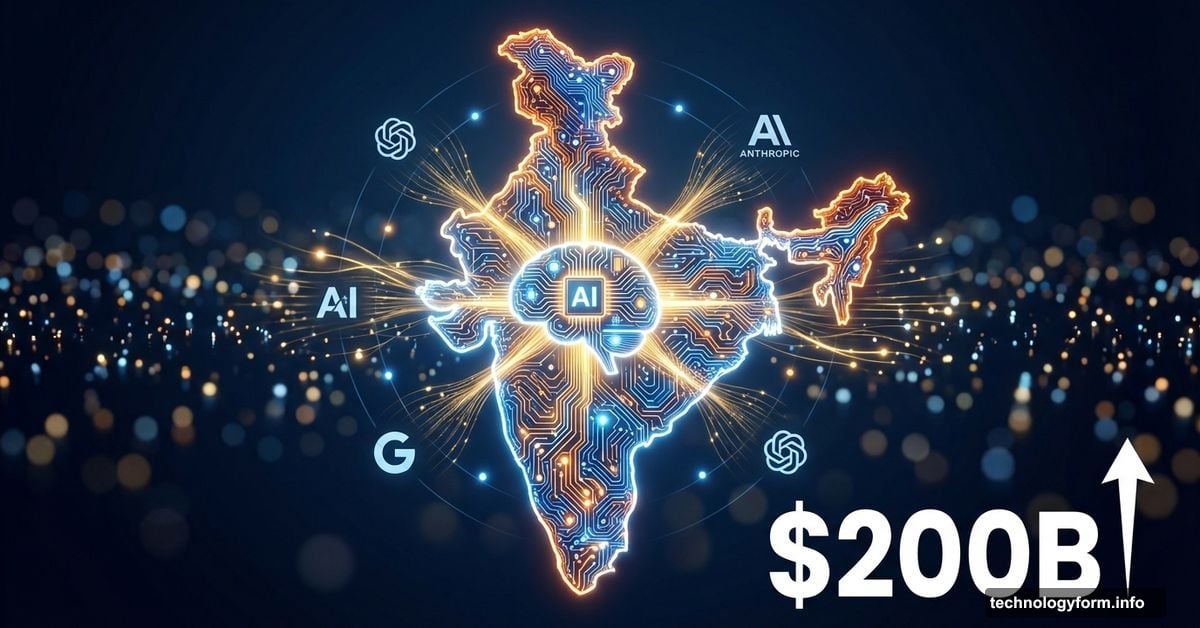
India’s tech minister Ashwini Vaishnaw went even bigger. He said India wants to attract more than $200 billion in AI infrastructure investment over the next two years. That’s an enormous target, but the announcements from this week suggest the country is already pulling serious commitments.
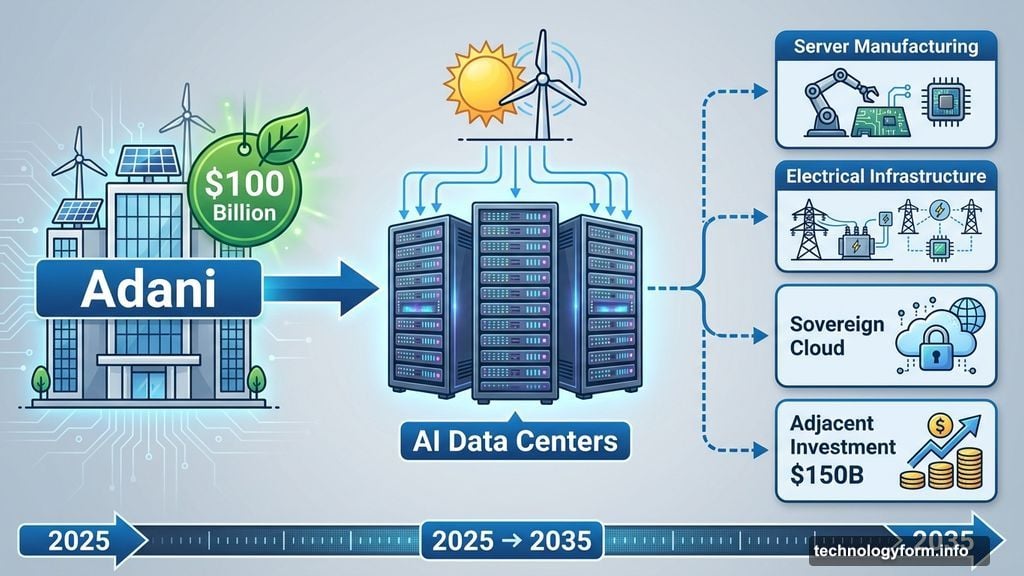
Conglomerate Adani added its own staggering number. The company said it plans to allocate $100 billion to build AI data centers running on renewable energy in India by 2035. Adani expects that investment to trigger an additional $150 billion flowing into adjacent areas like server manufacturing, advanced electrical infrastructure, and sovereign cloud platforms.
Sam Altman Drops a Surprise ChatGPT Stat
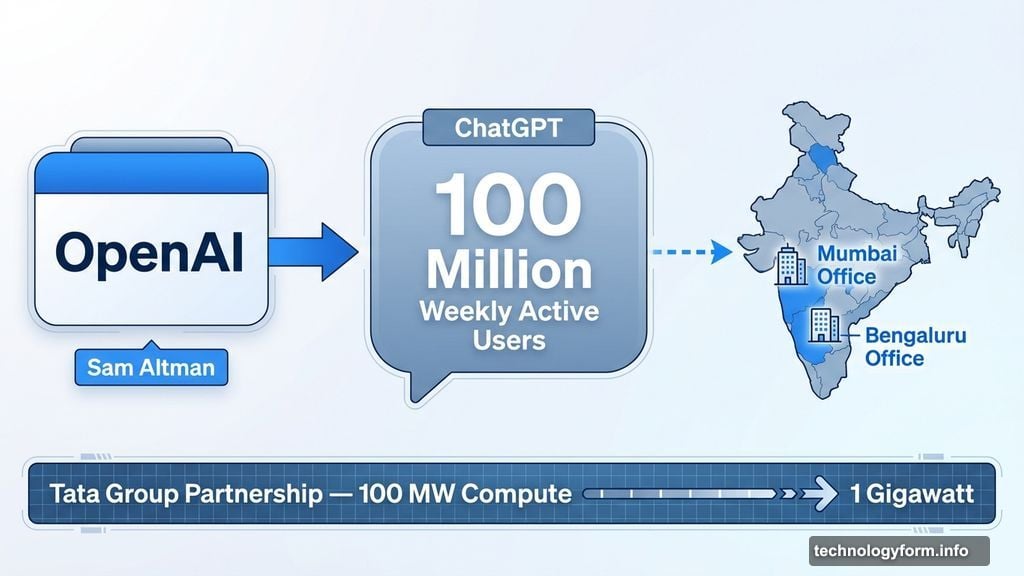
OpenAI CEO Sam Altman shared something that caught a lot of people off guard. India now accounts for more than 100 million weekly active ChatGPT users — second only to the United States. He also noted that Indians make up the largest group of students using the platform globally.
That context explains why OpenAI announced two new Indian offices, one in Bengaluru and one in Mumbai. Plus, OpenAI partnered with the Tata Group to deploy 100 megawatts of compute in India, with plans to scale that up to a full gigawatt eventually. That’s a serious infrastructure commitment, not just a PR move.
Anthropic Opens Its First India Office
Anthropic didn’t want to be left out. The company announced it’s opening its first office in India, based in Bengaluru.
Dario Amodei’s company also revealed that India is Claude’s second-largest user base after the US. So the office makes strategic sense. Anthropic is also partnering with IT giant Infosys to deploy Claude models and tools — including Claude Code — to Indian enterprises. They’re starting with the telecommunications sector and setting up a dedicated Anthropic Center of Excellence.
Blackstone Bets Big on Indian AI Startup Neysa
Private equity firm Blackstone picked up a majority stake in Indian AI startup Neysa as part of a $600 million equity fundraise. Teachers’ Venture Growth, TVS Capital, 360 ONE Asset, and Nexus Venture Partners also participated.
But Neysa isn’t stopping there. The company plans to raise another $600 million in debt and deploy more than 20,000 GPUs. That’s serious compute for an Indian startup, and it signals that investors see real infrastructure opportunity in the region.
Meanwhile, Bengaluru-based C2i — which builds power solutions specifically for data centers — raised $15 million in a Series A round led by Peak XV, with TDK Ventures and Yali Deeptech joining in.
AMD and TCS Team Up on AI Infrastructure
AMD announced a partnership with Tata Consultancy Services to develop rack-scale AI infrastructure based on AMD’s “Helios” platform. This kind of hardware collaboration shows that India isn’t just interested in AI software — it wants a piece of the infrastructure layer too.
That matches the broader theme of the summit. India is trying to build the full stack, from chips and data centers to software and AI-native applications.
Indian IT Faces a Tough Reckoning
Not everything at the summit was celebratory. HCL CEO Vineet Nayyar made a blunt statement: Indian IT companies will focus on turning profits, not being job creators. That landed at a sensitive moment, as Indian IT stocks have been sliding on fears that AI will disrupt the entire services sector.
Vinod Khosla, founder of Khosla Ventures, went even further. He said industries like IT services and business process outsourcing could “almost completely disappear” within five years because of AI. He suggested that 250 million young Indians should instead be selling AI-based products and services to the rest of the world.
That’s a big pivot for an economy where IT services employ millions of people. But Khosla’s view isn’t exactly fringe right now — it’s a conversation happening across the global tech industry.
Indian AI Startups Showing Real Momentum
Several homegrown Indian AI companies made moves during the summit worth paying attention to.
Sarvam, an Indian AI startup, released two new open-sourced models: Sarvam 30B and Sarvam 105B. The company also teased an upcoming smart glasses product called Sarvam Kaze. Plus, Sarvam announced partnerships with Qualcomm, HMD, and Bosch to deploy its models across smartphones, feature phones, cars, laptops, and smartglasses.
BharatGen, a government-backed AI consortium, released a 17 billion parameter model called Param 2 that supports 22 languages. That multilingual focus is a recurring theme here — India has enormous linguistic diversity, and its AI builders are taking that seriously.
Cohere Labs also launched a family of multilingual models with open weights supporting over 70 languages, including region-specific versions. These models can run on local devices, which matters a lot for markets with inconsistent internet access.
Voice AI startup Gnani released a zero-shot voice cloning text-to-speech model called Vachana, supporting 12 languages. And vibe-coding startup Emergent announced it hit $100 in annual recurring revenue and launched a mobile app.
Streaming, Enterprise, and Voice AI Round Things Out
Streaming service JioHotstar said it will use ChatGPT to power conversational content discovery. Think asking your TV what to watch and getting a real conversation back, rather than a generic scroll.
Voice AI company Cartesia is partnering with India-based orchestrator Blue Machines to deploy enterprise voice solutions with local data residency. That local data piece matters for Indian enterprise customers navigating privacy regulations.
The breadth of announcements here is genuinely impressive. AI infrastructure, AI models, AI hardware, AI consumer products, and AI enterprise tools all got major updates in the span of four days.
India clearly showed up to this summit with a point to prove. And from the volume of investment commitments, partnership deals, and product launches that came out of it, a lot of the attendees left believing the country can deliver. Whether $200 billion in infrastructure investment actually materializes over the next two years is a separate question. But the momentum from this week is hard to argue with.