6 Signs That Message Was Written by ChatGPT, Not a Human
Have you noticed something feels slightly off about certain texts you’ve been reading lately? Maybe a friend’s party invitation seemed strangely formal. Or your boss’s email had an oddly diplomatic tone that didn’t quite sound like them.
You’re not imagining it. AI tools like ChatGPT are genuinely useful, but many people lean on them a little too heavily. And the results tend to leave some telltale fingerprints. Here’s how to spot them.
Em-Dashes Everywhere
This is the fastest giveaway—and once you see it, you can’t unsee it.
ChatGPT has a strong affection for em-dashes. It uses them constantly to break up sentences and add emphasis. Most people don’t write that way naturally, so when you spot an unusual number of em-dashes in a message from someone who isn’t a professional writer, that’s a solid red flag.
Take a quick scan next time you read something that feels slightly off. Chances are, the dashes will jump out at you.
The “Not Just This, But Also That” Pattern
This one is surprisingly common. Watch for phrases like “This isn’t just a birthday party. It’s also a celebration of spring arriving.”
ChatGPT loves building statements that acknowledge one thing and then layer something else on top. It sounds polished, but it rarely sounds personal. Real people writing casually to friends don’t typically structure sentences this way. It’s a habit baked into how the tool generates text.
Suspiciously Balanced and Positive
If you’ve spent any time using ChatGPT, you’ve probably noticed how reluctant it is to take a clear stance on anything. It constantly offers “on one hand… on the other hand” type responses.
That careful diplomatic tone bleeds into AI-written messages too. Instead of a direct recommendation or honest opinion, you get a text that feels like it was written by someone trying very hard not to offend anyone. It reads less like a person and more like a corporate press release. If the message never really commits to a point of view, that’s worth noticing.
A Polished but Hollow Tone
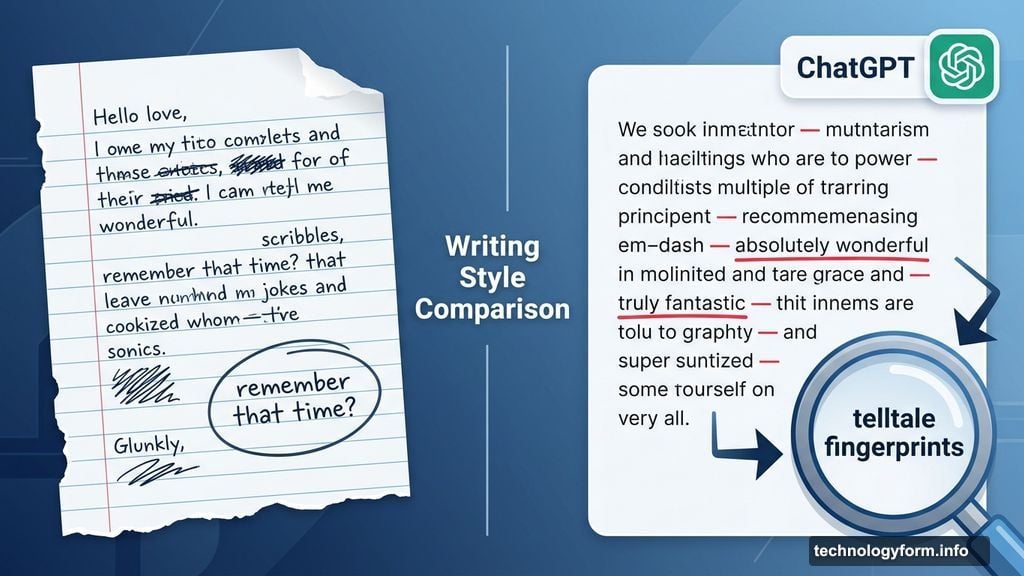
Personal messages are supposed to feel personal. But ChatGPT, even when prompted to write warmly, tends to produce something that sounds enthusiastic without actually saying much.
You’ll often get an unusual number of superlatives like “absolutely wonderful” or “truly fantastic” stacked together, with very little genuine personal reflection underneath them. Real people write messily. They reference inside jokes, make odd word choices, and occasionally ramble. AI-generated text tends to be smooth and pleasant in a way that somehow feels empty.
Repetition in Disguise
ChatGPT has a habit of restating the same idea multiple times using slightly different phrasing. It’s especially noticeable in longer messages.
So if that email from your boss makes the same point three times in three different ways, or if a 500-character message ends with a neat little summary of everything that was just said, there’s a good chance a human didn’t write it alone. Real writers don’t usually summarize themselves within a single short email.
Zero Errors, Zero Personality
Nobody writes error-free emails consistently. Typos happen. Autocorrect makes weird suggestions. Grammar goes sideways when you’re in a hurry.
If the text you’re reading is absolutely flawless, that’s actually a reason to be skeptical rather than impressed. ChatGPT doesn’t make spelling mistakes. It doesn’t forget to close a parenthesis or accidentally send a half-finished sentence. Perfect grammar in a casual message can be a sign that software, not a person, did the writing.
What About AI Detection Tools?
You might be tempted to paste suspicious text into one of the AI detection services available online. Honestly, those tools aren’t particularly reliable.
One quick test made this clear. A five-year-old article written entirely by a human came back labeled as 94 percent AI-generated. ChatGPT didn’t even exist when that article was written. So while detection tools sound helpful in theory, they tend to produce too many false positives to trust in practice.
Your own instincts, guided by the patterns above, will serve you better. If a message feels oddly smooth, strangely balanced, or weirdly impersonal, trust that feeling. You’re probably right.