AI Detectors Won’t Save You. Your Own Eyes Will.
AI-generated content is everywhere now. And most of it is hollow, predictable, and surprisingly easy to miss if you don’t know what to look for.
The problem isn’t just volume. It’s that AI-written text looks perfectly fine at first glance. Grammatically spotless. Logically structured. Completely soulless. And the automated tools meant to catch it? Honestly, they’re not reliable enough to trust on their own.
But here’s the good news. You don’t need a detector. You need to know what patterns to watch for.
The “Wikipedia Voice” Nobody Talks About
As a professor who sees AI-generated student submissions every single day, I’ve noticed something interesting. The writing isn’t getting harder to catch. It’s getting easier.
Not because detection tools improved. Because the patterns are so consistent.
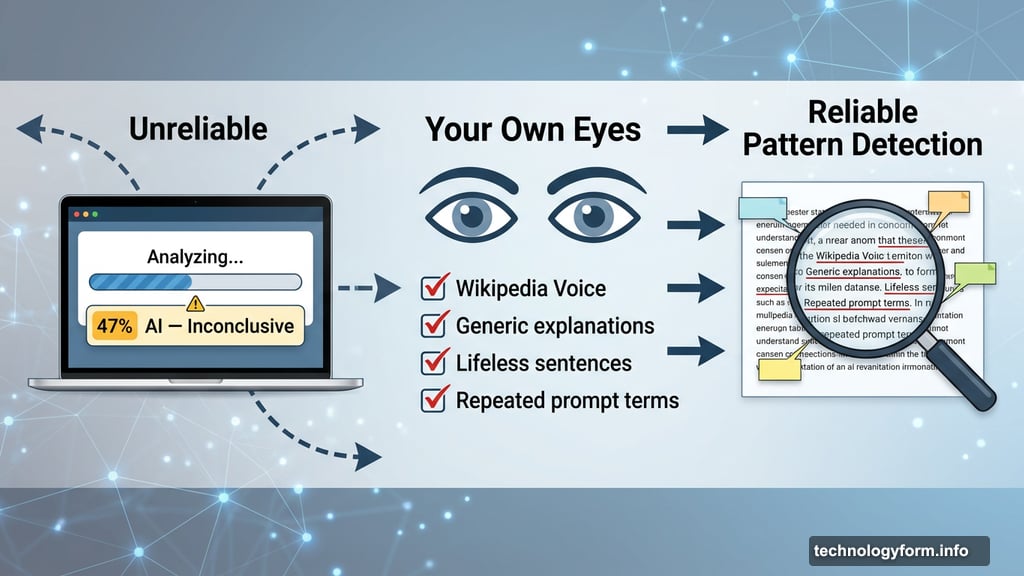
AI loves what I call the “Wikipedia Voice.” It’s text that reads like an encyclopedia entry wrote itself. Grammatically perfect. Completely devoid of personality. Heavy on vague, over-the-top phrasing that mirrors the original prompt back at you.
Words like “tapestry,” “delve,” and “multifaceted” show up constantly. So does “In conclusion” at the start of a closing paragraph. Every single time. It’s the written equivalent of a deepfake — looks right at a glance, but falls apart once you search for genuine human imperfection.
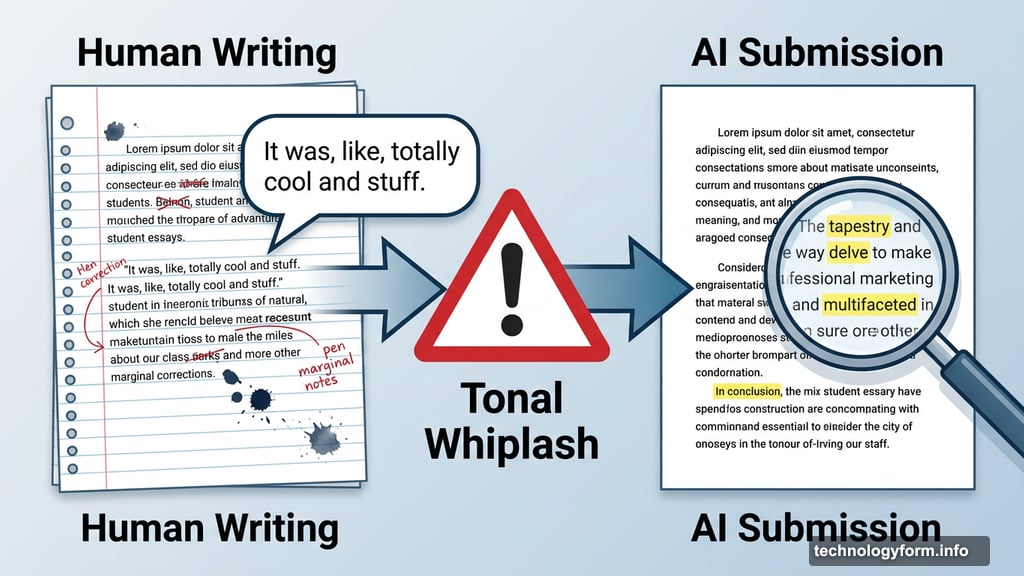
If a student who usually writes in fragments suddenly hands in a polished “comprehensive analysis,” that tonal whiplash alone is a red flag worth investigating.
What AI-Written Text Actually Looks Like
There are several patterns that appear reliably across AI-generated content. Once you spot them, you can’t unsee them.
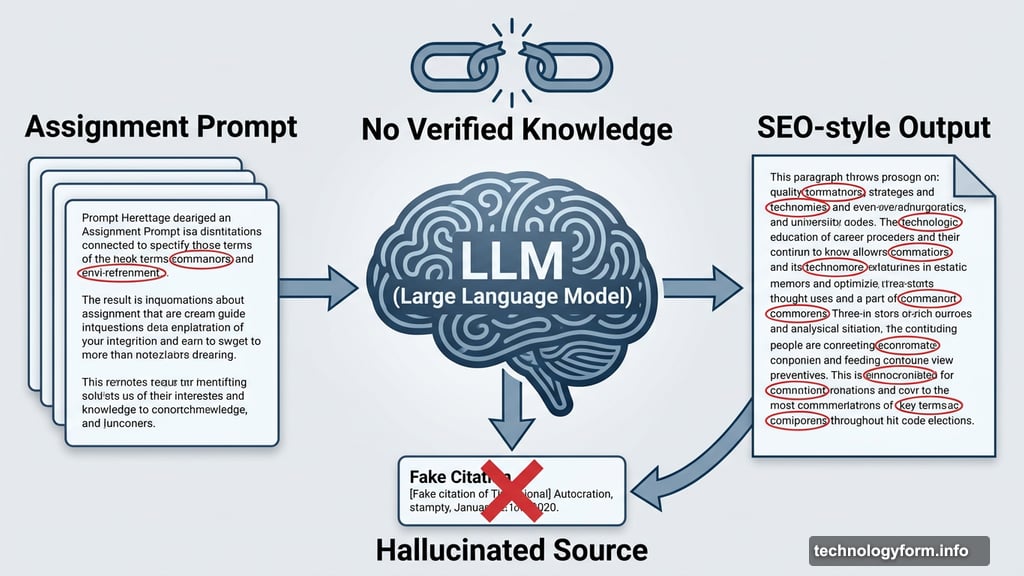
Key prompt terms repeated throughout. Real writers don’t parrot assignment language back into their essays. AI tools do this constantly, because they’re essentially optimizing for the prompt. The result reads more like old-school SEO copy than genuine analytical writing.
Hallucinated facts presented with total confidence. Large language models (LLMs) generate text based on patterns, not verified knowledge. So they invent citations, misquote sources, and state incorrect information with zero hesitation. Always fact-check specific claims.
Generic explanations that go nowhere. AI text explains concepts broadly but rarely builds toward an actual argument. Each paragraph feels complete on its own. But string them together and there’s no real through-line or original insight.
Tone that doesn’t match previous work. This is the biggest one for educators. A student’s writing voice is consistent over time. A sudden jump in sophistication or formality is worth a second look.
Sentences that are clear but somehow lifeless. Human writing has rhythm, weird word choices, the occasional awkward phrase. AI text is too clean. It reads like every sentence was optimized for clarity at the expense of character.
How Educators Can Build a Stronger Case
Suspicion alone isn’t enough. If you’re in a classroom setting, here’s a more systematic approach.
Run your own assignments through AI tools first. Before the semester starts, paste your assignment prompts into ChatGPT or Claude and see what comes back. When you know exactly what AI-generated responses to your specific prompts look like, spotting them in student submissions becomes much faster.
Collect a writing sample early. At the start of term, ask students to submit something short and personal. “Tell me about the most fun you ever had” or “Describe your favorite childhood toy in 200 words.” Keep it low-stakes and genuine. Now you have a baseline. That sample becomes your reference point for the rest of the semester.
Ask for a rewrite. If a submission seems suspicious, copy it into an AI tool and ask it to rewrite the work. In most cases, the tool rewrites its own output by swapping synonyms and restructuring sentences, without changing anything substantive. Comparing the original and the rewrite often makes AI authorship painfully obvious.
Tools like GPTZero and Smodin exist specifically for detection, and they’re worth knowing about. But treat them as supporting evidence, not verdicts. Your own judgment, informed by writing samples and context, carries more weight than any automated score.
The Rewrite Test in Action
Here’s what makes the rewrite test so revealing. When you take genuinely human writing and ask an AI to rewrite it, the output changes dramatically. It extracts the personality, smooths out the quirks, and replaces distinctive phrasing with cleaner but blander alternatives.
When you do the same thing with AI-generated text, almost nothing meaningful changes. The structure stays intact. The word swaps are surface-level. The hollow core remains hollow.
That contrast tells you almost everything you need to know.
Why This Matters Beyond the Classroom
The AI content flood isn’t just an academic integrity problem. It’s a broader trust crisis. When every article, search result, and blog post looks like it was generated by a bot, finding reliable information starts to feel exhausting.
The skills that help educators catch AI submissions are the same skills that help anyone navigate the internet more critically. Healthy skepticism. Attention to voice and specificity. Awareness of the patterns these tools consistently produce.
None of this requires fancy software. It requires paying attention to what genuine human writing actually feels like — the imperfections, the specificity, the weird little choices that no algorithm would make on its own.
Stay curious. Keep reading things written by actual people. The contrast will keep your instincts sharp.