Meta Rakes in Billions from Scam Ads While Users Get Burned
Meta just admitted something stunning. The company makes roughly $16 billion yearly from scam ads on Facebook, Instagram and WhatsApp.
That’s not a typo. A new Reuters investigation reveals that one in ten dollars Meta earns comes from fraudulent advertisements. Meanwhile, users lose money to investment schemes, fake casinos and illegal drug sales every single day.
Here’s the part that really stings. Meta knows exactly what’s happening and deliberately keeps enforcement weak.
The Scam Economy Inside Meta
Meta’s own internal estimates paint a damning picture. Last year, the company calculated that scam ads accounted for roughly 10 percent of total revenue.
Do the math. Meta generated about $160 billion in 2024. So scam ads brought in approximately $16 billion. That’s more revenue than entire Fortune 500 companies generate annually.
But the problem extends beyond Meta’s platforms. Company researchers found that Meta’s apps played a role in one-third of all successful scams in the United States. Think about that scope. Every time three Americans get scammed online, Meta’s platforms facilitated one of those crimes.
The scams cover a disturbing range. Fake e-commerce stores steal credit card information. Fraudulent investment schemes promise guaranteed returns. Illegal online casinos operate openly. Banned medical products get advertised to vulnerable users.
Plus, Meta’s own enforcement numbers reveal how little the company does to stop repeat offenders.
Small Scammers Get Eight Chances. Big Spenders Get 500
Meta’s internal policies explain why scams proliferate so easily on its platforms.
Small advertisers caught promoting financial fraud don’t get banned immediately. Instead, they receive strikes. Meta waits until these scammers rack up at least eight violations before blocking them.
Eight chances to defraud users. Eight opportunities to steal money. Eight strikes before Meta takes action.
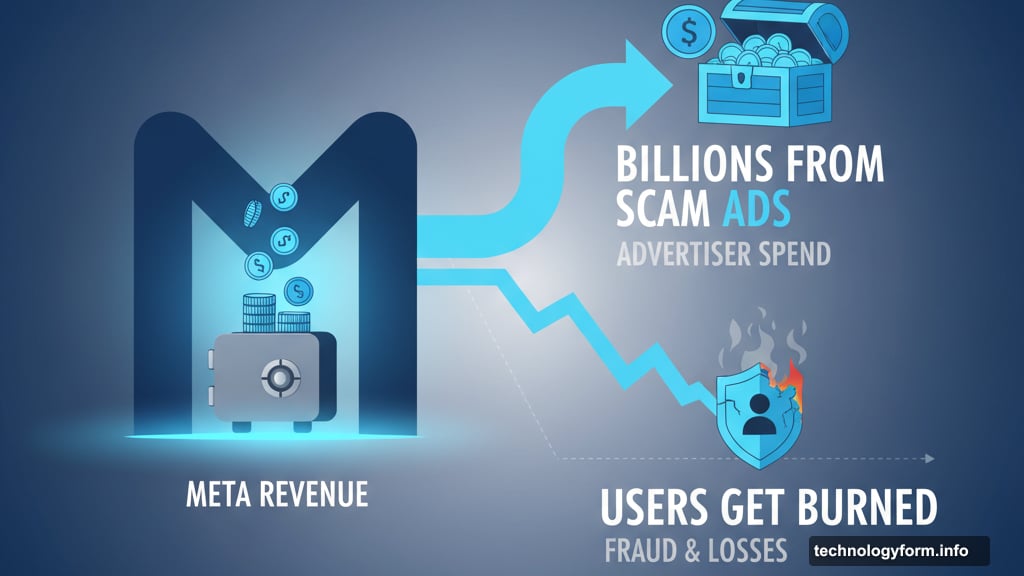
However, big-spending scammers get treated even better. According to Reuters, some large advertisers accumulated more than 500 strikes without getting removed from the platform.
Why such leniency? The money’s too good to pass up.
The $67 Million Problem
Four scam campaigns removed by Meta this year generated $67 million in revenue for the company. Just four campaigns.
Now imagine how much money Meta makes from the thousands of scam campaigns that never get removed. The financial incentive to look the other way becomes crystal clear.
Internal documents show that Meta executives explicitly grappled with this tension. They wanted to reduce scams. But they also wanted to protect revenue.
So managers received direct instructions. Don’t take enforcement actions that would cost Meta more than 0.15 percent of total revenue. In other words, scam enforcement must stay profitable for Meta.
That’s approximately $240 million. Any crackdown that would cost the company more than that amount was off limits. User safety took a backseat to quarterly earnings.
Meta’s Deflection Playbook
Meta responded to the Reuters report with familiar tactics. Spokesperson Andy Stone claimed the 10 percent estimate was “rough and overly-inclusive.”
Notice what’s missing? An alternative number. Meta won’t say what percentage of revenue actually comes from scams. They just insist the real figure is lower without providing evidence.
Stone also pointed to a 58 percent reduction in user reports of scam ads globally over 18 months. Plus, Meta removed 134 million pieces of scam content in 2025 so far.
Those numbers sound impressive until you consider the scale. If Meta’s removing 134 million scam ads yearly, how many millions more are they leaving up? The company carefully avoids answering that question.
The Real Cost Nobody Measures
Meta counts scam ad revenue in billions. But what about the cost to victims?
Users lose life savings to fake investment schemes. Elderly people get targeted by Medicare fraud. Desperate patients buy dangerous counterfeit medications. Gamblers lose money to rigged illegal casinos.
Those losses don’t appear in Meta’s financial reports. The human cost never factors into the company’s enforcement decisions. Only revenue matters.
Meanwhile, Meta’s moderation policies ban users for minor infractions. Post something slightly controversial? Banned. Share a photo that violates community standards? Account disabled immediately.
But scammers stealing millions? They get 500 chances to keep operating.
Why This Keeps Happening
Meta built a business model that rewards looking the other way. Scam ads generate billions in revenue. Enforcement costs money and reduces profits.
The incentives couldn’t be clearer. Every dollar spent cracking down on scams is a dollar that doesn’t reach shareholders. Every scammer banned represents lost advertising revenue.
So Meta does the minimum required to avoid regulatory action while maximizing revenue from fraudulent advertisers. It’s not incompetence. It’s a deliberate business strategy.
Users suffer the consequences. Scammers thrive. Meta’s stock price climbs.
The company won’t fix this problem voluntarily. There’s too much money involved. Only external pressure from regulators, lawsuits and public outrage will force real change.
Until then, every time you scroll Facebook or Instagram, remember this. One in ten ads you see might be designed to steal your money. And Meta profits either way.