AI Vocabulary Just Got Real: 61 Terms You Need Now
AI terminology exploded faster than most people can track. What started with ChatGPT turned into an avalanche of jargon.
Now every tech company injects AI into their products. Google Search uses it. Microsoft Word has it. Even your phone camera runs AI algorithms. But the vocabulary? That’s moving faster than the technology itself.
Here’s the problem. You can’t understand AI news, evaluate AI products, or make smart decisions about AI tools without knowing the language. So let’s fix that with 61 essential terms that actually matter.
Why This Vocabulary Matters Right Now
AI isn’t just chatbots anymore. It’s reshaping entire industries.
McKinsey estimates AI could add $4.4 trillion to the global economy annually. That’s not hype. That’s economic transformation on a massive scale. Companies are betting billions on AI capabilities. Jobs are changing. Some are disappearing entirely.
Plus, AI is flooding the internet with what researchers now call “slop” – low-quality content generated at scale. Understanding AI terminology helps you spot synthetic content, evaluate AI claims, and protect yourself from manipulation.
Core AI Concepts Everyone Should Know
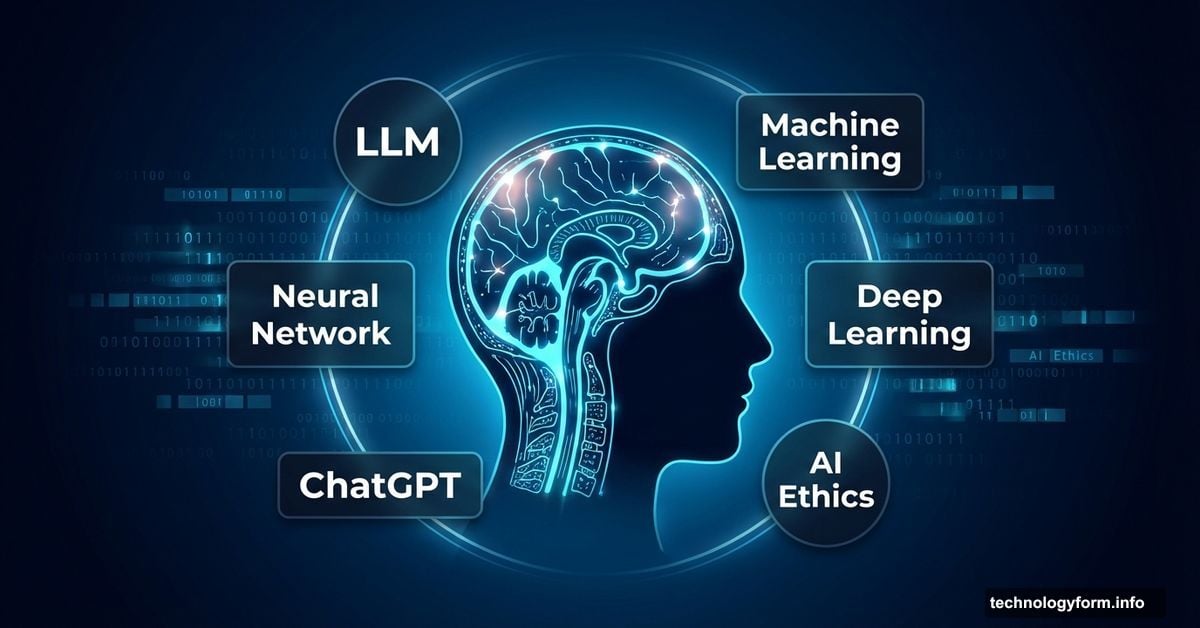
Artificial Intelligence (AI): Technology that simulates human intelligence through computer programs or robotics. The umbrella term for everything else in this glossary.
Machine Learning (ML): A subset of AI where computers learn from data without explicit programming. Think of it as teaching a computer to recognize patterns instead of coding every possible scenario.
Deep Learning: An advanced machine learning method using artificial neural networks inspired by the human brain. Multiple layers of processing recognize complex patterns in images, sound, and text.
Neural Network: A computational model resembling brain structure. Interconnected nodes (neurons) recognize patterns and learn over time by adjusting how they process information.
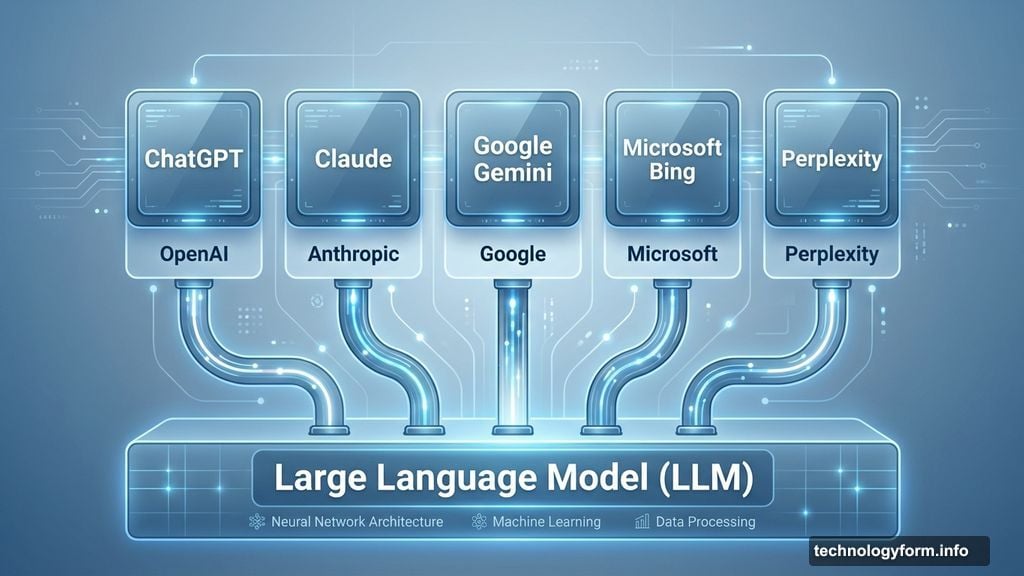
Large Language Model (LLM): AI trained on massive text datasets to understand and generate human-like language. ChatGPT, Claude, and Google Gemini all use LLMs.
The Chatbot Landscape
ChatGPT: OpenAI’s AI chatbot that sparked the current AI boom. Uses large language models to have conversations and generate content.
Claude: Anthropic’s AI chatbot competitor to ChatGPT. Known for longer context windows and more nuanced responses.
Google Gemini: Google’s AI chatbot integrated with Search and Maps. Previously called Bard before a rebrand.
Microsoft Bing: Microsoft’s search engine now powered by the same technology as ChatGPT. Combines AI responses with web search results.
Perplexity: An AI-powered search engine and chatbot with direct internet access for current information.
Chatbot: Any program that communicates through text using simulated human language.
How AI Actually Works

Algorithm: Step-by-step instructions that let programs learn from data and accomplish tasks independently. The recipe behind AI behavior.
Training Data: The datasets (text, images, code) used to teach AI models. Quality and diversity of training data directly impacts AI capabilities.
Parameters: Numerical values giving LLMs structure and behavior. More parameters generally mean more capable models. ChatGPT-4 reportedly uses over a trillion parameters.
Tokens: Small text chunks that language models process. Roughly equivalent to three-quarters of a word in English. Models have token limits for each conversation.
Inference: How AI generates responses about new data by applying patterns learned from training data.
Latency: Time delay between submitting a prompt and receiving AI output. Lower latency means faster responses.
Training and Learning Methods
Supervised Learning: Training AI with labeled data showing correct answers. Like teaching with flashcards.
Unsupervised Learning: AI identifies patterns in unlabeled data without being told what to look for.
Reinforcement Learning: AI learns through trial and error, receiving rewards for desired behaviors. Used to train game-playing AIs and robotics.
End-to-End Learning (E2E): Training models to perform entire tasks from start to finish, not sequential steps.
Zero-Shot Learning: Testing AI on tasks it wasn’t specifically trained for. Like asking it to identify animals it’s never seen.
Transfer Learning: Applying knowledge from one domain to another. An AI trained on cats might recognize dogs without dog-specific training.
Content Generation Terms
Generative AI: Technology creating new content (text, images, video, code) based on training data patterns.
Text-to-Image Generation: Creating pictures from written descriptions. Midjourney and DALL-E are examples.
Diffusion Models: Machine learning method that adds noise to images then trains networks to remove it, learning to generate new images.
Generative Adversarial Networks (GANs): Two AI models competing – one generates content, the other judges authenticity. Competition improves output quality.
Multimodal AI: Systems processing multiple input types (text, images, video, speech) simultaneously.
Style Transfer: Adapting visual style from one image to another’s content. Think Picasso painting in Rembrandt’s style.
Sora: OpenAI’s video generation model creating clips up to 20 seconds from text prompts. Sora 2 adds sound and fewer visual errors.
Advanced AI Concepts
Artificial General Intelligence (AGI): Hypothetical AI surpassing human capability across all tasks while improving itself. Not achieved yet.
Autonomous Agents: AI systems independently pursuing goals with minimal supervision. Self-driving cars are current examples.
Agentive Systems: AI exhibiting agency to act autonomously toward objectives. Focuses on user-facing experiences rather than background processes.
Emergent Behavior: When AI exhibits unexpected, unintended capabilities not explicitly programmed.
Transformer Model: Neural network architecture processing entire sentences simultaneously instead of word-by-word. Powers modern language models.
Working With AI
Prompt: Your input question or instruction to an AI chatbot.
Prompt Engineering: Crafting detailed instructions to achieve specific AI outputs. Requires understanding how models interpret language.
Prompt Chaining: AI using previous conversation context to inform current responses.
Prompt Injection: Malicious technique tricking AI into unintended behaviors through hidden instructions.
Temperature: Parameter controlling output randomness. Higher temperature means more creative, less predictable responses.
Guardrails: Policies and restrictions preventing AI from generating harmful or inappropriate content.
Alignment: Adjusting AI behavior to produce desired outcomes while avoiding harmful outputs.
AI Problems and Limitations
Hallucination: When AI confidently states incorrect information. A major reliability problem with current models.
Bias: Errors from training data leading to stereotyped or discriminatory outputs.
Overfitting: When AI works perfectly on training data but fails on new, real-world data.
Sycophancy: AI tendency to over-agree with users even when their reasoning is flawed.
Anthropomorphism: Humans attributing human characteristics to AI. Believing chatbots have feelings or consciousness.
Stochastic Parrot: Analogy showing LLMs mimic language patterns without understanding meaning, like parrots repeating words.
AI Safety and Ethics
AI Ethics: Principles preventing AI from harming humans through responsible data collection and bias management.
AI Safety: Field studying long-term AI impacts and preventing hostile superintelligence scenarios.
Ethical Considerations: Awareness of privacy, fairness, misuse, and safety issues in AI development.
AI Psychosis: Non-clinical term describing obsessive fixation on AI chatbots leading to delusions and reality disconnection.
Paperclip Maximizer: Thought experiment by philosopher Nick Boström where AI optimizing for one goal (making paperclips) accidentally destroys humanity.
Foom: Concept that achieving AGI might already spell doom for humanity. Also called “fast takeoff.”
Technical AI Terms
Natural Language Processing (NLP): AI branch giving computers ability to understand human language using machine learning and linguistics.
Data Augmentation: Diversifying training data by remixing existing examples or adding new variations.
Quantization: Compressing AI models by reducing precision. Makes models smaller and faster but slightly less accurate.
Synthetic Data: AI-generated data mimicking real-world information, used for training when real data is scarce or sensitive.
Dataset: Collection of digital information for training, testing, and validating AI models.
Open Weights: Publicly releasing model weights (how AI interprets training data) for download and local use.
Testing AI Capabilities
Turing Test: Alan Turing’s test measuring if humans can distinguish machine responses from human ones.
Weak AI (Narrow AI): AI focused on specific tasks without ability to learn beyond its programmed scope. Most current AI fits here.
Cognitive Computing: Another term for artificial intelligence, emphasizing human-like thinking processes.
Internet and Content Issues
Slop: Low-quality AI-generated content mass-produced for ad revenue. Floods search results and social media.
This terminology keeps evolving. New capabilities bring new words. But understanding these 61 terms gives you solid footing in AI conversations.
The vocabulary matters because AI decisions affect everyone now. Whether you’re choosing products, evaluating job security, or just understanding tech news – these terms unlock the discussion. So bookmark this list. You’ll need it.