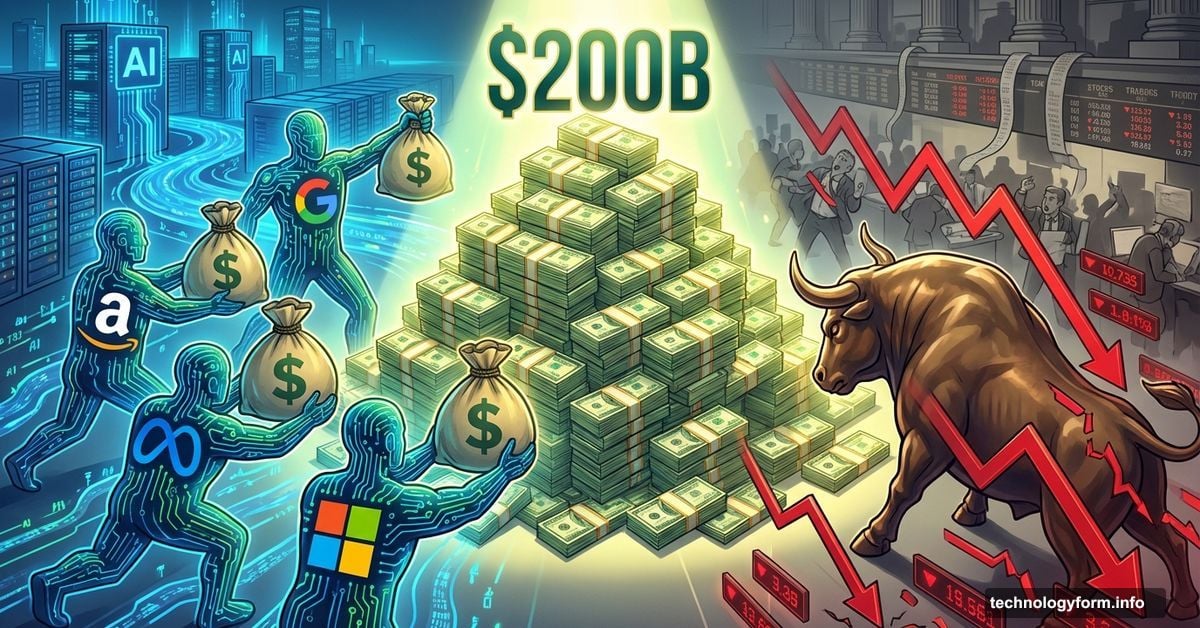
Big Tech Threw $200 Billion at AI Infrastructure. Wall Street Just Called Their Bluff
Amazon just committed $200 billion to AI infrastructure in 2026. Google’s right behind at $175-$185 billion. Meta’s chipping in another $115-$135 billion.
The numbers are staggering. But here’s the twist nobody saw coming: investors hate it. Stock prices tanked across the board when these companies announced their spending plans. Turns out, Wall Street doesn’t share Silicon Valley’s faith in the AI gold rush.
Amazon Leads the Spending Spree
Amazon’s projecting $200 billion in capital expenditures for 2026. That’s up from $131.8 billion in 2025. The money goes toward AI, chips, robotics, and low earth orbit satellites.
However, Amazon’s numbers hide something important. Unlike pure software companies, Amazon runs massive physical operations. Those expensive warehouse robots count as capex too. So the AI-specific spending isn’t as clear-cut as it seems.
Still, the scale is breathtaking. No other company comes close to Amazon’s total infrastructure investment. That gives them serious advantages in the compute race everyone’s obsessed with right now.
Google Matches the Pace

Google announced $175-$185 billion in capex for 2026 on Wednesday. That’s nearly double the $91.4 billion they spent in 2025.
The company’s betting big on owning AI infrastructure outright. Instead of renting compute from others, they’re building their own data centers at unprecedented scale. That means control over the entire stack from chips to software.
Moreover, Google sees this as existential. Search revenue still dominates their business model. But AI-powered alternatives threaten that foundation. So they’re spending whatever it takes to stay competitive.
Meta sits at $115-$135 billion for 2026. Microsoft’s penciling out around $150 billion based on recent quarterly figures. Even Oracle, once the infrastructure poster child, projects a comparatively modest $50 billion.
The Logic Behind the Madness
Tech executives share a simple belief: AI compute becomes the scarce resource of the future. Companies that control their own supply win. Companies that depend on others lose.
This thinking drives the spending frenzy. Every dollar invested today supposedly guarantees market position tomorrow. The revolutionary potential of AI justifies almost any price tag.
Plus, nobody wants to be the company that under-invested. If AI transforms everything like leaders predict, you’d be stupid to hold back just because Wall Street got nervous. So the spending continues despite investor pushback.
Wall Street Doesn’t Buy It
Here’s where things get messy. Investors punished every company that announced massive capex increases. Stock prices dropped hard across the board.
And the correlation is brutal: higher AI spending equals bigger stock declines. Companies projecting the most capex saw the worst investor reactions. That includes Microsoft and Amazon, who actually have clear paths to AI revenue through cloud services.
In fact, the problem isn’t limited to companies like Meta that haven’t figured out their AI product strategy yet. Even businesses with robust cloud operations and straightforward monetization plans face investor skepticism. The numbers are simply too high for comfort.
The Revenue Problem Nobody Wants to Discuss
Traditional business logic says companies succeed by making more money than they spend. AI infrastructure spending flips that equation upside down.

So far, AI products haven’t generated returns that justify these investments. ChatGPT is impressive. But does it generate $200 billion worth of value? Copilot helps developers. But does it justify Microsoft’s infrastructure bets?
The honest answer is: nobody knows yet. That uncertainty terrifies investors. They’re being asked to trust that revolutionary AI products are coming soon. Meanwhile, billions disappear into data centers every quarter.
Microsoft Feels the Heat
CEO Satya Nadella faces particular pressure. Microsoft’s AI spending reached roughly $150 billion for 2026 based on the latest quarterly figures of $37.5 billion.
Yet that puts Microsoft in third place behind Amazon and Google. For a company that positioned itself as the AI leader through OpenAI, third place feels uncomfortable. So Nadella must choose: spend more to compete or face questions about commitment.
However, spending more means more investor anger. Microsoft’s stock already took a hit. Ramping up capex further could trigger serious shareholder revolt. There’s no good option here.
The Compute Desert Theory
Tech leaders warn about future compute scarcity. They claim AI demand will outstrip supply, making high-end compute impossibly expensive. Only companies that built their own infrastructure early will survive.

This “compute desert” narrative justifies current spending. If you believe it, you’d be foolish to hesitate. Every data center built today provides insurance against future scarcity.
But what if the desert never arrives? What if AI demand plateaus before compute becomes truly scarce? Then these companies just burned hundreds of billions for nothing. That’s the bet investors worry about.
What Happens Next
Big Tech companies face mounting pressure to justify their spending. Investors want proof that AI infrastructure generates real returns, not just theoretical future value.
Expect companies to downplay capex figures going forward. Nobody wants to be the next headline about excessive AI spending. So the narrative will shift toward efficiency and measured investment.
Meanwhile, the infrastructure buildout continues. Despite investor pushback, tech leaders remain convinced AI transforms everything. They’re not changing course just because Wall Street got nervous. The compute race continues whether investors like it or not.
The question isn’t whether Big Tech stops spending. It’s whether they can prove the spending was worth it before investor patience runs out completely.