Google Just Made AI Agents Actually Useful by Fixing Their Biggest Problem
AI agents promise to plan trips, answer business questions, and automate workflows. But there’s a catch. Most agents can’t reliably connect to the tools and data they need to work.
Google thinks it solved this. The company just launched managed MCP servers that let AI agents plug directly into Google Maps, BigQuery, and other Google services. No more fragile custom connectors or governance nightmares.
This matters because developers currently waste weeks building and maintaining these connections. Plus, when they break, agents fail. Google’s approach removes that friction entirely.
What MCP Servers Actually Do
MCP stands for Model Context Protocol. Anthropic created it about a year ago as an open standard for connecting AI systems to data and tools.
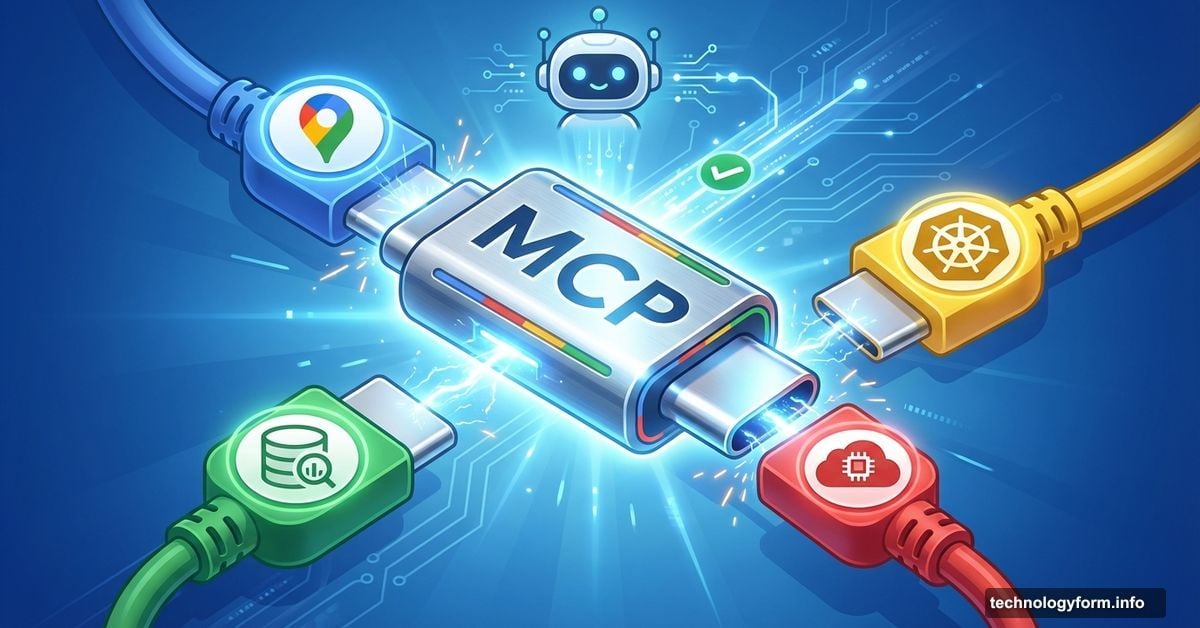
Think of it like USB-C for AI agents. Instead of building custom connectors for every service, developers use one standard protocol. MCP servers sit between the agent and the service, translating requests and responses.
Before this, developers patched together various connectors. Some worked. Many didn’t. All required constant maintenance. Plus, scaling these setups created security and governance headaches.
Google’s managed servers eliminate that work. Developers paste in a URL. The agent connects. That’s it.
Four Services Launch First
Google started with MCP servers for Maps, BigQuery, Compute Engine, and Kubernetes Engine. More services roll out weekly.
Here’s what that enables. An analytics agent can now query BigQuery directly instead of relying on the AI model’s built-in knowledge. An operations agent can interact with infrastructure services in real time.
For Maps, the difference is huge. Without MCP, agents use the model’s training data about locations. That information might be outdated. With the Maps MCP server, agents access current, accurate location data for trip planning and place searches.

Steren Giannini, product management director at Google Cloud, told TechCrunch this setup takes minutes instead of weeks. “We built the plumbing so that developers don’t have to,” he said.
Enterprise Security Baked In
Google protected these MCP servers with Google Cloud IAM. That’s the permission system that explicitly controls what an agent can do with each server.
Google Cloud Model Armor adds another layer. Giannini describes it as a firewall dedicated to agentic workloads. It defends against prompt injection attacks and data exfiltration attempts.
Administrators also get audit logging for observability. That means companies can track exactly what their agents access and when.
But here’s the real enterprise play. Google already has Apigee, its API management product. Many companies use Apigee to issue API keys, set quotas, and monitor traffic for their APIs.
Now Apigee can translate standard APIs into MCP servers. That means a product catalog API becomes a tool an agent can discover and use. All existing security and governance controls apply automatically.
In other words, the same guardrails companies use for human-built apps now protect AI agents too.
Why Open Standards Matter Here
MCP is open source. Anthropic donated it to a new Linux Foundation fund dedicated to standardizing AI agent infrastructure.
That matters because of interoperability. Google’s MCP servers work with any MCP client. Clients are the AI apps that talk to MCP servers and call the tools they offer.
Google supports Gemini CLI and AI Studio as clients. But Giannini said he also tested Anthropic’s Claude and OpenAI’s ChatGPT. “They just work,” he noted.
This creates a bigger opportunity. As more companies adopt MCP, agents become more capable across platforms. An agent built for Claude can use Google’s services. One designed for Gemini can access third-party tools.
The fragmentation that plagued early AI tooling might not repeat here. At least not yet.
Launch Details and What’s Next
These MCP servers launched under public preview. That means they’re not yet covered by Google Cloud’s full terms of service. But they are available at no extra cost to enterprise customers already paying for Google services.
Giannini expects general availability in early 2026. More MCP servers will trickle in weekly after that.
Google plans to expand support across storage, databases, logging, monitoring, and security services in the next few months. Eventually, MCP servers will cover all Google tools.
The timing aligns with Google’s Gemini 3 model launch. The company is pairing stronger reasoning capabilities with more dependable connections to real-world tools and data.
The Bigger Picture for AI Agents
AI agents need three things to work reliably. First, strong reasoning models. Second, access to current data and tools. Third, security and governance controls.
Google’s addressing the second and third requirements here. The company isn’t just connecting agents to its own services. It’s providing a framework that lets enterprises turn their existing APIs into agent-accessible tools while maintaining security postures they already have.
That’s the real value proposition. Companies don’t need to rethink their security infrastructure for AI agents. They extend what already exists.
Will this make AI agents mainstream? Maybe. But Google removed a major technical barrier. Developers can now build agents that reliably access the tools they need. Plus, they can do it fast.
The question shifts from “can we connect this?” to “what should we build?” That’s progress.