Google’s New Disco Browser Just Changed How We Think About Tabs
Google Labs dropped something unexpected today. Instead of improving Chrome, they built an entirely new experimental browser called Disco. The flagship feature? AI-powered tabs that generate interactive apps on demand.
This isn’t another chatbot bolted onto a browser. It’s a fundamental rethink of how tabs work. And honestly, it’s weird in the best possible way.
What Actually Makes Disco Different
Most browsers treat tabs as containers for websites. You open a page, it sits there, you maybe read it. Disco throws that model out.
Instead, it introduces “GenTabs” powered by Gemini 3. These aren’t static pages. They’re dynamically generated web applications that adapt to what you’re trying to accomplish.
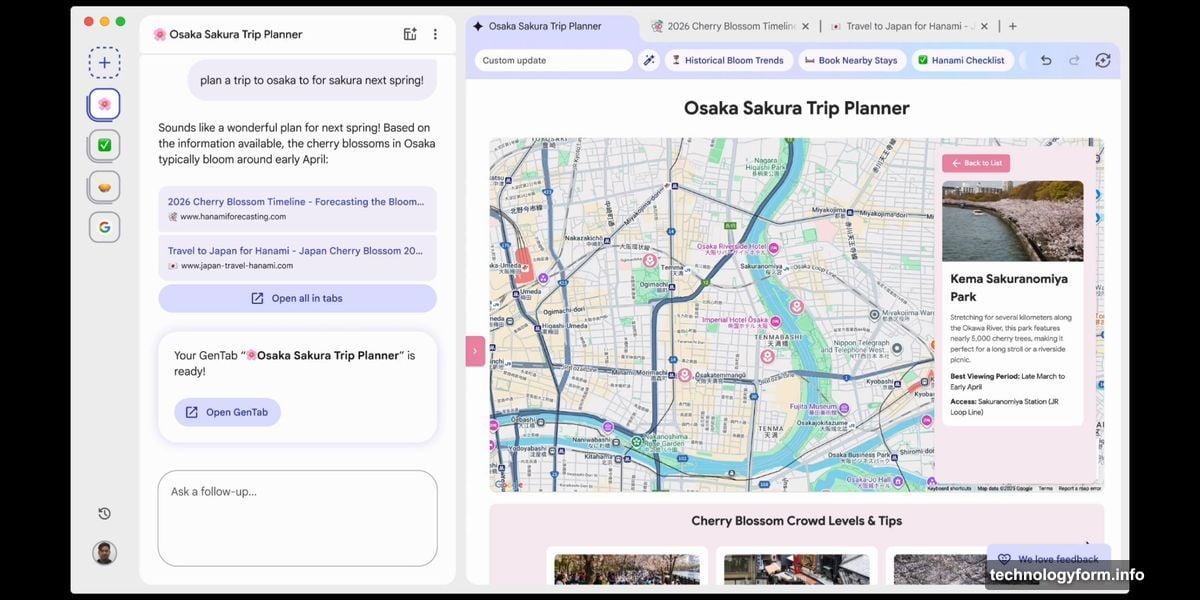
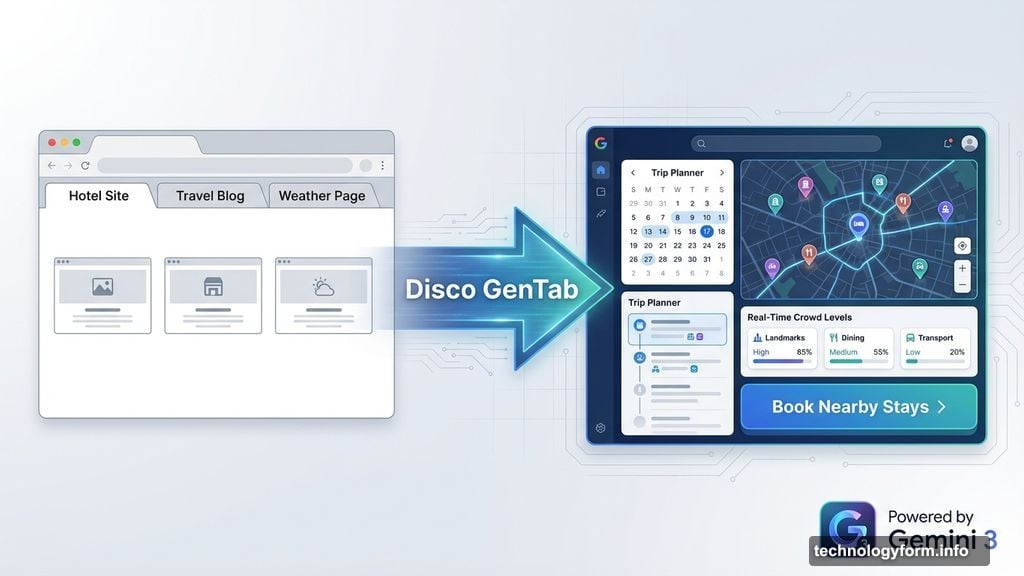
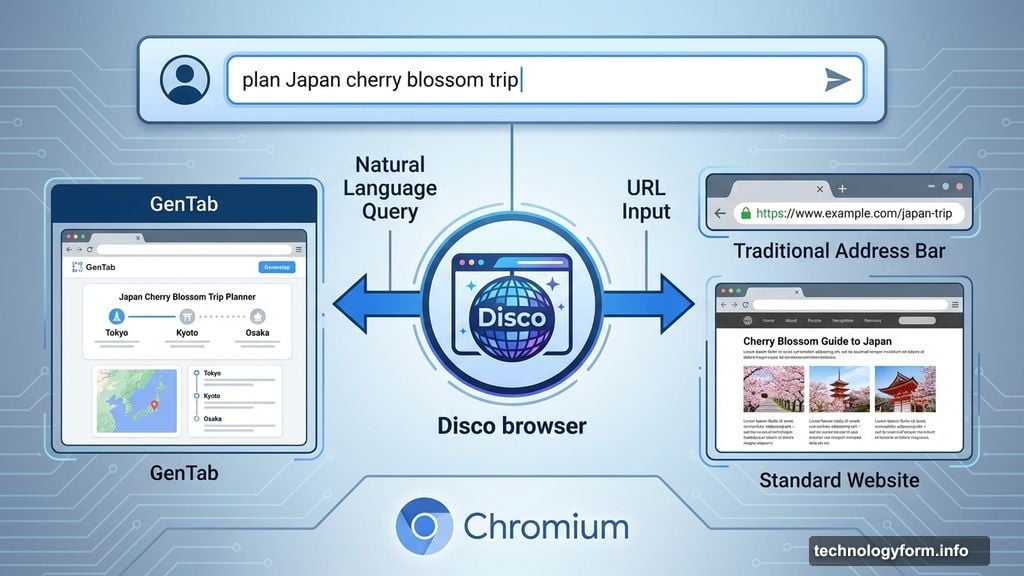
Here’s how it works in practice. Say you’re planning a trip to see cherry blossoms in Japan. You open several tabs researching cities, timing, hotels. Disco’s chat interface looks at those open tabs and your questions. Then it generates a custom trip planner as a GenTab.
This planner includes calendars, timelines, and interactive maps. Cards show crowd levels in suggested cities with management tips. Click “Historical Bloom Trends” or “Book Nearby Stays” and the GenTab updates with relevant tools. You never visit a traditional website. The browser builds the app you need.
GenTabs Transform Complex Research Tasks
Google specifically calls out the problem of “juggling dozens of open tabs to research a topic.” That resonates. We’ve all been there with 30+ tabs open trying to plan something complex.
GenTabs aim to solve this by consolidating research into interactive tools. Other examples Google showed include meal planners with rich imagery, gardening planners with complex layouts, and even a 3D solar system model for learning astronomy.
You describe what you need in natural language. The browser generates it. No coding required. Plus, Disco suggests generative apps you hadn’t considered based on your current task.
But here’s the crucial part. Google claims “every generative element ties back to the web” with links to original sources. So you’re not trapped in an AI bubble. The GenTab synthesizes web content into useful formats while maintaining attribution.
Built on Chromium But Completely Different
Disco runs on Chromium, just like Chrome. That means compatibility with existing web standards and extensions. The tab design looks familiar too.
But the experience diverges sharply from Chrome’s philosophy. Chrome wants to be invisible, a fast conduit to websites. Disco wants to be your research assistant that builds custom tools on demand.
There’s a chat box that doubles as an address bar. Type a question and get a GenTab. Type a URL and visit that site normally with a traditional address bar appearing. The browser adapts to what you’re trying to do.
This dual nature feels strange at first. Sometimes you want a website. Sometimes you want an AI-generated app. Disco tries to handle both seamlessly.
Gemini 3 Powers the Intelligence Layer
The GenTab magic comes from Gemini 3, Google’s latest AI model. It analyzes your open tabs and chat history to determine what tool serves your needs best.
That context awareness matters. If you have tabs about Japan travel open and ask about cherry blossom timing, Disco understands you want trip planning tools. Not general information. Not a list of links. A functional planner.
The quality of generated apps depends entirely on Gemini 3’s capabilities. Google’s examples look polished. But we’ll need real-world testing to see how well it handles edge cases or unusual requests.
Also worth noting: This burns through AI inference compute. Every GenTab generation hits Gemini 3’s API. For Google Labs, that’s fine. For a mainstream product? The infrastructure costs could be significant.
What Google Learns From This Experiment
Google frames Disco as a learning opportunity. They want community feedback about what future browsers should look like.
More importantly, they explicitly state that “compelling ideas from Disco may one day make their way into larger Google products.” That’s code for Chrome. This is a testbed for features that might eventually ship to billions of users.
So why launch a separate experimental browser instead of testing in Chrome Canary? Probably because these changes are too radical. GenTabs fundamentally alter browsing paradigms. Testing them in Chrome risks confusing users or breaking workflows.
By creating Disco as a distinct experiment, Google can push boundaries without Chrome’s baggage. If GenTabs fail, no harm done. If they succeed, Chrome gets upgraded.
The Waitlist Reality Check
Google Labs is opening a waitlist for Disco access starting today. They’re beginning small with macOS support first.
That limited rollout makes sense for an experiment this early. But it also means most people won’t try Disco for months. The waitlist will likely fill quickly given Google’s brand and the novelty factor.
Plus, macOS-first suggests Google is targeting power users and developers. The demographic most likely to provide useful feedback about reimagined browsing paradigms.
No word yet on Windows or Linux support. Or mobile, which could be fascinating. GenTabs on a phone might solve even bigger multitasking headaches than desktop browsing.
The Web Itself Doesn’t Need to Change
One clever aspect of Disco: It doesn’t require websites to change. GenTabs synthesize existing web content into new formats.
That’s crucial for adoption. If Disco needed sites to implement special protocols or APIs, it would fail immediately. Instead, it treats the open web as its data source and builds tools on top.
Websites remain websites. Disco just presents information differently when that serves users better. It’s additive, not disruptive to the web ecosystem.
This approach contrasts with some other experimental browsers that tried creating new web standards or closed platforms. Disco embraces the web’s openness while layering AI intelligence on top.
Where This Could Go Wrong
Not everything about Disco’s vision is guaranteed to work. A few concerns stand out.
First, attribution could get messy. Google says GenTabs link to original sources. But if a complex app pulls from 20 different sites, how clearly will users understand what came from where? AI-generated synthesis often obscures original creators.
Second, the chat interface might be limiting. Natural language works great for some tasks. But sometimes you know exactly what website you want. Adding a layer of AI interpretation could slow you down rather than help.
Third, GenTabs could trap users in Google’s AI ecosystem. Sure, you can visit regular websites. But if GenTabs work well, you might stop doing that. Then your browsing experience depends entirely on Gemini 3’s quality and Google’s continued support.
What Browsers Actually Need
Disco addresses a real problem. Tab overload during complex research is genuinely frustrating. And traditional browsers haven’t solved it despite decades of development.
But is AI-generated apps the right solution? Or would better tab grouping, workspace management, and research tools within traditional browsing suffice?
That’s what Google wants to learn from this experiment. They’re betting that generating custom tools beats organizing existing web content. The community’s response will determine if that bet pays off.
Personally, I’m skeptical of replacing websites entirely. But I’m intrigued by GenTabs as a complement to traditional browsing. Sometimes you need The New York Times. Sometimes you need an AI-generated trip planner. Having both options seems valuable.
Chrome’s Future Might Look Like This
The most significant aspect of Disco isn’t the browser itself. It’s what this experiment reveals about Chrome’s potential evolution.
Google clearly sees AI as central to browsing’s future. Not just AI-powered search or chatbots. But AI that fundamentally reshapes how we interact with web content.
If GenTabs succeed in Disco, expect Chrome to gain similar capabilities within a year or two. Probably behind a flag at first. Then gradually rolled out to mainstream users.
That would represent Chrome’s biggest paradigm shift since its 2008 launch. For 17 years, Chrome has been about fast access to websites. Adding AI-generated apps changes what a browser fundamentally is.
Worth Watching, Not Worth Waiting For
Disco matters as a signal of Google’s direction. It matters less as a product you’ll actually use soon.
The waitlist and macOS-only launch mean availability is limited. Plus, this is explicitly an experiment. Features might change dramatically based on feedback. Or the whole project could shut down if it doesn’t work.
So don’t expect to replace Chrome with Disco next month. Do expect Chrome to gain some Disco-inspired features eventually. And pay attention to how the community responds to GenTabs.
Because if AI-generated apps catch on, every browser vendor will copy the approach. Disco could define browsing for the next decade. Or it could be a fascinating dead end. Either outcome tells us something important about technology’s future.
For now, it’s the most interesting browser experiment in years. That alone makes it worth following.