Cursor Just Built Photoshop for Code. Designers Should Pay Attention
Cursor wants to kill the handoff between designers and developers. Their new Visual Editor lets anyone tweak fonts, colors, and layouts using plain English commands.
No more translating mockups into code. No more endless Slack threads about button spacing. Just point at what you want changed and tell the AI to fix it.
This matters because Cursor isn’t some scrappy startup anymore. They hit $1 billion in revenue faster than almost any AI company in history. Now they’re gunning for Adobe and Figma’s turf.
Design Tools That Actually Touch Code
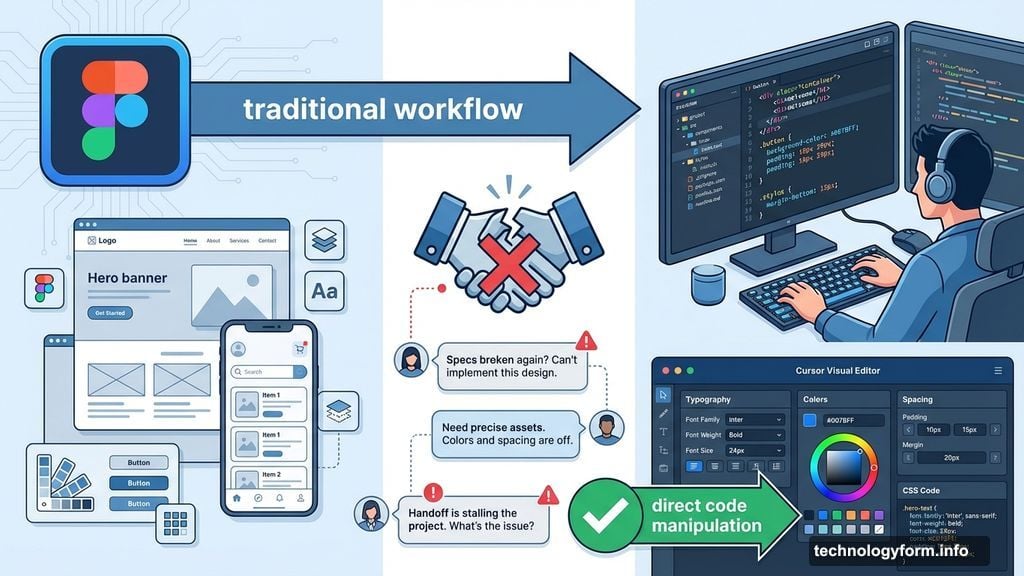
Visual Editor looks like any modern design tool at first glance. Right panel shows typography controls, color pickers, spacing options. Standard stuff designers expect.
But here’s the twist. Every change maps directly to CSS code that ships to users. You’re not working in some symbolic representation of a website. You’re manipulating the actual code base in real time.
Plus, the AI agent understands natural language requests. “Make this button red” works. So does “add a gradient to the header” or “increase letter spacing by 2 pixels.” The agent applies changes instantly while preserving your design system.
Traditional design tools force you to export assets and hand them off to developers. That process breaks constantly. Designers and engineers argue about implementation details. Visual Editor eliminates that friction entirely.
You Can Inspect Any Live Website
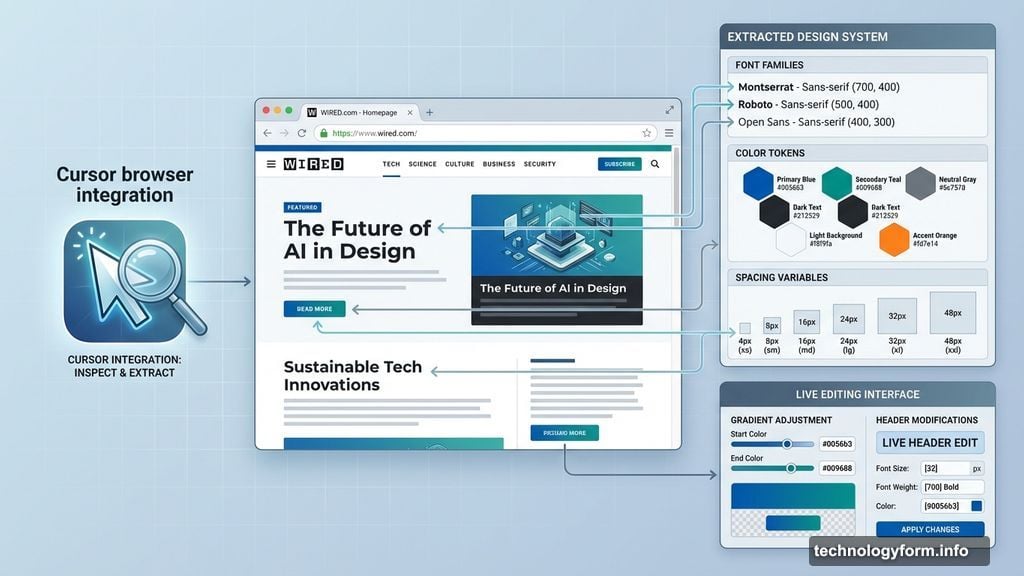
Cursor’s browser integration unlocks something wild. Point Visual Editor at any live site—including competitors—and it reverse-engineers their design system instantly.
I watched them load WIRED’s homepage during a demo. Within seconds, Cursor surfaced every font family, color token, and spacing variable we use. Then they started editing our site in real time, tweaking headers and adjusting gradients like they owned the code base.
This isn’t just useful for inspiration. Companies can analyze successful products, understand their visual language, and adapt those patterns to their own projects. All without leaving Cursor’s environment.
Most design tools show you pixels and frames that don’t translate to real code. Cursor shows you the actual CSS that renders in browsers. That difference matters more than it sounds.
The Purple Gradient Problem
Most AI coding tools produce generic-looking websites. You’ve probably seen them. Purple gradients everywhere. Cookie-cutter layouts. Zero brand personality.
Designers hate this about vibe-coding apps. Those tools optimize for speed, not taste. They ignore the specific visual language that makes each brand unique.
Cursor’s pitch focuses on precision controls that respect design intent. You can adjust corner radii down to the pixel. Change whether menus open left or right. Fine-tune letter spacing to match your brand guidelines.
Every control maps to real CSS properties. So designers aren’t working in abstraction—they’re making the same decisions professional developers would make. Just faster and with AI assistance.
Facing Pressure From Bigger Players
Cursor grew insanely fast. From 2023 debut to $1 billion annual recurring revenue. Nvidia, Salesforce, and PwC all signed on as customers. Then they closed a $2.3 billion funding round at nearly $30 billion valuation.
But the landscape shifted hard this year. OpenAI, Anthropic, and Google all launched competing AI coding products. Anthropic’s Claude Code hit $1 billion in revenue even faster than Cursor—just six months after launch.
Those companies historically licensed AI models to Cursor. Now they’re direct competitors with way more resources. So Cursor started building its own models to reduce dependence on rivals.
Visual Editor represents Cursor’s bet that professional tools need more than just coding. Developers work with designers, product managers, and other roles. Bringing those functions into one platform could defend against larger competitors.
Not Just Making Things Easier
Cursor’s team rejects comparisons to Replit and Lovable. Those apps target people building quick demos, not professionals managing large code bases.
“We care about people who are software builders, who are opinionated, who have taste,” says Roman Ugarte, Cursor’s head of growth. “We might do similar things for product managers in the future. But the theme is ambition—raising the ceiling for what people can do.”
That positioning matters. Cursor isn’t trying to replace designers or democratize design for everyone. They want to give professionals more powerful tools that preserve their creative control.
Shopify designers are already using Cursor’s tools organically, according to Martin Casado from Andreessen Horowitz. Demand is emerging from teams that need design tightly coupled to code bases, not separated into different tools.
Adobe and Figma Should Worry
Cursor’s design capabilities could threaten incumbents. Adobe and Figma built empires on design tools that live separately from code. That separation made sense when AI couldn’t bridge the gap.
But Visual Editor collapses design and development into one workflow. Designers can make visual changes that immediately become production-ready code. Developers can tweak designs without jumping between tools.
Casado argues the market is big enough for multiple approaches. Some teams will stick with traditional design tools. Others will embrace Cursor’s integrated model as AI makes software creation more accessible.
Still, Cursor’s $30 billion valuation signals serious ambition. They’re not content staying in the coding lane. They want to own more of the software creation process—and design is the next logical expansion.
The Real Test
Can Cursor maintain its quality advantage as it expands beyond coding? Building professional-grade design tools takes years of iteration. Adobe and Figma refined their products over decades.
Cursor’s betting that AI acceleration changes those timelines. Visual Editor ships with controls designers actually need, not dumbed-down versions for beginners. That focus on professional users could win over skeptical design teams.
But taste matters in design. Generic AI outputs won’t cut it for brands with strong visual identities. Cursor needs to prove its tools enhance creativity instead of replacing it.
Early signs look promising. The focus on precision controls, real CSS mapping, and design system preservation shows they understand the problem. Whether execution matches ambition remains to be seen.