Most People Can’t Spot AI on Social Media. A New CNET Survey Shows How Bad It’s Gotten
AI-generated content is everywhere you scroll. But here’s the uncomfortable truth: most of us can’t reliably tell what’s real anymore.
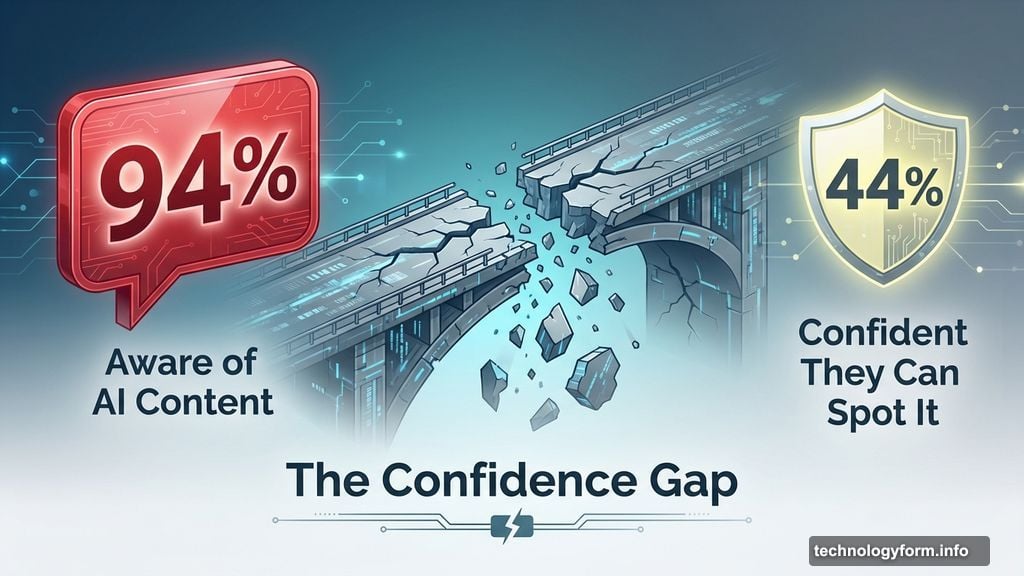
A new CNET survey found that 94% of US social media users believe they regularly encounter AI-created or AI-altered content. Yet only 44% feel confident they can actually distinguish real photos and videos from AI-generated ones. That’s a massive gap between awareness and ability, and it’s getting wider as AI tools keep improving.
The survey, conducted by YouGov in early February 2026, polled 2,443 US adults who use social media. What it found paints a pretty unsettling picture of where we are right now.
The Confidence Gap Nobody Wants to Talk About
Think about that number for a second. Nearly everyone online suspects they’re seeing AI content. But fewer than half feel equipped to catch it.
That’s not really surprising when you consider what modern AI tools can do. OpenAI’s Sora video generator and Google’s image models now produce hyperrealistic media that can fool even trained eyes. Chatbots generate fluent, convincing text that reads just like something a real person wrote.
The old visual tells are mostly gone too. Remember when AI images always gave people six fingers? Or when video continuity errors were a reliable red flag? Newer models have quietly fixed those obvious mistakes. So the shortcuts we used to rely on simply don’t work the way they used to.
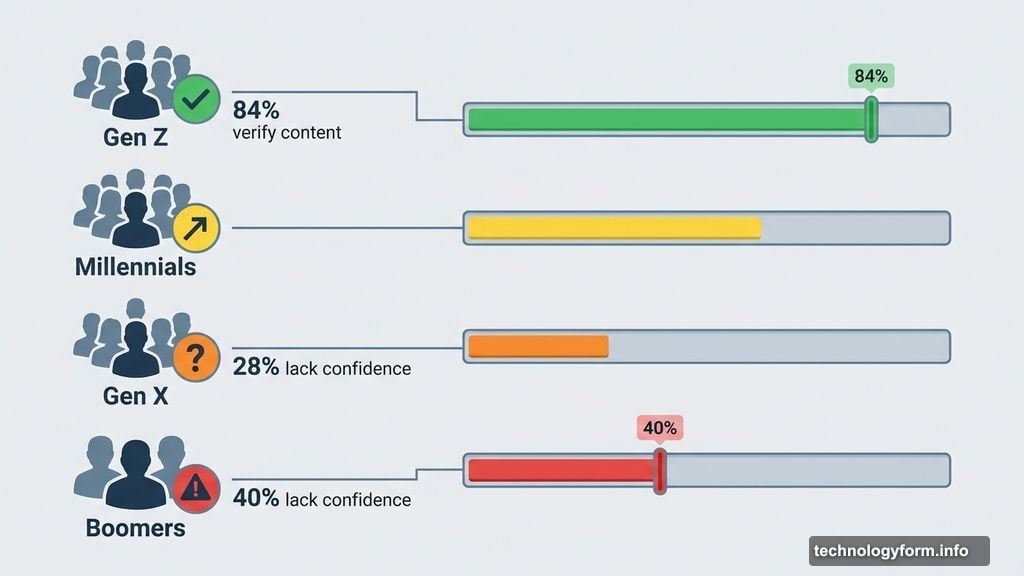
A full quarter of US adults (25%) say they’re flat-out not confident in their ability to spot AI content. Older generations feel this most acutely. Boomers clock in at 40% lacking confidence, while Gen X sits at 28%. That tracks. If you haven’t spent much time using or learning about these tools, spotting their output feels like guesswork.
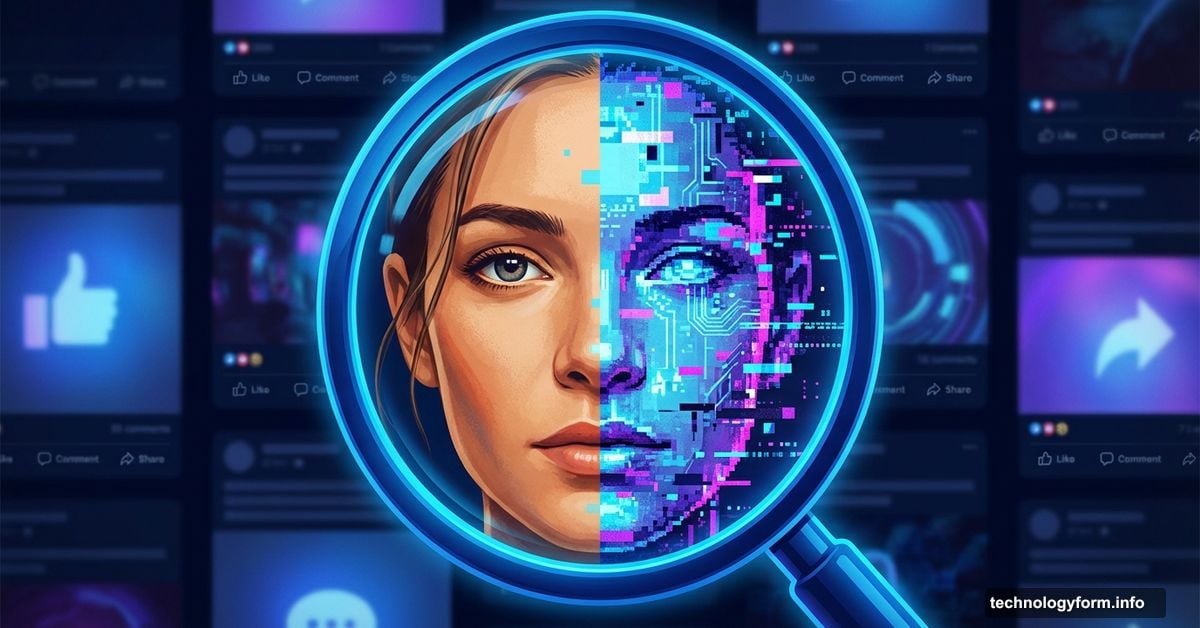
![A person scrolling through a social media feed on their phone, surrounded by a mix of real and AI-generated post thumbnails illustrating the challenge of spotting fake content online]
How People Try to Verify What They See
Despite the confusion, most people aren’t just passively accepting everything in their feeds. Nearly three in four US adults (72%) say they take some kind of action when something online looks suspicious.
Gen Z leads the pack here. A full 84% of that age group actively tries to verify content, the highest of any generation. Here’s what people actually do when they’re not sure something is real:
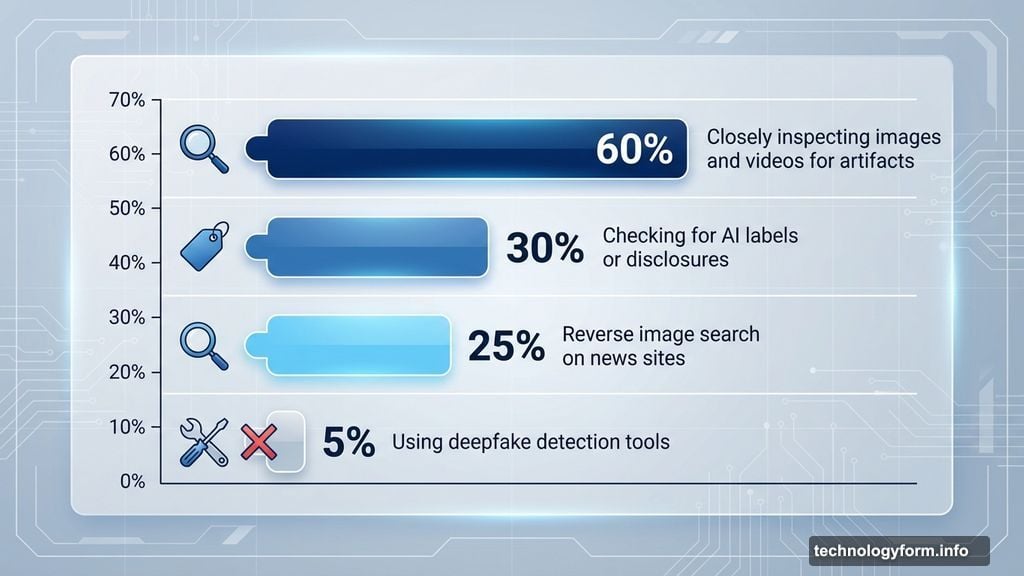
- Closely inspecting images and videos for visual cues or artifacts — 60% of adults do this
- Checking for labels or disclosures that flag AI involvement — 30% use this approach
- Searching for the content elsewhere, like through reverse image searches or news sites — 25% go this route
- Using a dedicated deepfake detection tool — only 5% have tried this
That last number is worth sitting with. Deepfake detection tools exist and they work reasonably well. But almost nobody uses them. There’s a real awareness problem there.
Meanwhile, 25% of US adults do absolutely nothing to verify content they see. That number jumps to 36% among Boomers and 29% among Gen X. Given how effectively AI is already being used for fraud and abuse online, that passive approach carries real risk.
AI-Generated Content Labels Are Failing Us
So what’s the fix? For 51% of US adults, the answer is simple: better labeling.
Right now, labeling is a mess. Platforms often rely on creators to self-disclose when they’ve used AI. Sometimes platforms apply labels automatically on the back end, but that process is inconsistent and error-prone. The result is a patchwork system that catches some AI content and misses plenty more.
Support for better labeling is strongest among Millennials (56%) and Gen Z (55%). Those are the generations most immersed in social media, which might explain why they feel the problem most personally.
Beyond labels, some platforms are experimenting with feed-level controls. Pinterest rolled out AI content filters last year. TikTok is still testing its own version. The idea is giving users direct control over how much AI content appears in their feeds, which is a sensible middle-ground approach.
Not everyone wants a middle ground, though. One in five respondents (21%) believe AI content should be banned from social media entirely, with no exceptions. That number rises to 25% among Gen Z. And 36% want AI content allowed but strictly regulated.
The context for those opinions? Only 11% of respondents find AI content genuinely useful, informative, or entertaining. And 28% say it provides little to no value. When the vast majority of people see AI content as noise at best and a threat at worst, it makes sense that they want stronger controls.
![Infographic showing CNET survey results with key statistics: 94% of social media users encounter AI content, 44% confident they can spot it, 51% want better AI labels, and 21% want a full ban]
What You Can Actually Do Right Now
While the platforms and policymakers work out systemic solutions, there are practical steps worth taking today.
Your first line of defense is healthy skepticism. If something looks too polished, too dramatic, or too perfectly aligned with what you already believe, that’s worth a pause. Trust that instinct.
Beyond gut feeling, checking the account that shared the content is often revealing. Mass AI slop producers tend to have feeds full of disconnected, bizarre posts with no consistent theme or audience. If the account follows nobody, has no followers you recognize, and posts spam links, that’s a strong signal something’s off.
For content you really want to verify, the Content Authenticity Initiative offers a detection tool that works across multiple file types. It’s one of the more reliable options available and a good starting point if you want to move beyond eyeballing things.
On the platform side, you can adjust your settings to limit AI content in your feeds. Meta offers options to mute AI in Instagram and Facebook. Pinterest has filtering tools. If you see AI slop that slipped through, marking it as “not interested” trains the algorithm to show you less of it.
And if you still occasionally get fooled? That’s okay. These tools are designed to deceive, and they’re getting better at it every month. There’s only so much any individual can do against a firehose of synthetic media. The goal right now is to stay informed, stay skeptical, and share what you know with people around you who might be more vulnerable.
A universal detection system doesn’t exist yet. Until it does, collective awareness is genuinely one of the best tools we have.