Nvidia Just Bet $4 Billion on Light to Power the Future of AI
Copper wires are hitting their limits. Nvidia sees the problem clearly and is throwing serious money at the solution.
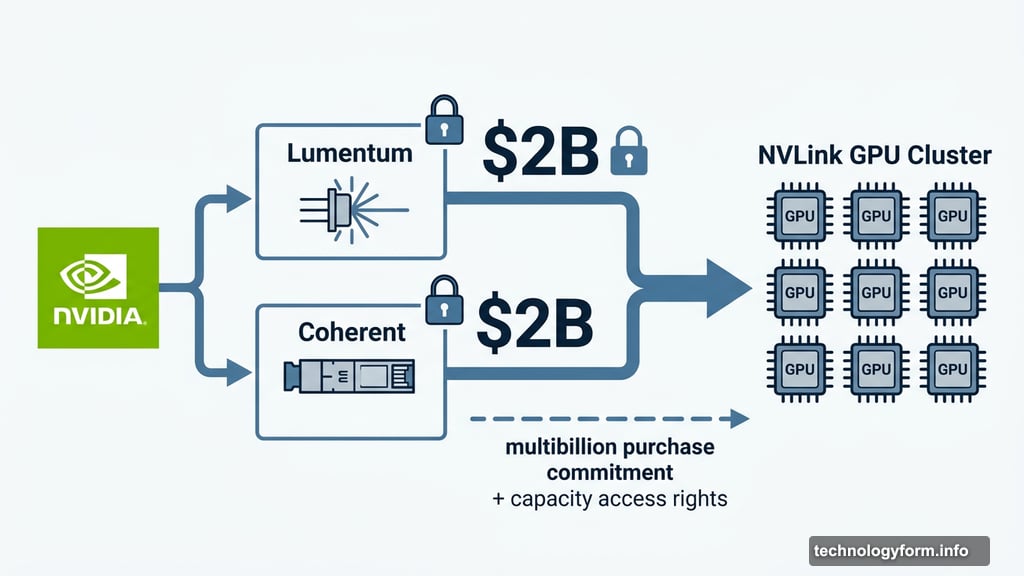
The chipmaker announced a pair of $2 billion investments — one in Lumentum, one in Coherent — two companies building photonics technology that could reshape how data moves inside AI data centers. That’s $4 billion total, and it signals exactly where Nvidia thinks the next big bottleneck lies.
What Photonics Does That Copper Can’t
Think about how a traditional data center moves information. Right now, most connections rely on copper cables — the same basic technology your home ethernet cable uses, just much more sophisticated.
Copper works fine up to a point. But modern AI workloads push data in massive volumes, constantly, across thousands of GPUs running in parallel. And copper starts to buckle under that pressure.
Optical fibers work differently. Instead of moving electrons through metal, they move light. That means significantly higher bandwidth, lower latency, and less power consumption per bit transferred. For an industry increasingly obsessed with both speed and energy efficiency, that combination is genuinely attractive.
Both Lumentum and Coherent specialize in exactly this space — optical transceivers, circuit switches, and laser components that move data at high speeds over long distances. Their products are designed for the scale that modern AI infrastructure demands.
The NVLink Connection
Nvidia didn’t stumble into networking by accident. Back in 2020, the company acquired Mellanox, a network hardware firm that helped Nvidia supercharge NVLink — its proprietary interconnect technology for passing data between GPUs.
That acquisition paid off. NVLink became a core part of what makes Nvidia’s GPU clusters so powerful. More data moving faster between chips means better AI training and inference performance.
The Lumentum and Coherent deals look like the next move in that same playbook. Secure the supply chain for the technology you need before everyone else realizes they need it too.
For Lumentum, the deal includes what Nvidia describes as a “multibillion purchase commitment and future capacity access rights for advanced laser components,” plus support for expanding research and manufacturing. Coherent’s arrangement is structured similarly, covering “advanced laser and optical networking products.”
Both deals are nonexclusive and span multiple years. Nvidia isn’t buying these companies outright — it’s locking in priority access while keeping its options open.
Why AI Agents Are Driving Bandwidth Demand
The timing matters here. Agentic AI — systems like Anthropic’s Claude and Microsoft’s Copilot that handle multiple complex tasks simultaneously — needs a lot more from data centers than older AI applications.
Earlier AI workloads were relatively predictable. You send in a request, you get a response. Agentic systems are different. They juggle multiple tasks at once, coordinate between different tools and models, and generate far more internal data traffic as a result.
That translates directly into higher bandwidth requirements. The pipes connecting GPUs inside data centers need to get bigger and faster. Photonic interconnects are one of the most promising ways to do that without the power costs spiraling out of control.
Nvidia Isn’t Alone in This Race
What’s interesting about this moment is that Nvidia is moving fast precisely because others see the same opportunity.
Last month, DARPA issued a call for research proposals focused on improving photonic computing for AI applications. That kind of government interest tends to signal that a technology is graduating from interesting research concept to genuine strategic priority.
Meanwhile, AMD — Nvidia’s closest rival in the AI chip market — acquired Enosemi, a silicon photonics startup, last year. AMD said the deal would “accelerate” its optics innovation across AI systems. So both of the dominant players in AI accelerators are betting on light-based data transfer as a critical part of the next generation of infrastructure.
The question isn’t whether photonics matters for AI data centers. At this point, that seems settled. The question is who controls the supply chain when demand really ramps up. Nvidia just spent $4 billion trying to make sure the answer includes them.
Securing photonics capacity now, before it becomes universally essential, looks a lot like the kind of forward thinking that helped Nvidia dominate the GPU market in the first place. Whether Lumentum and Coherent deliver at the scale Nvidia needs is the next thing to watch.