OpenAI Just Became a Private Equity Player. That’s Weird.
OpenAI doesn’t need more money. So why did it just cut a deal to partly own an investment firm?
The AI giant announced an ownership stake in Thrive Holdings last week. Here’s the twist: Thrive Holdings’ parent company, Thrive Capital, is one of OpenAI’s biggest investors. So OpenAI now owns part of a company whose parent company owns part of OpenAI.
Confused yet? You should be. This circular arrangement represents the latest example of AI industry dealmaking that looks increasingly like companies passing money around a very small table.
No Cash Changed Hands
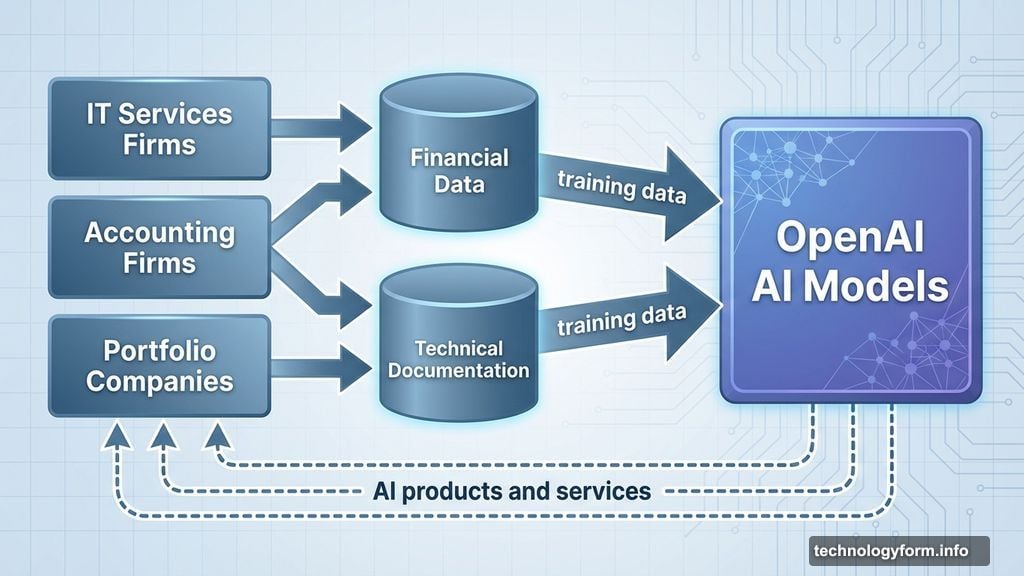
OpenAI didn’t pay for its stake in Thrive Holdings. Instead, the company will provide something potentially more valuable: employees, AI models, products, and services to companies in Thrive’s portfolio.
Plus, OpenAI might receive payouts from Thrive Holdings’ future returns, according to sources cited by The Financial Times. So OpenAI gets equity and potential profit without spending a dollar upfront.
That’s a clever structure. But it raises questions about what OpenAI is actually getting from this arrangement beyond another investor relationship wrapped in complex ownership ties.
The Real Prize: Training Data and Corporate Access
The partnership focuses on two sectors where Thrive Holdings is actively acquiring companies: IT services and accounting. OpenAI claims these “high-volume, rules-driven, workflow-heavy processes” are perfect for AI transformation.
Translation? OpenAI gets direct access to companies in Thrive’s portfolio. More importantly, it gets their data for training AI models.
That’s the actual payoff here. OpenAI can now tap into accounting firms’ financial data and IT services companies’ technical documentation. That’s exactly the kind of specialized, domain-specific information that current AI models lack.
Moreover, OpenAI potentially becomes the default AI provider for every company Thrive Holdings acquires. That’s guaranteed distribution without traditional sales cycles.
Private Equity Meets AI Hype
Joshua Kushner, CEO of Thrive Capital and Holdings, framed this as AI transforming industries “from the inside out.” He argues that domain experts using AI as a native tool will reshape their fields more effectively than external technology disruption.
That sounds reasonable. But it also conveniently positions Thrive to acquire traditional businesses, promise AI transformation, and use OpenAI’s technology to justify higher valuations.
Kushner’s connection to President-elect Trump through his brother Jared adds another layer. Trump and his administration officials like David Sacks are vocal AI boosters who stand to benefit from the industry’s growth.

So this deal sits at the intersection of AI hype, private equity acquisition strategies, and political connections. That’s a potent combination for generating returns, regardless of whether the AI transformation actually delivers.
A Template for More Deals
OpenAI COO Brad Lightcap suggested this Thrive deal is just the beginning. The company wants to work more broadly with private equity firms, using a similar model.
Sources close to Thrive Capital described OpenAI as the equity group’s “research arm.” That’s telling. OpenAI isn’t just building AI tools. It’s positioning itself as infrastructure for private equity’s next wave of acquisitions.
Here’s how this playbook likely works: Private equity firm buys traditional company. Promises AI transformation to justify purchase price. Brings in OpenAI to provide technology and expertise. Uses resulting “AI-powered” business to generate returns. Repeat.
Whether those AI transformations actually improve the acquired companies remains an open question. But the financial engineering works regardless.
Circular Deals Are Now Standard
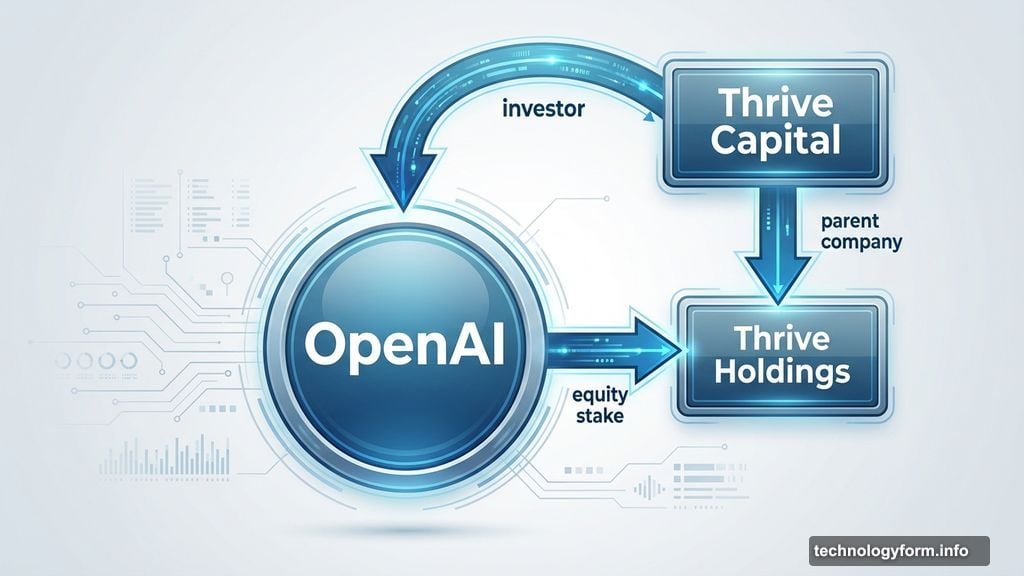
This arrangement exemplifies how the AI industry operates. A small group of companies and investors continuously exchange money, equity, and services in increasingly complex structures.
Microsoft invests billions in OpenAI while also competing with it. OpenAI now owns part of an investment firm owned by one of its investors. Anthropic took similar investments from Google while Amazon also backed the company.
These circular relationships make sense from each company’s perspective. But they create an ecosystem where the same capital flows between the same players, inflating valuations without necessarily generating real economic value outside the group.
It’s not exactly a bubble. But it’s not a healthy market structure either. When money moves in circles, it’s hard to tell who’s actually making progress versus who’s just shuffling chips around the table.
Training Data Remains the Bottleneck
The most concrete benefit for OpenAI is access to proprietary data from Thrive’s portfolio companies. Current AI models are trained primarily on publicly available internet data.
That approach hits limits quickly. Models need specialized knowledge from accounting firms, IT service providers, and other industries where the best information isn’t published online.
By partnering with private equity firms acquiring these companies, OpenAI gets direct access to that specialized data. It’s a shortcut around the training data bottleneck that’s slowing AI development.
Whether companies in Thrive’s portfolio agreed to have their proprietary data used for AI training is unclear. The announcement didn’t specify how data sharing would work or what protections exist for sensitive information.
That matters. Accounting firms handle confidential financial data. IT services companies manage proprietary technical documentation. Using that information to train commercial AI models raises obvious questions about privacy and competitive dynamics.
What This Means for OpenAI’s Direction
This deal signals OpenAI’s evolution from research lab to infrastructure provider for traditional industries. The company isn’t just building AI tools. It’s embedding itself directly into how other companies operate.
That’s potentially lucrative. It also represents a significant shift from OpenAI’s original mission of ensuring artificial general intelligence benefits humanity. Trading equity for access to corporate data is pure business strategy, not research.
Some people will say that’s necessary. AI research costs enormous amounts of money. Commercialization pays those bills. Fair point.
But the gap between “democratizing AI” and “becoming a private equity research arm” is worth noting. Especially when the deals get this circular and the relationships this interconnected.
OpenAI is playing a sophisticated financial game. Whether it leads to better AI or just better returns for a small group of investors remains to be seen.