Language Models Can’t Think. The Entire AI Bubble Ignores This Fact
Tech CEOs promise superintelligent AI by 2026. Nobel Prize-level reasoning. Cures for aging. Scientific breakthroughs beyond human capability.
The problem? Their entire industry rests on a fundamental misunderstanding of how human intelligence works. And cutting-edge neuroscience proves it.
Large Language Models Master Words, Not Thought
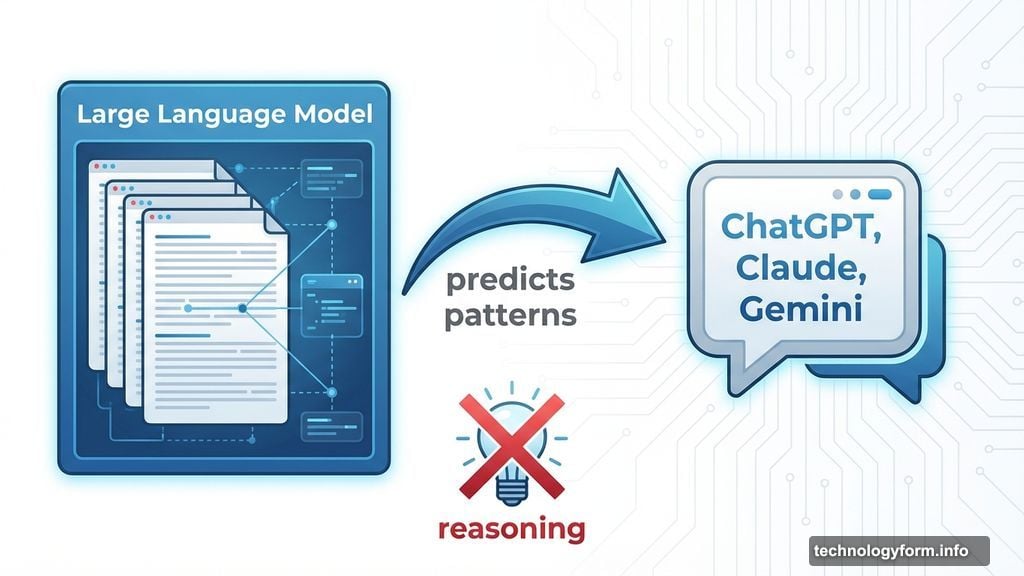
ChatGPT, Claude, Gemini, and Meta’s AI products share one core feature. They’re all large language models. They gather massive amounts of text data, find correlations between words, and predict what comes next.
That’s it. No matter how complex the architecture seems, these systems model language patterns. Nothing more.
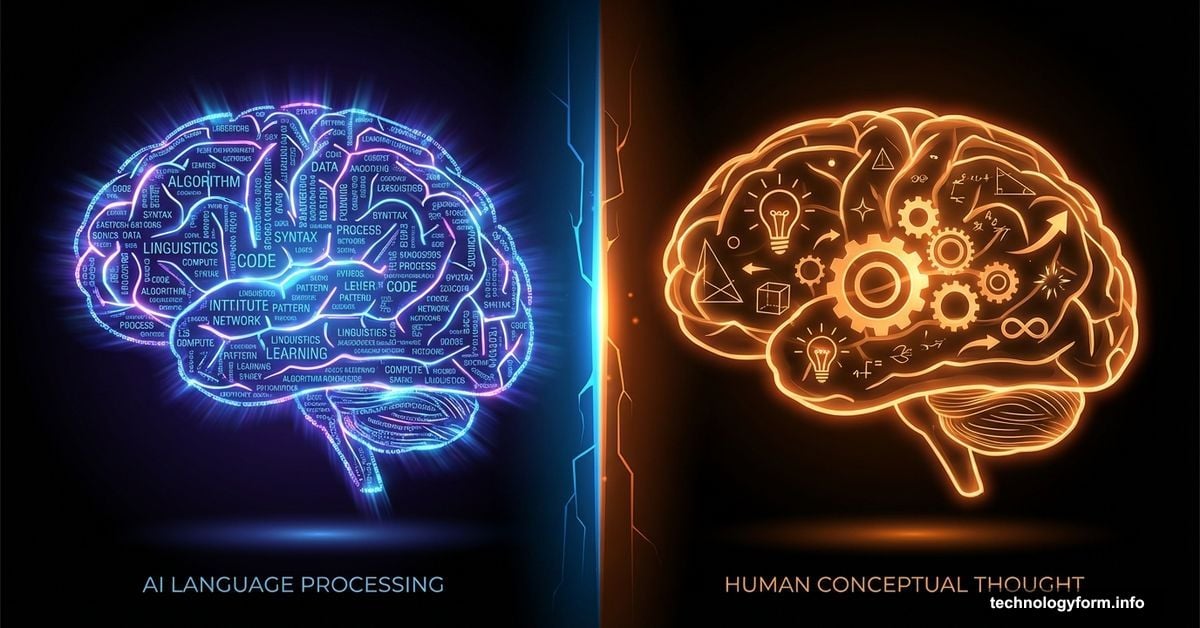
But here’s what the AI industry desperately wants you to ignore. Human intelligence operates largely independent of language. Our ability to reason, form abstractions, and solve problems exists separately from our linguistic capabilities.
So scaling language models bigger and bigger won’t magically create human-level intelligence. It’s like building a faster calculator and expecting it to write poetry.
Neuroscience Shows Language Doesn’t Equal Intelligence
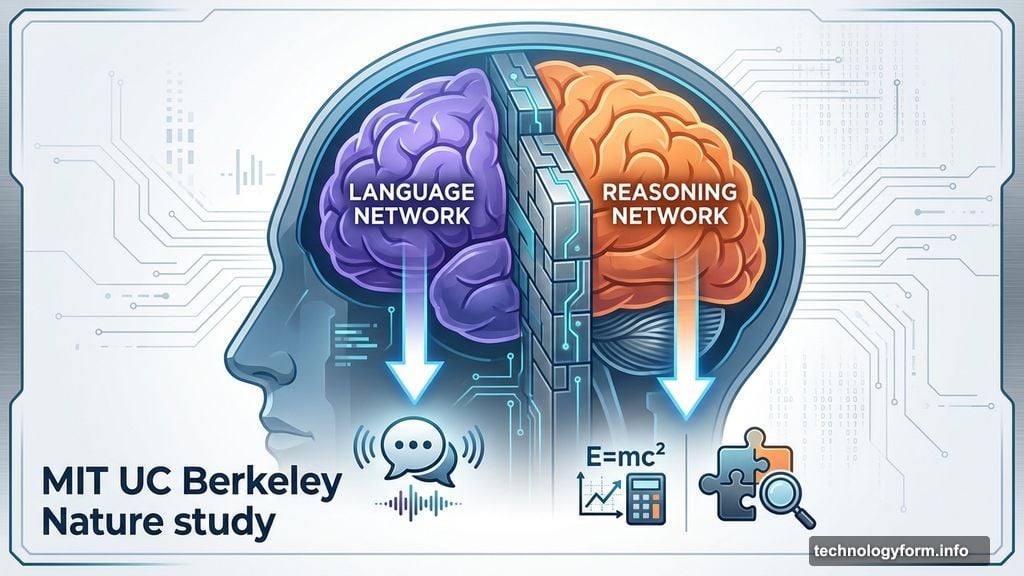
MIT and UC Berkeley researchers published devastating findings last year in Nature. Their article, “Language is primarily a tool for communication rather than thought,” demolishes the idea that language creates intelligence.
The evidence comes from two sources that can’t be argued with.
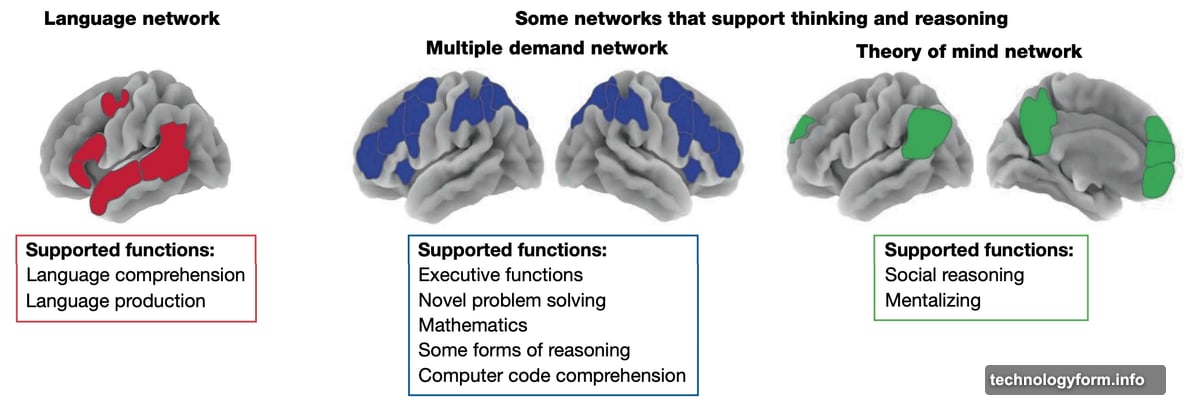
First, brain imaging shows different neural networks activate for language versus reasoning. When you solve math problems or understand someone’s motivations, completely different brain regions light up. Language and cognition use separate systems.
Second, people who lose language ability don’t lose intelligence. Stroke victims with severe language impairment can still solve complex problems, follow instructions, understand cause and effect, and engage in logical reasoning.
If language created intelligence, taking it away would destroy thinking. Yet that doesn’t happen.
Babies Think Before They Talk
Watch any infant for five minutes. You’ll see a tiny human exploring objects, imitating faces, and learning from experience. Studies show children conduct experiments, analyze patterns, and build theories about the physical world before learning words.
Babies obviously think. They just can’t communicate those thoughts yet through language.
This reveals what language actually does. It’s a tool for sharing ideas, not generating them. Across all human languages, common features make them easy to learn, efficient to use, and robust against noise.
Language helps us transmit knowledge across generations with extraordinary precision. But our cognition exists independent of linguistic ability.
AI Industry Admits LLMs Won’t Get There
Even prominent AI researchers now recognize language models alone can’t achieve general intelligence.
Yann LeCun, a Turing Award winner, just left Meta to build “world models” instead. These systems would understand physical reality, maintain persistent memory, reason, and plan complex actions. All things LLMs can’t do.
Meanwhile, a group including another Turing winner, former Google CEO Eric Schmidt, and noted AI skeptic Gary Marcus defined AGI as matching “the cognitive versatility and proficiency of a well-educated adult.” They explicitly reject treating intelligence as a single capacity.
Instead, they propose a complex architecture spanning multiple distinct abilities. Knowledge, reasoning, metacognition, and perception all contribute to intelligence.
But here’s the problem with their framework. We still don’t know how to weight these capabilities, which ones matter most, or how to aggregate them into general intelligence. Plus, even if we replicate how humans currently think, that doesn’t guarantee AI can make creative leaps forward.
The Dead Metaphor Machine
Scientific breakthroughs don’t come from processing existing data better. They come from paradigm shifts when thinkers become dissatisfied with current frameworks.
Einstein conceived relativity before any evidence confirmed it. He created a new metaphor for understanding space and time. That metaphor then became our common understanding of truth.
AI systems trained on existing data can predict what humans would say or do. They can remix knowledge in interesting ways. But they have no reason to become dissatisfied with their training data.
So they’ll forever remain trapped in existing vocabularies. Dead metaphor machines that recycle what humans already discovered.
Meanwhile, actual humans thinking, reasoning, and using language to share those thoughts will keep transforming our understanding of reality.
Why This Matters Beyond Hype
The AI industry’s $500 billion bet assumes scaling solves everything. Build bigger data centers. Train on more text. Add more computing power. Eventually, magic happens.
Except neuroscience shows that’s fundamentally wrong. Language models, no matter how sophisticated, can’t spontaneously generate the kind of intelligence humans possess.
This doesn’t mean AI lacks value. These systems excel at specific tasks like translation, summarization, and content generation. But they won’t cure aging, double human lifespans, or achieve “escape velocity” from death.
Those claims aren’t just premature. They reflect a profound misunderstanding of intelligence itself.
The emperor has no clothes. And the scientific community just published the measurements to prove it.