Amnezia’s New VPN Protocol Outwits Government Censors
Internet censorship is getting worse. In dozens of countries, governments aren’t just blocking specific websites anymore — they’re shutting down entire chunks of the web by default.
That’s the problem Amnezia set out to solve. And on Tuesday, the Cyprus-based VPN company released AmneziaWG 2.0, a new protocol designed to stay one step ahead of the tech governments use to catch and block VPN users.
The Arms Race Between VPN Users and Censors
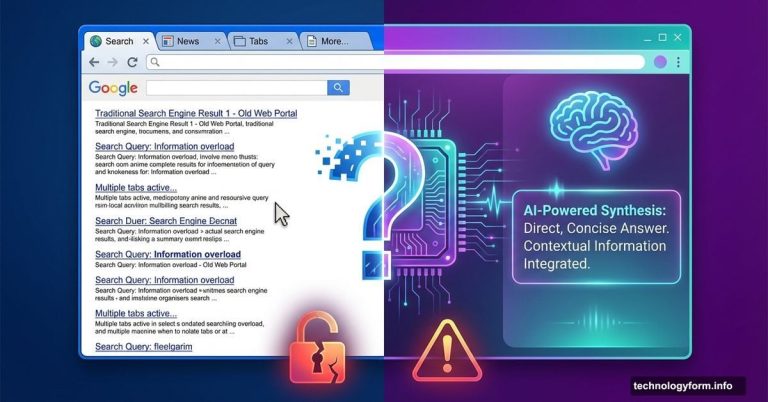
Here’s the challenge. Governments with sophisticated internet controls use a technique called deep packet inspection (DPI) to sniff out VPN traffic. Even if your data is encrypted, DPI can identify the VPN protocol itself — essentially spotting the disguise even if it can’t read the contents.
Once a government’s system flags your connection as VPN traffic, it can block you. So the encryption that protects your privacy isn’t enough on its own. The VPN protocol needs to be invisible too.
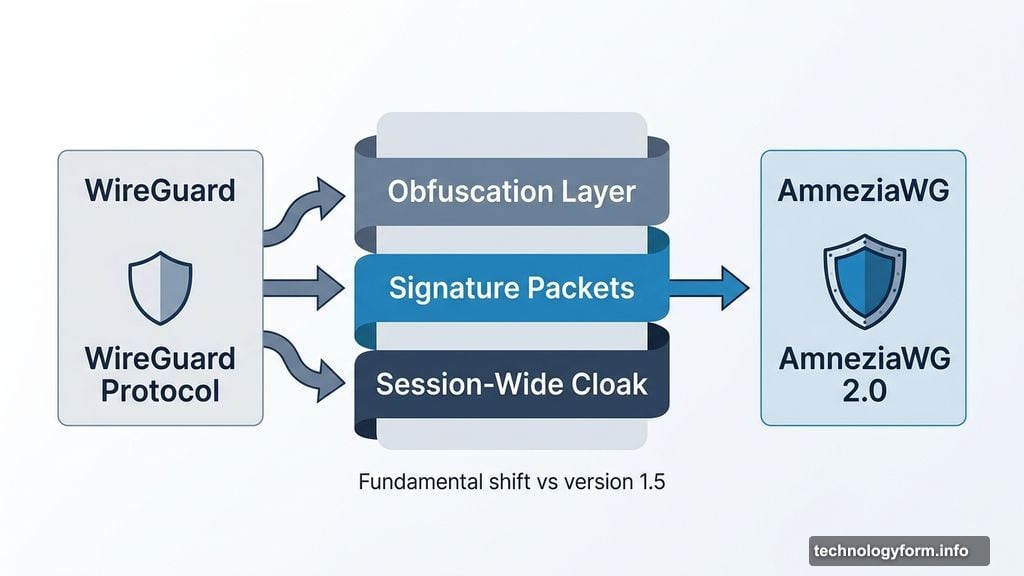
That’s where obfuscation comes in. AmneziaWG, Amnezia’s original protocol, was already built on WireGuard — a fast and widely used VPN protocol — but with extra layers of disguise added on top. Version 2.0 takes that concept much further.
How AmneziaWG 2.0 Fools Deep Packet Inspection
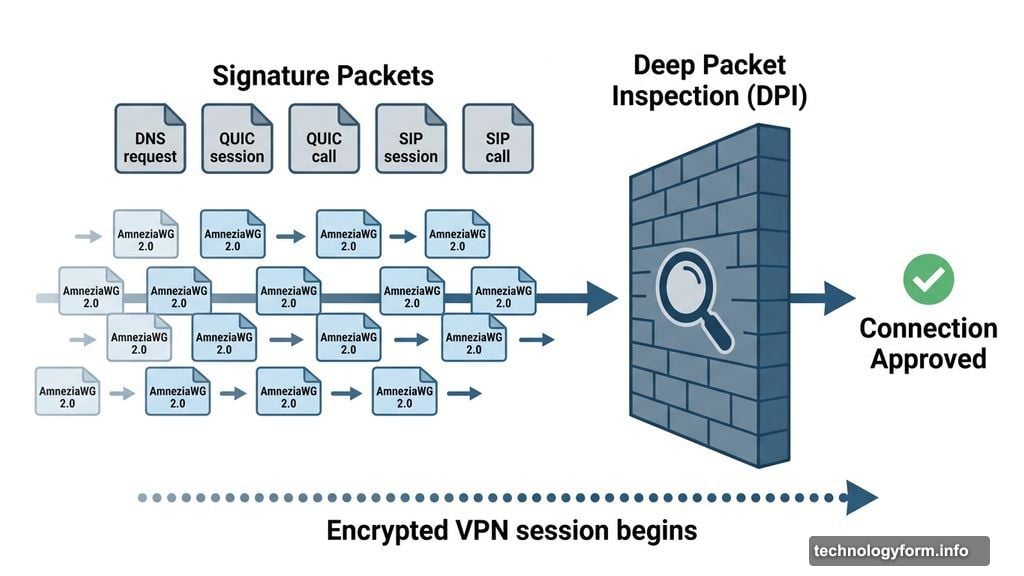
The big innovation in version 2.0 is what Amnezia calls signature packets. Before your real VPN connection starts, the protocol sends up to five packets that look exactly like a normal network request. Think of it like a decoy. The DPI system sees what appears to be legitimate traffic, approves the connection, and then the actual encrypted VPN session begins underneath.
Mazay Banzaev, founder of Amnezia, described the goal to CNET as making VPN traffic “indistinguishable from legitimate UDP-based traffic: a DNS request, a QUIC session or a SIP call.” In plain terms, your VPN session looks like completely ordinary internet activity.
Plus, Amnezia says this cloak holds throughout your entire session — not just at the initial connection. That matters because some DPI systems can identify VPN traffic mid-session even if they miss it at the start.
Banzaev called this a “fundamental shift” in how the protocol works, compared to version 1.5.
Why This Matters Right Now
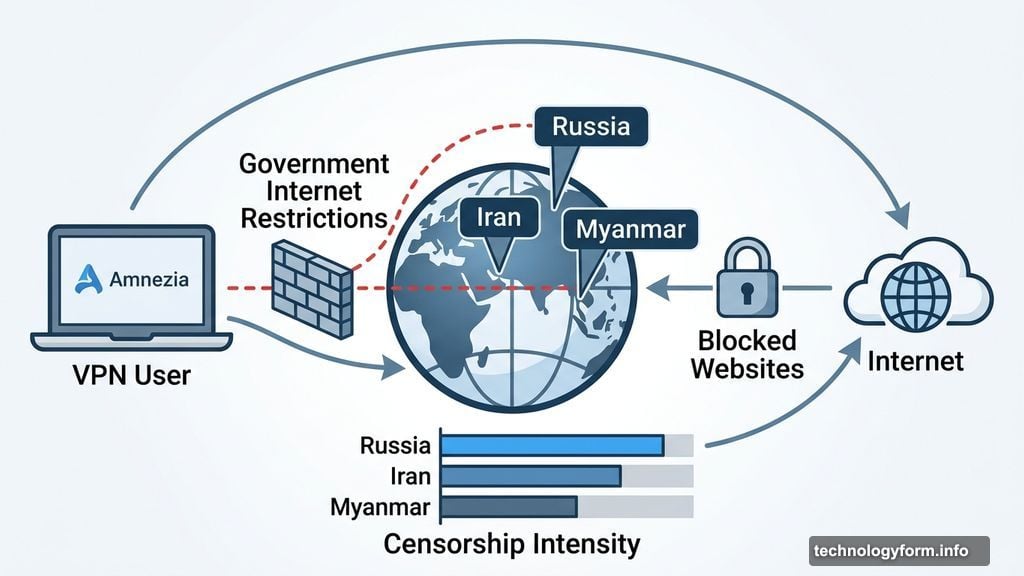
The timing of this release isn’t random. Amnezia has large customer bases in Russia, Iran and Myanmar — three countries where internet restrictions have intensified dramatically.
Banzaev put it bluntly. “Countries with censorship invest heavily in technologies to prevent users from visiting the open web,” he told CNET. “Today, they no longer just block specific websites in Iran — instead, they try to restrict much of the internet by default, leaving access only to those who are explicitly allowed.”
Iran’s situation is particularly severe. Many Iranians now face near-total internet blackouts. Russia, meanwhile, has been tightening its grip on internet access throughout its ongoing conflict with Ukraine.
The scale of the problem is striking. According to Surfshark’s Internet Shutdown Tracker, 17 Asian countries and nine African countries currently restrict social media and messaging apps. Russia and Belarus rank as the two most heavily censored nations in Europe. Amnezia is also seeing growing interest in Africa, where those restrictions are expanding.
For context, Amnezia has 2.5 million monthly active users on its free service. The company’s profile got a significant boost in March when WhatsApp recommended Amnezia and Mullvad as two VPNs worth using to access the Meta-owned messaging app in restricted regions.
What a VPN Actually Does
If you’re new to VPNs, here’s the short version. VPN stands for virtual private network. When you connect through one, it creates an encrypted tunnel between your device and a remote server. Your internet service provider can’t see what sites you visit or what apps you use. Your real IP address — the unique number that identifies your device online — gets masked by the VPN server’s address instead.
That’s useful for streaming sports or shows that aren’t available in your country. But in places with heavy censorship, it’s far more than a convenience. It’s often the only way to reach the open internet at all.
Amnezia’s Free and Paid Options
Amnezia offers several ways to use its service. The free version covers the basics. For users who want more, there’s a premium plan at $28 for six months or $48 for a year. The company also offers a self-hosted option and a business version for organizations.
Being open-source matters here too. Anyone can inspect the code, which builds trust in a space where transparency is everything.
Banzaev said the goal is simply to “stay ahead of the curve” against government censors. With each protocol update, it becomes a little harder for those censors to win.
For millions of people in Iran, Russia, Myanmar and elsewhere, that margin is everything.