AI’s Real Future? It’s Not in the Cloud
Chatbots are nice. But they miss the point entirely.
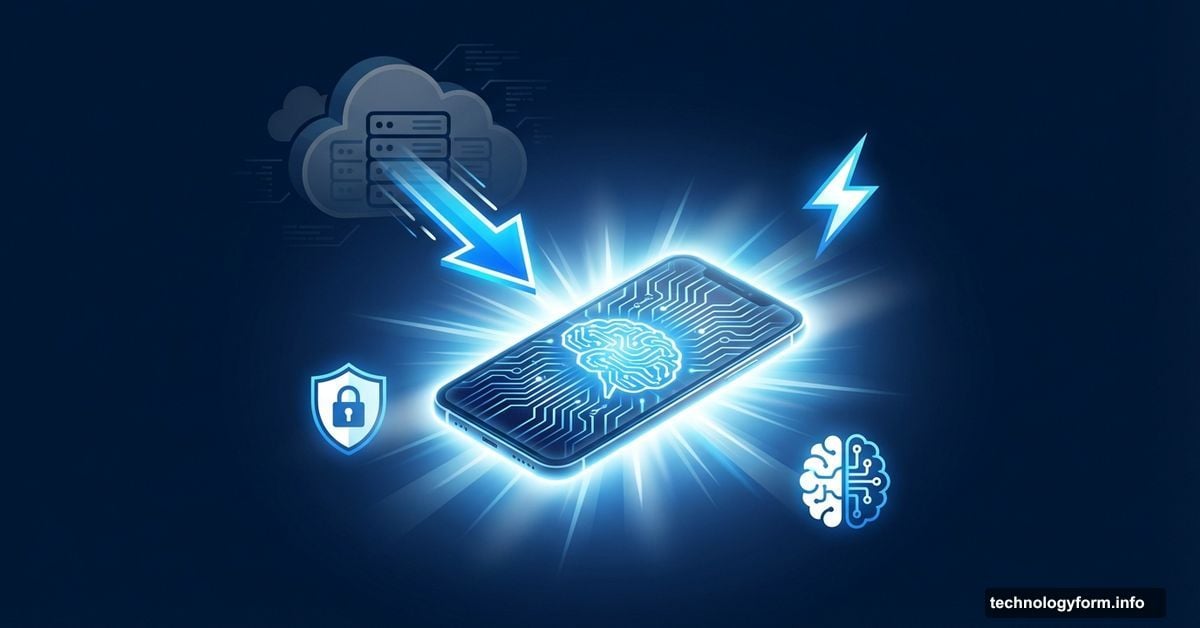
The most powerful AI applications need speed and privacy that distant data centers simply can’t deliver. So the industry is quietly shifting processing power from massive server farms to the device in your pocket.
This isn’t about generating cat stories or answering trivia questions. It’s about AI that actually changes how you interact with the world around you.
Cloud AI Has a Speed Problem
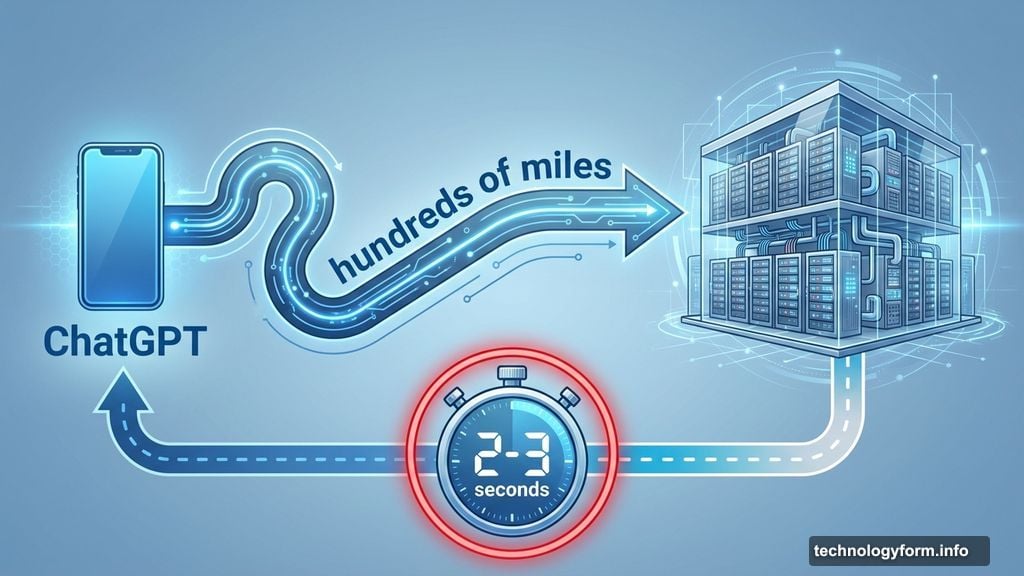
Every time you ask Claude or ChatGPT a question, your request travels hundreds of miles to a data center. The model processes it. Then the response travels back.
That round trip takes seconds. For casual queries, it’s fine. But what if AI needs to alert you about an obstacle in your path? Or translate a conversation in real time? Or recognize someone you’re talking to?
Seconds become unacceptable. You need milliseconds.
“The ideal model for true edge computing is the human brain,” says Mahadev Satyanarayanan, a Carnegie Mellon computer science professor. Your brain doesn’t offload vision or speech to any external processor. Everything happens instantly, right there.
Nature took a billion years to evolve that system. Tech companies are trying to replicate it in five.
Your Phone Already Runs AI
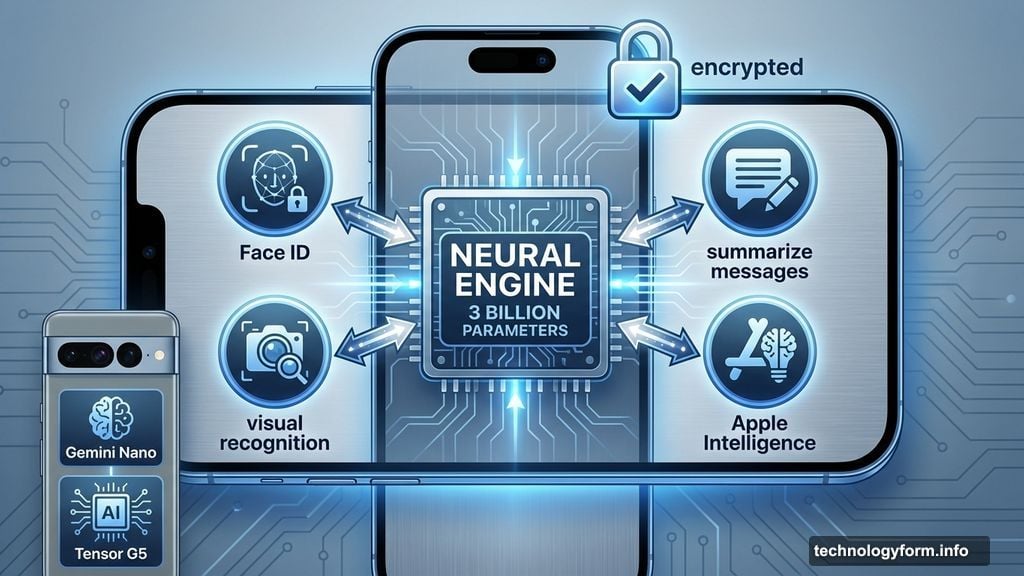
Remember unlocking your iPhone with Face ID back in 2017? That was on-device AI. Not generative like ChatGPT, but fundamental artificial intelligence running entirely on your phone’s neural engine.
Today’s iPhones use a far more capable on-device model. It has about 3 billion parameters—the individual calculations that power AI predictions. That’s tiny compared to models like Deepseek-R1, which has 671 billion parameters.
But it doesn’t need to be huge. It’s built for specific tasks like summarizing messages or recognizing visual information in screenshots. These features can’t afford to rely on cloud connections.
Apple calls this system Apple Intelligence. Meanwhile, Google’s Pixel phones run Gemini Nano on custom Tensor G5 chips. That powers features like Magic Cue, which surfaces relevant information from your emails and messages exactly when you need it—no manual searching required.
So on-device AI is already working behind the scenes. Most people just don’t realize it yet.
Privacy Actually Matters Here
Cloud-based AI sends your data flying through multiple servers. Each hop creates vulnerability.
On-device AI keeps everything on your encrypted phone or laptop. Your preferences, browsing history, location data—all the information AI needs to personalize your experience—stays entirely in your hands.
“What we’re pushing for is to make sure the user has access and is the sole owner of that data,” says Vinesh Sukumar, head of generative AI at Qualcomm.
But here’s the catch. Sometimes on-device models hit their limits. They need to offload complex tasks to cloud-based systems.
That’s where things get tricky. If not handled carefully, the handoff undermines the whole privacy advantage.
Apple’s solution is Private Cloud Compute. When offloading happens, it only uses Apple’s servers. Only the minimum necessary data gets sent. None of it is stored or made accessible to Apple afterward.
Other companies are taking similar approaches. The key is that you should explicitly grant permission before any data leaves your device. Without that control, on-device AI loses one of its biggest selling points.
Small Developers Can Actually Afford This
Charlie Chapman develops Dark Noise, a noise machine app. He built a feature that uses AI to create custom sound mixes by selecting and adjusting different sounds.
Because the AI runs on-device using Apple’s Foundation Models Framework, there’s zero ongoing cost. No cloud services to pay for. No compute charges that scale with users.
“If some influencer randomly posted about it and I got an incredible amount of free users, it doesn’t mean I’m going to suddenly go bankrupt,” Chapman says.
For big tech companies, the cost savings are even more dramatic. Building massive data centers to handle AI processing costs billions. Every major tech company is scrambling for cash and computer chips to fuel this expansion.
If devices can handle more tasks locally, that infrastructure burden shrinks significantly. “If you really want to drive scale, you do not want to push that burden of cost,” Sukumar says.
Plus, on-device models work without internet connections. That reliability matters more than most people realize.
Speed Determines What’s Actually Possible
Today’s on-device AI handles simple image classification well. It can identify objects in photos within 100 milliseconds—fast enough for practical use.
“Five years ago, we were nowhere able to get that kind of accuracy and speed,” Satyanarayanan says.
But four other critical tasks still require offloading to more powerful computers: object detection, instant segmentation (recognizing objects and their shapes), activity recognition, and object tracking.
These capabilities unlock entirely new applications. Imagine smart glasses that warn you about uneven pavement before you trip. Or devices that recognize who you’re talking to and surface context about your previous conversations with them.
These scenarios demand specialized AI models and specialized hardware. Neither exists yet at the right scale or price point.
“These are going to emerge,” Satyanarayanan says. “We can see them on the horizon, but they’re not here yet.”
The Hardware Race Is On
Developers are designing phones, laptops, tablets—and the chips inside them—specifically for on-device AI. But the real challenge comes with smaller devices.
Smartwatches. Glasses. Earbuds. These offer far less space than even the thinnest smartphone.
“The system challenges are very different,” Sukumar notes. “Can I do all of it on all devices?”
Right now, no. Not reliably. But hardware is improving fast.
The next five years will see specialized chips optimized for specific AI tasks. More efficient models that deliver better results with fewer parameters. Better integration between hardware and software.
This convergence will determine how seamless your experience becomes. Whether AI assistants feel like magical helpers or clunky tools that sometimes work.
Forget the Hype, Focus on the Use Case
Chatbots grab headlines. They’re flashy and accessible. Anyone can try ChatGPT right now.
But the real transformation happens in boring, practical applications. Navigation. Translation. Object recognition. Health monitoring. These require speed, privacy, and reliability that cloud models struggle to deliver.
On-device AI isn’t perfect yet. Models hit their limits. Hardware isn’t optimized. Developers face challenges building for different devices with different capabilities.
But the trajectory is clear. As hardware improves and models get more efficient, more processing will happen locally. The devices in your pocket and on your wrist will get smarter without sending your data around the world.
That’s where AI’s true potential lies. Not in distant data centers, but right here in your hands.