
Google’s Gemini AI Agents Are Heading to the Pentagon
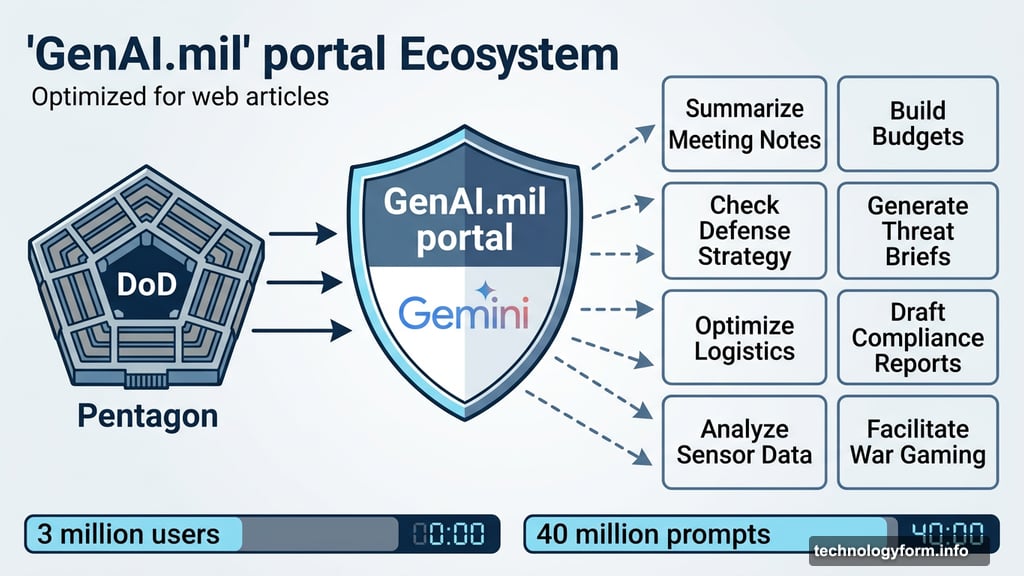
The U.S. military just got a major AI upgrade. Google is rolling out Gemini-powered AI agents to the Department of Defense, putting advanced AI tools in front of more than 3 million civilian and military employees.
That’s a massive deployment by any measure. And it comes at a time when the Pentagon is moving faster than ever to bring AI into everyday military operations.
Eight Pre-Built Agents, Millions of Users
The initial rollout focuses on unclassified networks. Eight ready-made agents will handle tasks like summarizing meeting notes, building budgets, and checking proposed actions against the national defense strategy.
Plus, Defense Department personnel won’t be locked into those eight options. Google VP Jim Kelly confirmed in a blog post that employees can build custom agents using plain, natural language. No coding required.

The groundwork was already there. Google’s AI chatbot has been available through the Pentagon’s GenAI.mil portal since December. In that short time, 1.2 million DoD employees used it for unclassified work, running 40 million unique prompts and uploading more than 4 million documents.
That’s a staggering amount of activity for a rollout that’s barely half a year old.
Classified Networks Could Come Next
Right now everything runs on unclassified systems. But talks are already underway to push Gemini agents into classified and top-secret environments, according to Emil Michael, the Under Secretary of Defense for Research and Engineering.
That would be a significant step. Moving AI into classified networks means handling sensitive information at a completely different level. Still, the Pentagon seems eager to push forward quickly.
One wrinkle worth noting: training hasn’t kept pace with adoption. Only 26,000 employees have completed AI training since December, compared to 1.2 million active users. However, future training sessions are reportedly fully booked, which suggests the demand is genuinely there.
Why Google? The Anthropic Fallout Explains a Lot
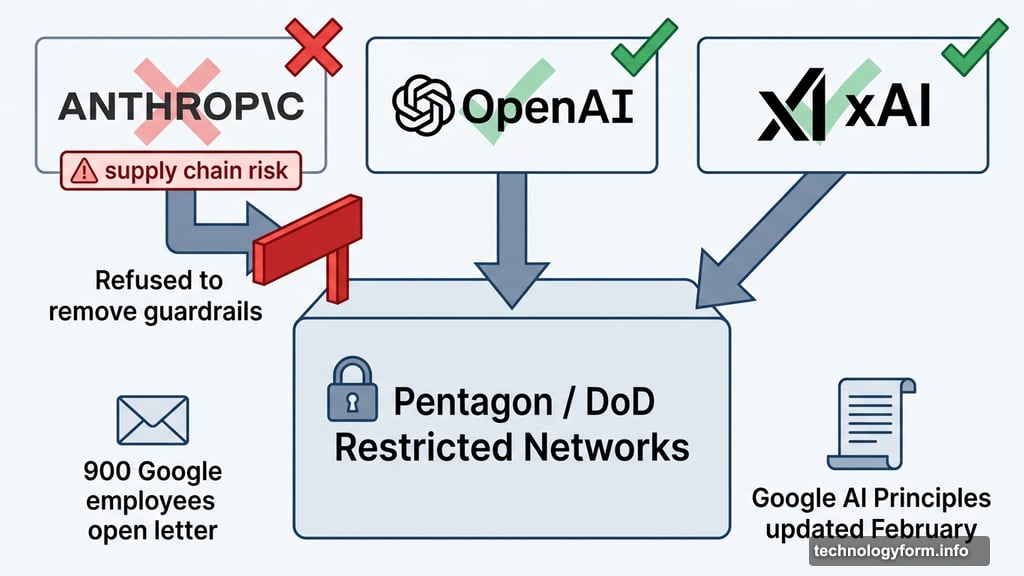
This expansion doesn’t happen in a vacuum. The Pentagon recently hit a wall with Anthropic, which refused to strip out guardrails against domestic surveillance and autonomous weapons from its AI systems. The DoD responded by classifying Anthropic as a “supply chain risk,” a designation Anthropic plans to fight in court.
So the Pentagon turned elsewhere. Since then, the DoD has struck deals with OpenAI and Elon Musk’s xAI for restricted networks. Google stepped into the space with Gemini.
The tension inside these AI companies is real. About 900 Google employees and 100 OpenAI employees signed an open letter urging their employers to hold firm on the same safety guardrails Anthropic refused to remove. Google, meanwhile, quietly updated its official AI Principles in early February, loosening restrictions around exactly these types of military uses.
Google’s History With Pentagon AI Work
This isn’t Google’s first run at military AI. Back in 2018, thousands of employees protested Project Maven, a program that used AI to analyze drone video feeds. The backlash was loud enough that Google declined to renew the contract.
But things have shifted. Google has since relaxed its internal restrictions on military work, and this Gemini deployment represents a far broader commitment than Project Maven ever was.
Whether that shift reflects a calculated business decision, a change in corporate values, or both probably depends on who you ask. What’s clear is that Google now sees the Defense Department as a long-term partner, not an ethical red line.
The combination of 3 million potential users, classified network ambitions, and a Pentagon hungry for AI tools makes this one of the largest AI government deployments in history. Where it goes next is worth watching closely.