Microsoft Built a Health AI That Knows Your Medical Records. Here’s What It Can’t Do.
Microsoft wants to change how you interact with your own health data. But the company is being surprisingly clear about where the line gets drawn.
The tech giant just announced Copilot Health, a dedicated health experience built into its existing Copilot chatbot. It pulls together your wearable data, medical records, and lab results, then wraps an AI around all of it to help you make sense of everything. Think of it less like a digital doctor and more like the world’s most organized, medically literate friend who actually read every page of your patient files.
Your Smartwatch Data Finally Gets Some Context
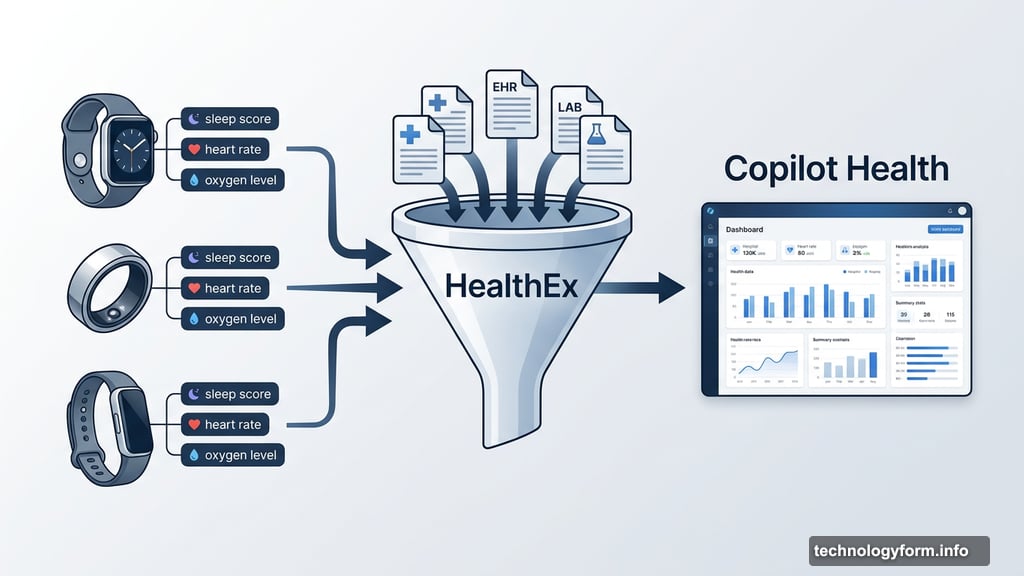
If you own an Apple Watch, Oura Ring, or similar device, you already know the data problem. You get thousands of data points, sleep scores, heart rate trends, step counts, and oxygen levels, but understanding what any of it means for your actual health is a different challenge entirely.
Copilot Health connects to that wearable data directly. It also lets you upload your electronic health records (EHRs) from multiple doctors, hospitals, and labs at once through a third-party program called HealthEx. So instead of juggling five different patient portals and a folder of PDF lab results, everything lives in one place with an AI trained to discuss it.
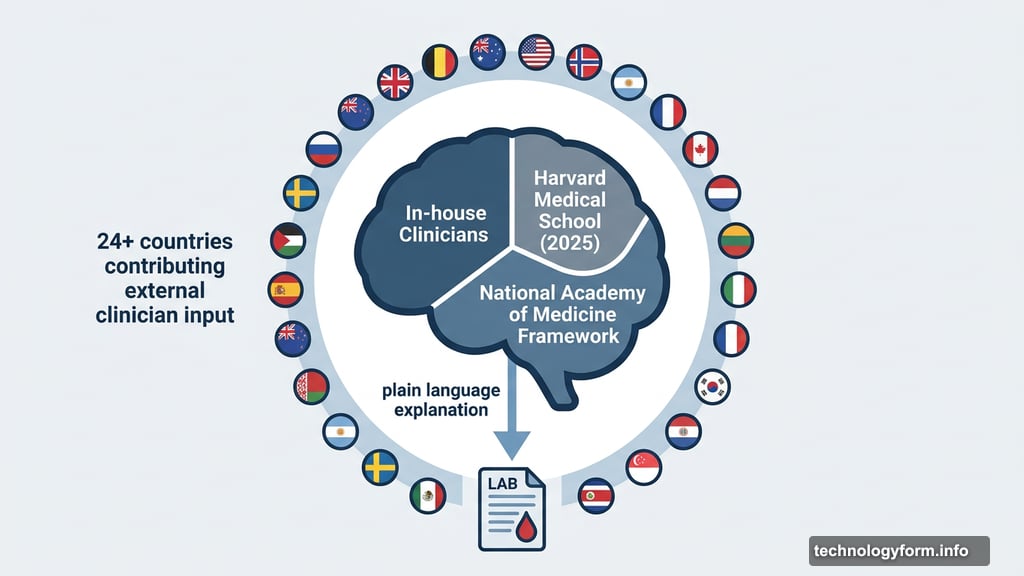
That “trained to discuss it” part matters more than it might seem. Microsoft didn’t just point a general-purpose chatbot at your medical records. The company fine-tuned Copilot Health with its own in-house clinicians and an external panel of hundreds of clinicians across more than 24 countries. It also uses the National Academy of Medicine’s framework for evaluating credible medical sources, plus licensed information from Harvard Medical School through a 2025 agreement.
So when you ask it to explain a specific blood marker from your recent lab work, it’s drawing on a meaningfully different knowledge base than what you’d get from a standard Copilot chat.
Copilot Health Won’t Replace Your Doctor
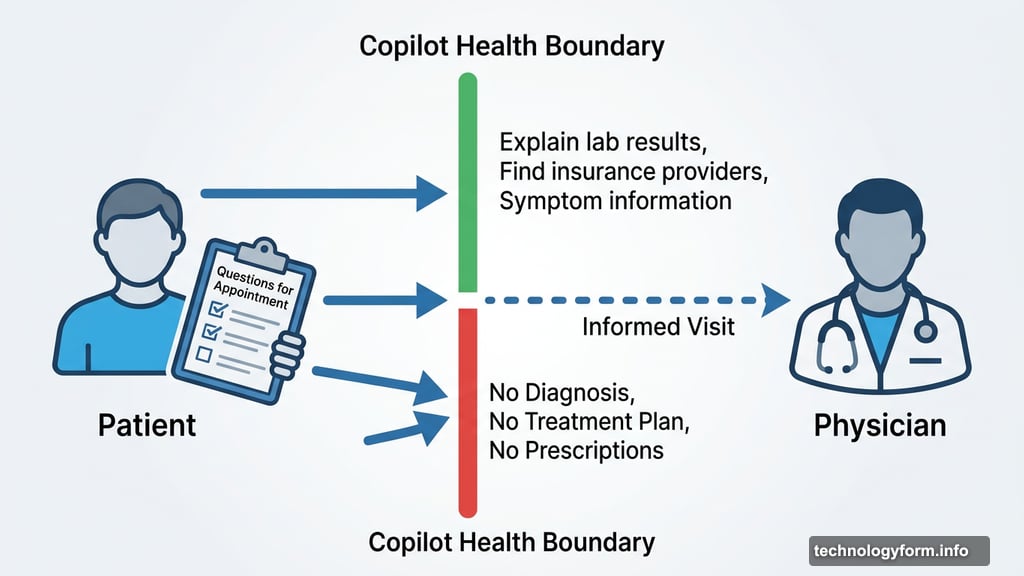
This is where Microsoft deserves credit for being genuinely direct. Dr. Dominic King, vice president of health at Microsoft AI and a former surgeon who led the team that built this product, put it plainly: “Copilot Health is not meant to give you a definitive diagnosis or a formal treatment plan, but it’s certainly here to support you in getting to the right answers.”
What Copilot Health can do is actually quite useful. It can help you build a list of questions before an appointment, explain what your lab results mean in plain language, walk you through what a new symptom might indicate, and even help you find a provider who accepts your insurance.
What it won’t do is diagnose you or prescribe anything. That boundary is intentional, and honestly, appropriate.
Mustafa Suleyman, Microsoft’s AI CEO, framed the ambition in bigger terms. “We are really on the cusp of building a true medical superintelligence,” he said. “One that can learn everything about you, all of your health conditions, from your wearable data, your electronic health records, and use that to provide support and insights and intelligence at your fingertips.”
That’s a bold claim. But the current version of Copilot Health is far more modest, and that restraint is probably the right call.
Your Health Data Stays Separate. But HIPAA Doesn’t Apply.
Privacy is the obvious concern whenever medical data meets AI. Microsoft took some meaningful steps here. Your health information lives in a completely separate tab from your regular Copilot conversations. It won’t surface in normal chats. And crucially, Microsoft says your data won’t be used to train its AI models.
Deleting your data is also refreshingly simple. Toggle off one setting and it’s gone. That sounds basic, but it’s genuinely rare in the AI space, and worth acknowledging.
However, there’s a significant caveat that Microsoft doesn’t hide but does require you to understand. Your medical information stored in Copilot Health is not protected under the Health Insurance Portability and Accountability Act, better known as HIPAA. That’s the federal law that governs how traditional healthcare providers and insurers must handle your health data. Consumer AI tools fall outside that protection, and Copilot Health is no exception.
That doesn’t mean your data is unprotected. But it does mean the protection works differently than what you’d expect from your doctor’s office or hospital.
AI in Healthcare Is Promising, But Messy
It’s worth zooming out for a moment. Copilot Health doesn’t arrive in a vacuum. AI is already spreading across healthcare, though in scattered, disconnected ways. Some doctors use AI scribing tools to capture appointment notes. Administrative teams rely on AI for insurance claims processing. Wearables increasingly offer AI-powered coaching built into their apps.
None of these tools are flawless. And none should be trusted for important decisions without human oversight. That’s not a knock on the technology specifically. It’s just the honest state of where AI reliability sits right now.
The argument Microsoft and other AI optimists make is that American healthcare’s tangled bureaucracy is exactly the kind of system where AI can make a real, measurable difference. Helping patients understand their own data, prepare better for appointments, and navigate a confusing system are genuinely valuable contributions.
But those gains don’t fix structural problems like access, cost, or the insurance system itself. AI in healthcare, at least in this early form, addresses symptoms rather than root causes. That’s useful. It’s just not the transformation the boldest voices in the space sometimes imply.
Who Can Access Copilot Health Right Now
Microsoft is taking a slow, measured approach to the rollout. Copilot Health is currently available to adults 18 and older in the United States, in English only. You can sign up for the waitlist now if you want early access.
The limited rollout makes sense given the stakes. Health AI done poorly isn’t just annoying, it can genuinely harm people. Starting narrow, refining the product, and expanding gradually is the kind of caution this space actually needs more of.
The real test won’t be the waitlist or the launch announcement. It’ll be whether people who use Copilot Health over several months feel more informed and more prepared when they actually sit down with their doctor. If it achieves that, Microsoft will have built something worth taking seriously.
Whether it gets to “medical superintelligence” is a conversation for another day.