Nashville Went Full AI. Nobody Asked Permission
Country music’s biggest secret isn’t on the charts. It’s happening right now in thousands of writing rooms across Nashville.
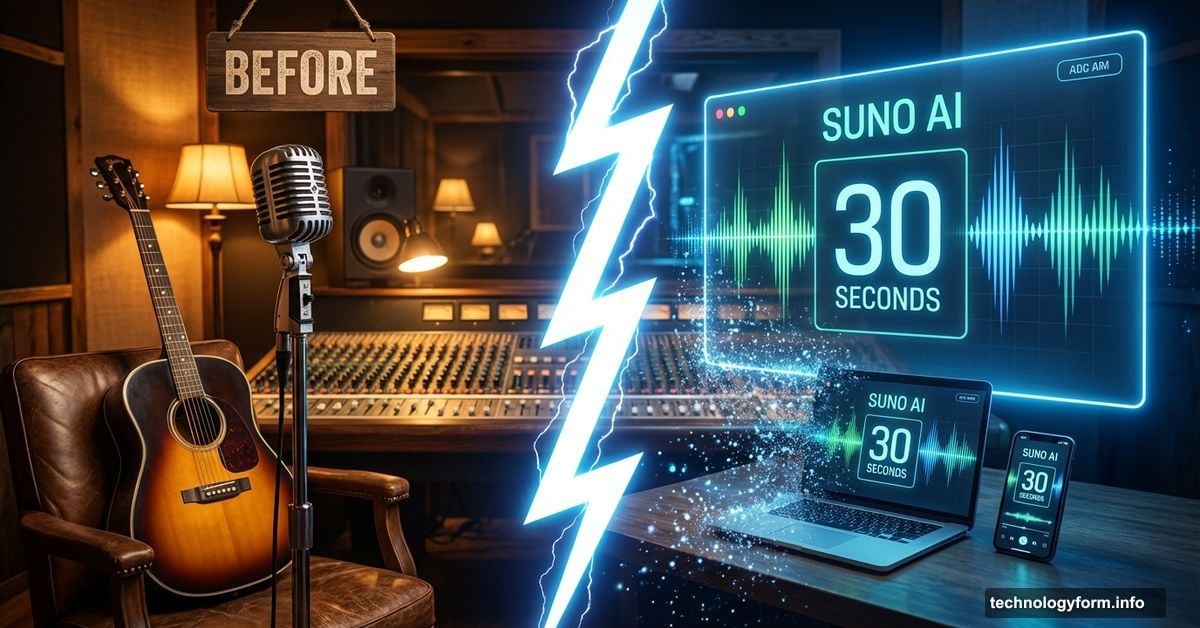
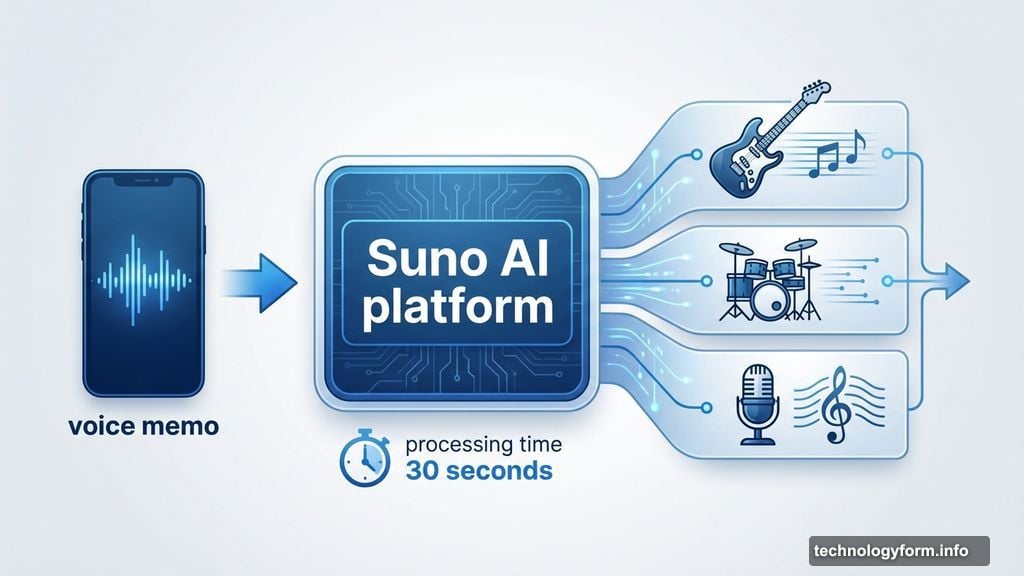
Songwriters are uploading voice memos into Suno, an AI music platform, and getting back fully produced demos in 30 seconds. Drums, guitars, harmonies—all generated instantly. No studio musicians. No $1,000 invoices.
This isn’t some distant future scenario. Multiple sources confirmed that even stars like Dustin Lynch and Jelly Roll receive song pitches with their voices artificially cloned into demos. Nashville became an AI town in just six months, and most people outside the industry had no idea.
The Old Way Just Died
Patrick Irwin moved to Nashville last year chasing the songwriter dream. He expected late nights in studios, collaborations with session players, the grind of Music City’s famous “10-year town” culture.
Instead, he watched a cowriter open Suno during a session. They uploaded a simple guitar-and-vocal recording. Thirty seconds later, two polished country demos appeared. Complete production. Multiple instruments. Backing vocals.
“You tell it the genre and it totally does the whole thing, it’s insane,” Irwin says. His voice carries equal parts wonder and dread.
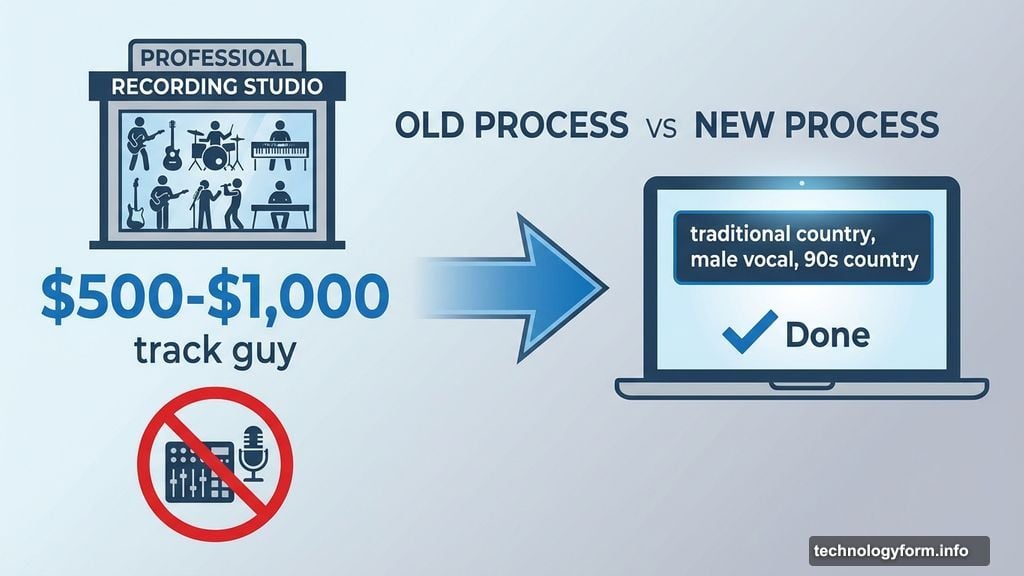
The traditional demo process used to work like this: Write a song, then pay a “track guy” $500 to $1,000 to produce a professional recording. That demo gets pitched to publishers, who pitch to labels, who maybe—just maybe—get it to an artist who cuts it.
Now? Upload a voice memo. Type a prompt like “traditional country, male vocal, folk country, storytelling, 90s country, rhythmic.” Wait 30 seconds. Done.
Everyone’s Using It Already
Songwriter Trannie Anderson has written hits for Lainey Wilson, Dan + Shay, and Reba McEntire. She doesn’t use AI herself, but she sees it everywhere now.
“From entry-level songwriters to the top dogs,” Anderson says. She’s not exaggerating.
Brad Belanger, Dustin Lynch’s manager, confirmed that his client receives AI-generated demos featuring Lynch’s own voice. “What a world we’re moving into,” Belanger added.
Jelly Roll’s camp wouldn’t comment. But multiple Nashville insiders confirmed similar practices across the industry.
The headlines focused on “Walk My Walk” by Breaking Rust, an AI country song that topped a Billboard chart recently. That story’s mostly smoke. The Country Digital Song Sales chart is a relic from pre-streaming days and easily manipulated.
The real revolution is invisible. It’s in the rooms where songs get written, where AI now handles what humans used to do.
Speed Changed Everything
Jon Sherwood, a songwriter signed to Universal Music Publishing Group, penned Bailey Zimmerman and Luke Combs’ hit “Backup Plan.” He still writes the traditional way, without AI.
But he notices the pace accelerating around him. Songs that used to take two years from writing session to radio airplay now move faster. Much faster.
Maggie Reaves, signed to publishers Dream 3 and Kobalt, recently got an assignment for a major artist with a one-day turnaround. She wrote the song and “threw it in Suno.” Her publisher’s response? “This is perfect. This is going straight to her.”
Reaves writes roughly 200 songs yearly. Demoing them all the old way would cost tens of thousands of dollars at $500 per demo. Now she pays $96 annually for Suno and generates unlimited attempts.
“I immediately saw this could replace that,” Reaves explains.
Publishers are even running old catalog songs through Suno to find fresh angles on forgotten tracks. The sound isn’t perfect—slightly lo-fi, over-compressed, with that telltale grainy AI vocal quality. But it’s good enough to play in a car, where road noise masks the imperfections.
These are demos, after all. Not finished records. At least not yet.
Creative Tool or Job Killer
Independent songwriter Kalen Nash calls Suno a “band in your pocket.” He uses it to turn diary entries into complete songs, to experiment with different arrangements instantly.
Jacob Durrett, a Big Loud producer, uses it to find alternative “vibes” for songs. Just a guitar scratch track is enough for Suno to output multiple full arrangements in any genre imaginable.
“I’m in awe of it sometimes, how good it can be,” Durrett says. For him, it’s about productivity more than creativity. He’s perfectly capable of trying a song in different styles—it just takes longer.
His hope? That AI handles tedious parts like renaming files and preparing mixes, freeing him to focus on actual creative work.
Music publisher Eric Olson calls Suno an “unlimited co-writer in the room.” He likes using it for samples without clearance headaches or worrying that someone else sampled the same part.
“If I can give Suno the last 20 percent and spend more time with my kids, that’s huge,” Olson says.
The Farm Team Is Disappearing
Ian Fitchuk produced Kacey Musgraves’ Grammy-winning album Golden Hour. He’s steering clear of Suno entirely.
His concern? The demo musicians making six figures playing on pre-production recordings. That entire ecosystem is evaporating.
“There used to be a whole world where musicians were making six figures only playing demo scale,” Fitchuk explains.
Trannie Anderson calls AI “the final nail in the coffin” for the demo studio system. If that farm team of session players disappears, where will the next generation of touring musicians and producers come from?
The industry might face a serious talent crisis in five to ten years. Nobody’s planning for that future yet.
Legal Mess Nobody Solved
Copyright law doesn’t protect AI-generated work. So what happens when Suno outputs a melody that an artist uses on a final recording? Who owns it?
“If Suno spits out a lead line an artist uses, what’s the protocol?” Reaves asks. Nobody knows. The rules don’t exist yet.
Then there’s the training data problem. Suno learned from existing music—including songs written by Anderson, Reaves, and countless others. None of them got compensated for their work being used to train the AI.
“AI learns from my songs, my friends’ songs … We aren’t being compensated,” Anderson says.
Durrett has another concern: the AI sometimes outputs vocals that sound exactly like his friends. Real people. Real voices. Cloned without permission.
“I hate when that happens,” Durrett admits. According to him, it happens frequently.
Two Years From Now
Despite the concerns, Suno just secured $250 million in funding. The company generates $200 million in annual revenue. Adoption is accelerating across Nashville.
Wait two years and you’ll hear Suno-assisted songs all over country radio. That’s not speculation. That’s the reality multiple insiders described.
The question isn’t whether AI-generated music will reach mainstream country audiences. The question is what those songs will sound like. Whether they’ll carry the soul and humanity that makes great country music resonate.
Anderson hears something missing already. “Humanity and a soul,” she says. “The Holy Spirit doesn’t live in AI.”
Nashville built its reputation over 200 years on collaboration between talented humans—writers, musicians, producers, all working together to create something bigger than themselves. That ecosystem is being replaced by prompts and algorithms.
The city didn’t vote on this change. Labels and publishers won’t comment publicly. But the transformation happened anyway, quietly, in rooms where songs get written and dreams either come true or die.
Irwin moved to Nashville expecting to join that storied tradition. Instead, he watched it disappear in real time. Thirty seconds at a time.