Nvidia Just Made AI Video Run on Your Laptop. Studios Will Care
Most AI video tools need cloud servers to work. Your laptop simply lacks the horsepower to generate clips without melting down.
That just changed. Lightricks unveiled a new AI video model at CES 2026 that runs entirely on Nvidia-powered devices. No cloud required. Plus, it’s open-weight, meaning developers can peek under the hood and modify the model for their needs.
For creators worried about data privacy and studios protecting intellectual property, this matters more than better prompts or longer clips.
Why On-Device Video Generation Is Rare
Generating AI video eats computational power like nothing else. A single 5-second clip demands more processing than thousands of image generations.
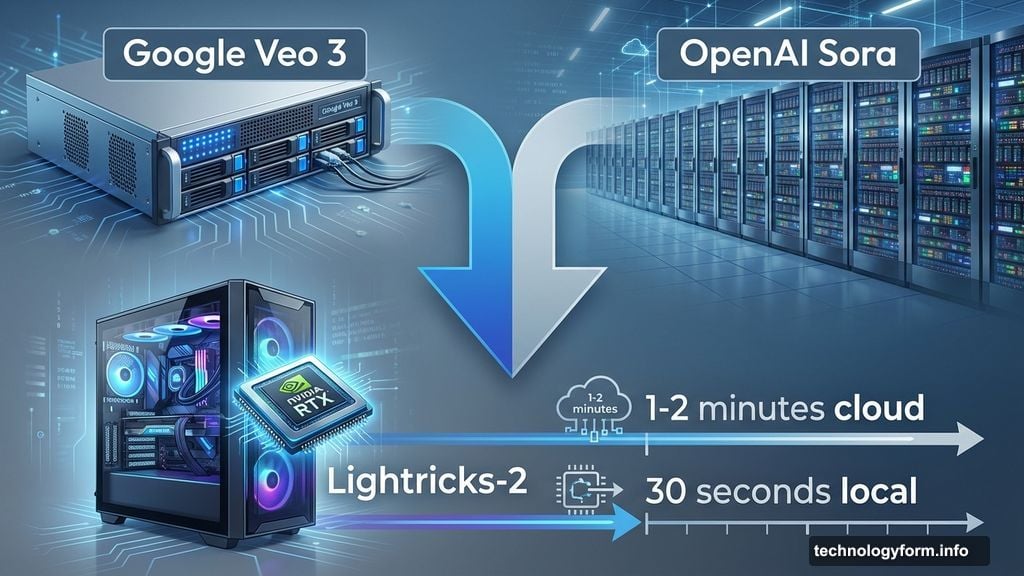
So most video models offload the work to massive data centers. Google’s Veo 3 and OpenAI’s Sora run on server farms packed with specialized chips. Your prompt gets sent to the cloud, processed on their hardware, then sent back to you.
This works fine for casual users. But it creates problems for professionals. Every prompt you send shares data with the company running the model. That data might train future versions of their AI. For entertainment studios or corporate creators, that’s a dealbreaker.
Besides, cloud processing adds latency. The typical AI video prompt takes 1-2 minutes to generate. Half that time is just network overhead – uploading your request, downloading the result, waiting in the queue.
Lightricks-2 Changes the Math
Lightricks built their second-generation model specifically to run on Nvidia RTX chips. Those are the graphics cards already powering gaming PCs and professional workstations.

The specs look competitive with cloud-based rivals. The model generates clips up to 20 seconds long at 50 frames per second. That’s on the longer end of current AI video capabilities. It also outputs in 4K resolution with native audio built in.
More importantly, everything happens locally. Your prompts never leave your machine. The model processes entirely on your GPU. Results appear faster because there’s no network bottleneck.
Moreover, the model is open-weight and available now on HuggingFace and ComfyUI. Developers can download it, inspect the architecture, and fine-tune it for specific use cases. That’s unusual for video models, which typically stay locked behind proprietary APIs.
What Open-Weight Actually Means
“Open-weight” sits between fully closed and truly open-source AI models. It’s not as transparent as open-source, which requires disclosing training data, code, and everything else. But it reveals far more than closed models.
Think of AI model weights like ingredients in a recipe. A closed model is like a restaurant that won’t even tell you what’s in the dish. An open-weight model lists all the ingredients but not the exact measurements. A truly open-source model gives you the complete recipe with instructions.
So developers can see how Lightricks-2 was constructed. They can understand which techniques it uses for motion consistency, temporal coherence, and detail preservation. Then they can modify those components for their specific needs.
In fact, studios could fine-tune the model on their own footage styles without sharing that proprietary data with Lightricks. The training happens entirely in-house using the open weights as a foundation.
Why Studios Will Pay Attention
Entertainment studios have been cautious about generative AI. Many see potential for concept art, storyboarding, and pre-visualization. But they’re terrified of IP leakage.
Cloud-based video models create legal headaches. When you send a prompt, you’re uploading data to someone else’s servers. The model might learn from your prompts. Worse, other users might accidentally generate content similar to your unreleased projects.
On-device processing eliminates that risk. Your data never leaves your network. The model can’t leak what it never sees. For studios developing billion-dollar franchises, that security matters more than any feature improvement.
Plus, on-device models scale differently than cloud services. Cloud pricing grows with usage – more clips mean higher bills. Local processing has upfront hardware costs but minimal variable expenses. Generate 10 clips or 10,000, the cost stays flat.
That pricing structure favors high-volume professional use over casual experimentation. Which explains why Lightricks positioned this model for “professional creators and big studios” rather than hobbyists.
The Nvidia Advantage
This model only works because of Nvidia’s RTX architecture. Specifically, the tensor cores designed for AI workloads.
Standard graphics cards can technically run AI models. But they’re painfully slow without specialized AI acceleration hardware. Nvidia’s RTX chips include dedicated tensor cores that handle the matrix math required for AI at dramatically higher speeds.
So Lightricks optimized their model to leverage those tensor cores efficiently. The result runs fast enough for practical use – not just technically possible but actually usable.
However, you’ll still need high-end hardware. Lower-end RTX cards might struggle with 4K output or longer clips. The model scales with available GPU memory and compute power.
Nvidia showcased this at CES alongside other AI announcements. They’re clearly positioning RTX as the platform for local AI workloads. Not just for gaming but for professional creative applications.
What’s Missing From the Announcement
Lightricks didn’t share concrete performance numbers. How fast does this actually generate video compared to cloud alternatives? What’s the quality-versus-speed tradeoff?
They also didn’t specify minimum hardware requirements. Which RTX cards work? Do you need top-tier 4090s or will mid-range 4070s suffice?
And there’s no pricing information yet. Is this a one-time purchase? Subscription? Free for non-commercial use? The business model matters almost as much as the technical capabilities.
Still, the core promise is clear. High-quality AI video generation without cloud dependencies. That’s been the industry unicorn since video models launched.
Where This Goes Next
On-device AI video is early days. Lightricks-2 is a proof of concept more than a finished product. But it proves the concept works.
Expect competitors to follow. Adobe, Runway, and others have strong incentives to offer local processing options. Studios will demand it. Regulatory pressure around data privacy will accelerate adoption.
However, cloud models won’t disappear. They’ll stay relevant for users without high-end hardware or for use cases that don’t require data privacy. The industry will split into cloud-based consumer tools and on-device professional options.
For creators, this means more control and better security. But also higher upfront costs and new technical requirements. You’ll need to actually understand your hardware rather than just paying for cloud credits.
That tradeoff will appeal to serious professionals. Hobbyists will probably stick with cloud services. Which is exactly what Lightricks intended.