OpenAI Just Launched a Lightning-Fast Coding Tool Built on Custom Silicon
OpenAI dropped something interesting on Thursday. They released a stripped-down version of their coding assistant Codex, and it runs on dedicated hardware from Cerebras. This marks a shift in how the company thinks about AI infrastructure.
The new model, called GPT-5.3-Codex-Spark, isn’t trying to replace the full-fat Codex released earlier this month. Instead, it’s designed for speed. Real-time collaboration. Quick iterations. The kind of work where waiting three seconds for a response kills your flow.
But here’s what matters most. OpenAI powered this thing with Cerebras’ Wafer Scale Engine 3 chip. That’s not just a partnership on paper anymore. It’s actual hardware integration powering a real product.
Cerebras Chips Enter the Chat
Back in January, OpenAI announced a massive deal with Cerebras worth over $10 billion across multiple years. At the time, the company said it wanted to make AI respond faster. Now we’re seeing the first result of that partnership.
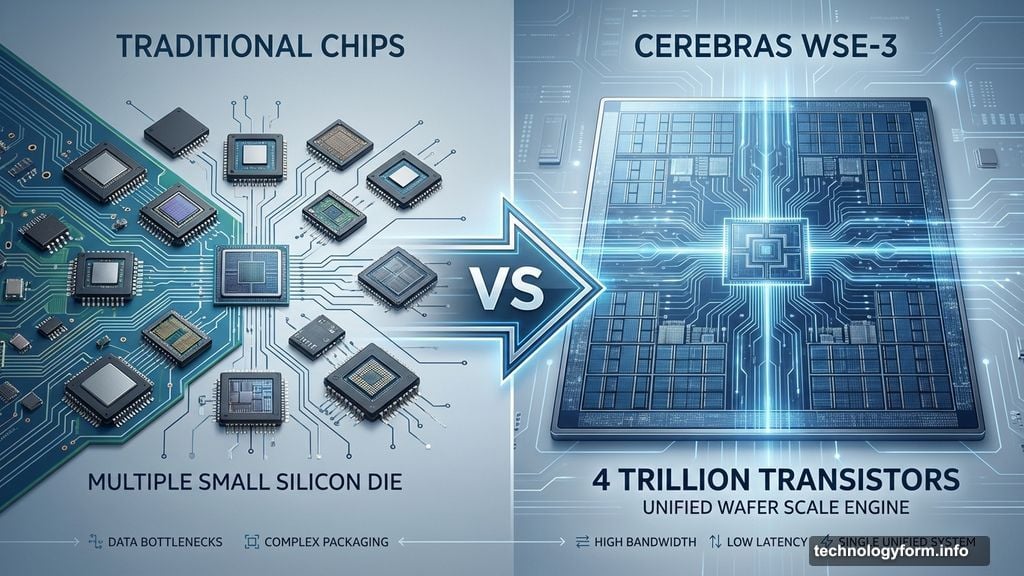
The WSE-3 chip packs 4 trillion transistors into a single wafer-scale design. That’s not a typo. Most chips use multiple smaller dies. Cerebras builds one massive processor that spans an entire silicon wafer.
Why does this architecture matter? Low latency. When you’re coding and need instant feedback, every millisecond counts. Traditional cloud infrastructure routes requests through multiple layers. Cerebras’ approach cuts that overhead dramatically.

OpenAI says this is just the “first milestone” in their Cerebras relationship. Translation: expect more specialized hardware backing different models soon.
Two Codex Models for Different Workflows
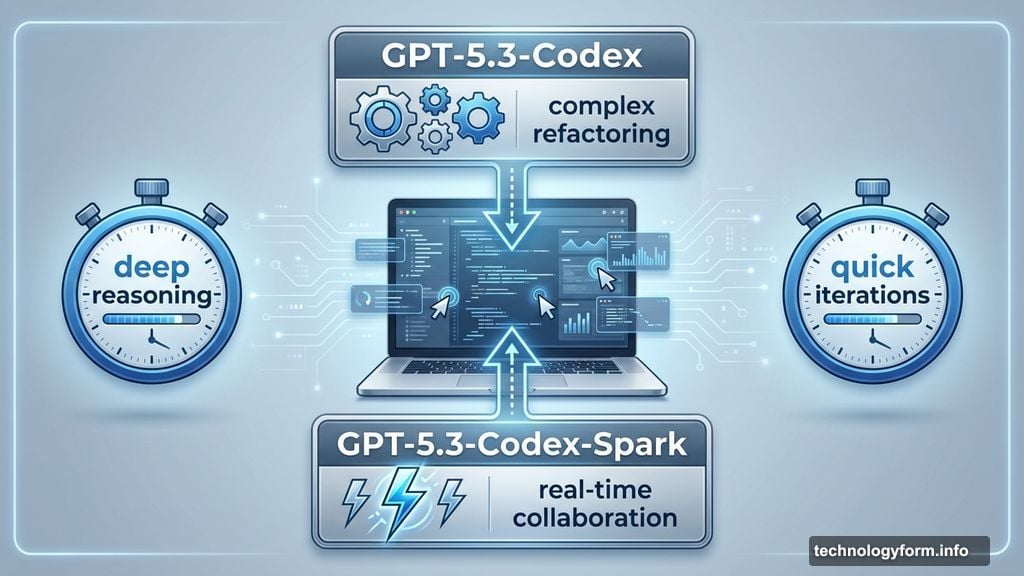
OpenAI now positions Codex as having two distinct modes. The original GPT-5.3-Codex handles complex, long-running tasks that need deeper reasoning. Think refactoring entire codebases or architecting new systems.
Spark, meanwhile, targets daily productivity. Quick prototypes. Real-time pair programming. Fixing bugs on the fly. It’s the difference between asking for a detailed architectural review and asking “why is this function throwing an error?”
Currently, Spark is in research preview for ChatGPT Pro users in the Codex app. CEO Sam Altman teased the launch earlier, saying it “sparks joy” for him. Subtle hint at the name? Probably.
The company emphasizes that Spark isn’t replacing the heavier model. Instead, users will switch between modes depending on what they need. Fast iteration or deep analysis. Not both simultaneously.
Cerebras Rides the AI Infrastructure Wave
Cerebras has been around since 2016, but the AI boom turned them into a major player. Last week alone, they raised $1 billion at a $23 billion valuation. They’re also eyeing an IPO soon.
Their success makes sense. As AI models grow, companies need faster hardware to run inference at scale. Traditional GPU clusters work, but they’re not optimized for the lowest possible latency.
Cerebras’ wafer-scale approach solves that problem. Instead of connecting thousands of smaller chips, everything runs on one massive processor. Data moves faster. Latency drops. For coding tools where speed determines usability, that matters enormously.
“What excites us most about GPT-5.3-Codex-Spark is partnering with OpenAI and the developer community to discover what fast inference makes possible,” said Sean Lie, Cerebras’ CTO. He’s talking about new interaction patterns that weren’t feasible before.
What Fast Inference Actually Enables
Here’s why this matters beyond just “faster is better.” When AI responds instantly, it changes how developers use it.
Slow AI tools feel like sending an email and waiting for a reply. You ask a question, context switch to something else, then come back when results arrive. That workflow breaks concentration.
Fast AI feels like pair programming with a human. You type. It responds immediately. You stay in flow state. The tool disappears into your workflow instead of disrupting it.
Plus, instant feedback enables new use cases. Real-time code review as you type. Immediate suggestions for test cases. Catching bugs the moment you introduce them. These patterns only work if latency stays under 100 milliseconds.
OpenAI clearly believes specialized hardware enables fundamentally different AI experiences. The Cerebras partnership signals they’re willing to invest heavily in infrastructure, not just model development.
The Bigger Infrastructure Picture
This launch reveals OpenAI’s broader strategy. They’re not just building better models. They’re building the entire stack from silicon to software.
Most AI companies rely on cloud providers like AWS or Google Cloud for compute. That works fine but limits optimization. You’re stuck with whatever hardware the cloud provider offers.
OpenAI is going deeper. Custom chips. Specialized inference pipelines. Dedicated hardware for specific model types. That requires massive capital but gives them control over the entire user experience.
The $10 billion Cerebras deal isn’t just about buying compute. It’s about ensuring they can deliver experiences competitors can’t match using standard cloud infrastructure.
Expect other AI companies to follow this path. As models mature, differentiation will come from infrastructure as much as algorithms. The companies that control their hardware stack will move faster than those depending on generic cloud services.
What This Means for Developers
If you’re using Codex Pro, you’ll get access to Spark soon. The research preview started today for paying subscribers.
Should you care? Depends on your workflow. If you’re doing complex architectural work, the original Codex probably works better. If you’re fixing bugs, writing small features, or prototyping quickly, Spark might become your default.
The key question is whether the speed difference is noticeable enough to change behavior. OpenAI clearly thinks it is. They wouldn’t dedicate custom hardware to this if marginal speed improvements were the only benefit.
We’ll see how developers respond. Fast inference matters, but so does accuracy. If Spark trades correctness for speed, it won’t stick. If it delivers both, it might redefine how developers expect AI tools to behave.