OpenAI Took the Pentagon Deal. Nobody Knows What Comes Next.
Sam Altman did not expect this kind of pushback.
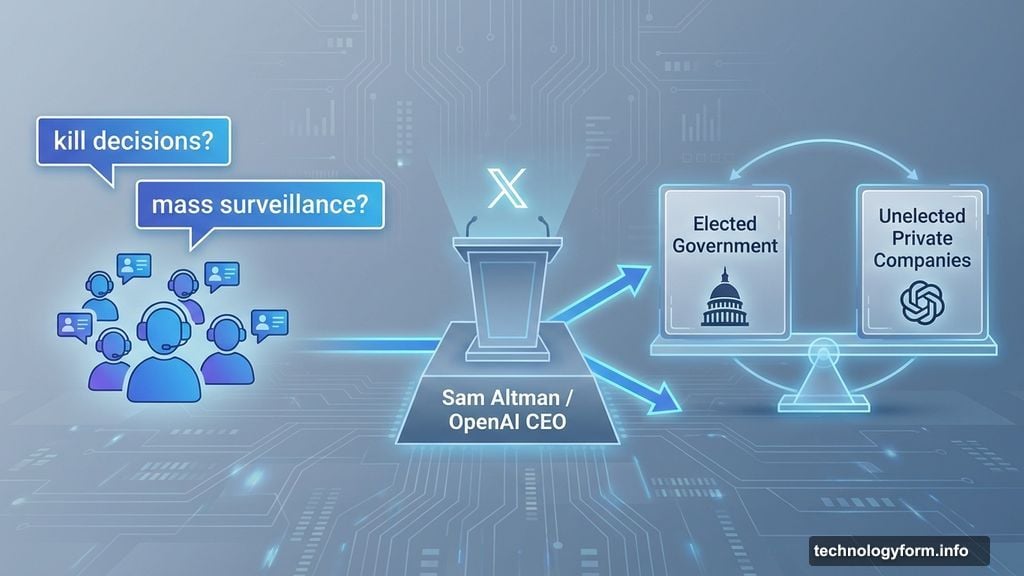
On Saturday night, the OpenAI CEO jumped onto X to answer questions about his company’s decision to pick up a Pentagon contract that Anthropic had just walked away from. He framed it as transparency. What he got instead was an hour of blowback about mass surveillance and automated weapons — the exact things Anthropic had refused to support in its negotiations with the Defense Department.
Altman’s response was essentially a shrug. It’s not my job to set national policy, he said. Elected leaders handle that. “I very deeply believe in the democratic process,” he wrote, “and that our elected leaders have the power, and that we all have to uphold the constitution.”
Then, about an hour later, he admitted something revealing. “There is more open debate than I thought there would be,” Altman said, “about whether we should prefer a democratically elected government or unelected private companies to have more power.”
That single admission tells you everything about where the AI industry stands right now.
OpenAI Wasn’t Ready for This Conversation
Altman’s defense-contractor logic is completely standard in the military world. Industry partners defer to civilian leadership. You build what the government asks. You don’t set policy.
But OpenAI isn’t Raytheon. It started as a consumer AI company with a mission about benefiting humanity. It built its brand on openness and safety. Now it’s signing Pentagon contracts and fielding questions about kill decisions from its own employees and users.
The company has been talking to Washington for years. When Altman testified before Congressional committees in 2023, he followed the classic Silicon Valley playbook — big promises about world-changing technology, some hand-wringing about risks, genuine enthusiasm for regulators. It worked perfectly. Investors got excited, lawmakers felt heard, nobody passed any serious rules.
That approach doesn’t work anymore. AI is too powerful and too capital-intensive to avoid real government entanglement. The problem, as this weekend made clear, is that neither OpenAI nor the government actually prepared for what serious entanglement looks like.
The Anthropic Situation Is Scarier Than It Looks
The bigger story here isn’t OpenAI’s awkward town hall. It’s what happened to Anthropic.
Anthropic was working under an existing contract, terms established years ago. When the administration demanded changes — specifically removing limits on surveillance and automated weapons — Anthropic declined. Defense Secretary Pete Hegseth responded by threatening to designate the company a supply-chain risk.
That designation sounds bureaucratic. It isn’t. As former Trump official Dean Ball explained over the weekend, it would effectively cut Anthropic off from hardware and hosting partners. The company would be destroyed, not by a court ruling or a market failure, but by an administrative designation.
Ball didn’t mince words about what this means for everyone watching. “Even if Secretary Hegseth backs down and narrows his extremely broad threat against Anthropic, great damage has been done,” he wrote. “Most corporations, political actors, and others will have to operate under the assumption that the logic of the tribe will now reign.”
That’s a chilling message. Anthropic didn’t break a law. It held firm on contract terms it had negotiated in good faith. The response was a threat to delete the company from the supply chain. No private company negotiates with another private company this way.
OpenAI Is Caught Between Two Fires
This situation puts OpenAI in an almost impossible position.
On one side, employees are already pushing back hard. They want some kind of red line — a commitment that the company won’t enable mass surveillance or autonomous weapons decisions. That pressure is real. ChatGPT uninstalls reportedly surged 295% after news of the DoD deal broke.
On the other side, right-wing media and Trump-aligned investors are watching closely. Anthropic has long been perceived in those circles as too cozy with the Biden administration. Now that the tables have turned, OpenAI needs to look like a reliable political ally. Any hesitation reads as disloyalty.
In the middle sits the Trump administration, which seems genuinely comfortable using government power to pressure private companies into compliance. For OpenAI, there are no neutral moves here. Signing the contract alienates one group. Refusing it, or adding conditions, risks the treatment Anthropic is currently receiving.
Defense Contracting Has Rules. AI Companies Don’t Know Them.
Here’s the irony nobody wants to say out loud. There’s a reason Pentagon contracts historically went to slow, bureaucratic giants like Lockheed Martin and Raytheon.
Those companies are frustrating. They’re expensive, slow, and not particularly innovative. But they built something valuable over decades: political durability. By operating as a de facto industrial wing of the defense establishment, they gained the cover to stay focused on the technology through multiple administrations. Republican or Democrat, the contracts kept coming. The rules stayed predictable.
Today’s AI companies move much faster. They’re far more capable, technically. But they have no equivalent political infrastructure. They haven’t built the relationships, the compliance frameworks, or the institutional patience that long-term government contracting requires.
So when political winds shift — and they always do — companies like OpenAI and Anthropic find themselves exposed in ways that Raytheon simply never would be. Palantir and Anduril built their entire identities around this problem, choosing political alignment as a deliberate strategy. Whether that strategy holds when administrations change remains an open question.
For companies that didn’t make that choice explicitly, the situation is genuinely uncharted. Nobody has a good playbook for being a tech startup and a piece of national security infrastructure at the same time.
The decisions being made right now — by OpenAI, by Anthropic, by the administration — will shape what that playbook eventually looks like. It’s just going to be painful for everyone involved while they figure it out.