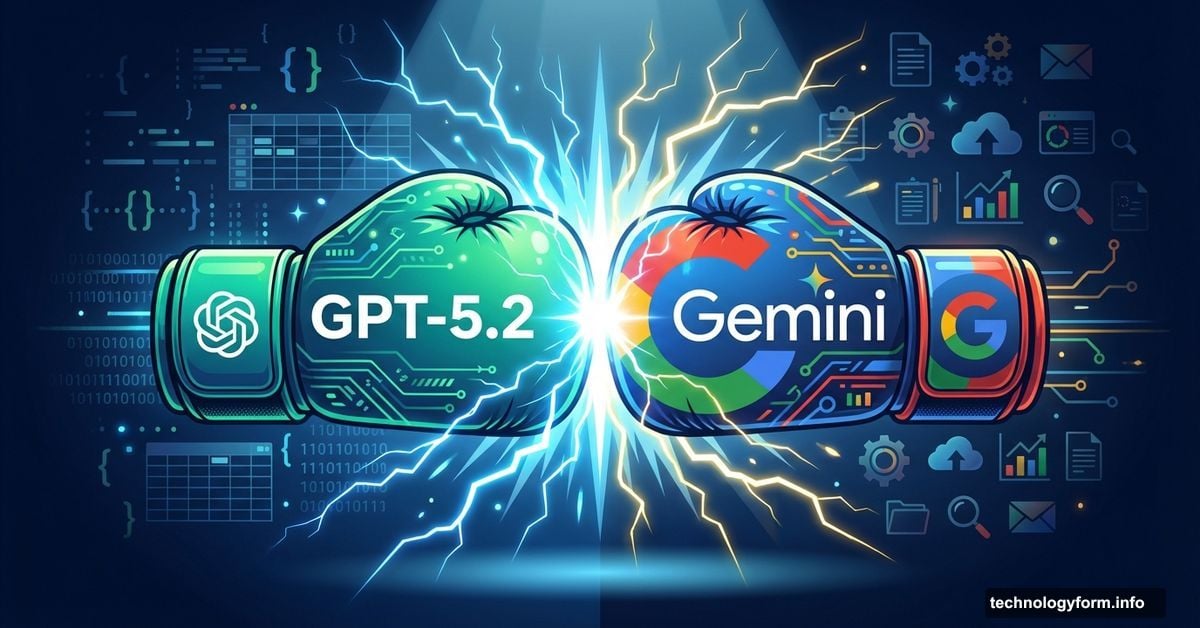
OpenAI’s GPT-5.2 Targets Google’s Gemini Lead With Work-First Focus
OpenAI just dropped GPT-5.2. But this isn’t about casual chat. It’s about work.
The company designed this model specifically for professional tasks. Spreadsheets, presentations, code, complex projects. That’s where you’ll see the biggest improvements. So if you mainly use ChatGPT for quick questions or fun experiments, this update won’t blow your mind.
But if you use AI for actual work? Pay attention.
The Code Red That Sparked This Launch
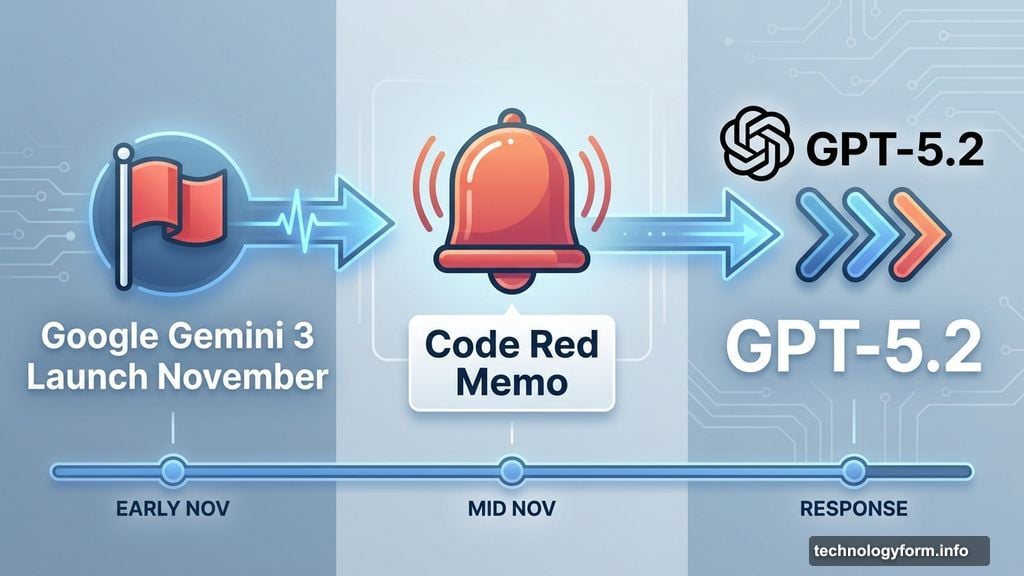
Behind the scenes, OpenAI’s CEO sent an internal memo earlier this month. The subject? Google’s threat.
Specifically, Google’s Gemini 3 chatbot launched in November and rattled OpenAI’s confidence. Sam Altman called it a “code red” situation. His team needed to respond fast.
Here’s the ironic part. Google sent its own “code red” memo a few years ago when ChatGPT first launched and dominated headlines. Now the roles flipped completely. Each company views the other as its main AI rival.
That competitive pressure explains why GPT-5.2 arrived so quickly. Plus, OpenAI launched GPT-Image Model 1.5 on Tuesday to challenge Google’s Nano Banana Pro image generator. The AI race is heating up fast.
Three Models for Different Needs
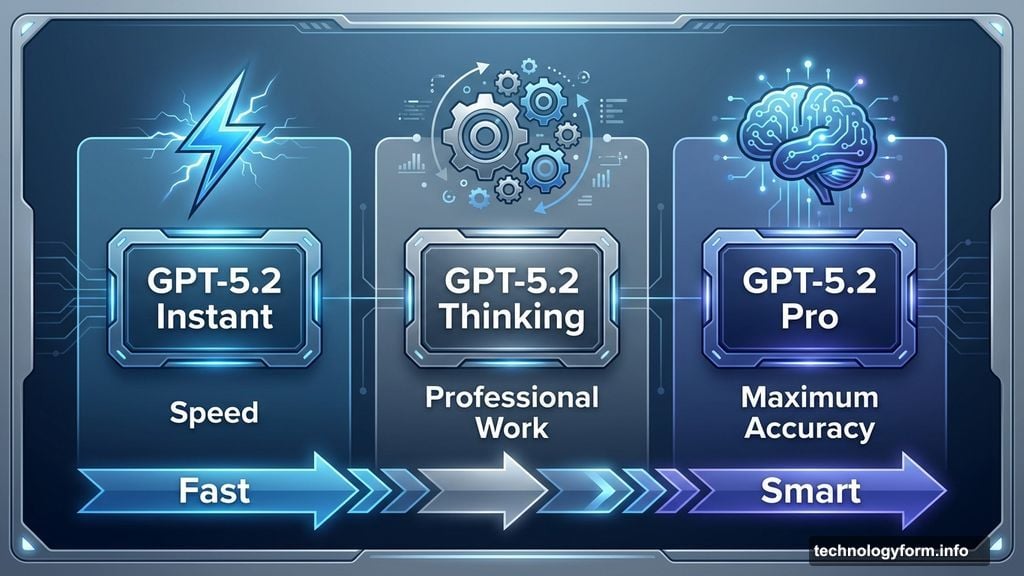
OpenAI split GPT-5.2 into three versions. Each serves a specific purpose.
GPT-5.2 Instant handles everyday activities quickly. Need a fast answer? This version delivers speed over depth. It’s the workhorse for routine tasks.
GPT-5.2 Thinking tackles professional, real-world problems. OpenAI calls it their most advanced version for work scenarios. It takes more time but provides better reasoning for complex challenges.
GPT-5.2 Pro represents their smartest model yet. When you need the absolute best answer and don’t mind waiting, this model handles difficult questions with maximum accuracy. OpenAI says it’s their most trustworthy option.
The company emphasizes that all three versions provide meaningful upgrades over previous models. But again, the improvements shine brightest in work and learning contexts.
What Actually Got Better
OpenAI’s press release lists specific improvements. These aren’t vague promises. They’re concrete capability upgrades.
The model now excels at creating spreadsheets and building presentations. It writes better code. It perceives images more accurately. It understands longer contexts without losing track. It uses tools more effectively. And it handles multi-step projects without getting confused.
For developers, GPT-5.2 brings major enhancements. The model improves general intelligence, long-context understanding, agentic tool-calling, and vision capabilities. That makes it particularly strong for building AI agents.
In AI development, “agents” are systems that can perceive information, reason about what to do, and then take action. They might run code, operate software, or coordinate multiple tasks. GPT-5.2’s improvements make building these systems more practical.
The Work Focus Makes Sense
OpenAI’s strategy becomes clear when you read their statement. “We designed GPT-5.2 to unlock even more economic value for people.”
Translation? They want businesses to use this. They want professionals to rely on it for revenue-generating tasks. Casual users are fine, but they’re not the priority audience.
This approach differs from earlier ChatGPT releases. Those versions aimed broadly at everyone. GPT-5.2 targets a narrower but more lucrative market. Companies pay more than individuals. So OpenAI optimized for workplace scenarios where AI can justify its cost.
The science and math improvements support this strategy. Researchers, engineers, and analysts need strong performance in these areas. If GPT-5.2 delivers, it becomes a must-have tool for technical professionals.
Rollout Starts with Paid Plans
The new model began rolling out Thursday. But it’s not available to everyone immediately.
Paid plan subscribers get first access. Free users will likely wait weeks or months. Meanwhile, developers can access GPT-5.2 right away through OpenAI’s API.
This tiered rollout follows OpenAI’s typical pattern. Premium features reach paying customers first. Free users eventually get access to older models as new ones launch.
For companies evaluating whether to upgrade, the decision hinges on one question: Does your team use ChatGPT for serious work? If yes, GPT-5.2’s improvements probably justify the cost. If your team just experiments occasionally, stick with free access.
The Bigger Picture
This launch isn’t just about a new model. It’s about two tech giants fighting for AI dominance.
Google and OpenAI both recognize that whoever leads in AI will control massive economic value. That’s why both companies reacted to each other’s advances with “code red” urgency.
The competition benefits users in the short term. Faster innovation, better models, more features. But it also raises questions about AI safety and responsible development. When companies race this hard, cutting corners becomes tempting.
OpenAI clearly feels pressure to maintain its lead. GPT-5.2’s work focus suggests they’re prioritizing business customers who generate reliable revenue. That’s smart business strategy. But it also means future improvements might focus less on general users and more on enterprise needs.
The AI race continues accelerating. GPT-5.2 represents OpenAI’s latest move. Google will respond. Then OpenAI will counter again. For now, professionals who use AI for real work stand to benefit most from this upgrade.