
OpenAI’s Prism Turns Scientists Into AI-Powered Writers
OpenAI just dropped Prism, a free AI workspace that rewrites how scientists work. No subscription needed. Just your ChatGPT account and a research problem to solve.
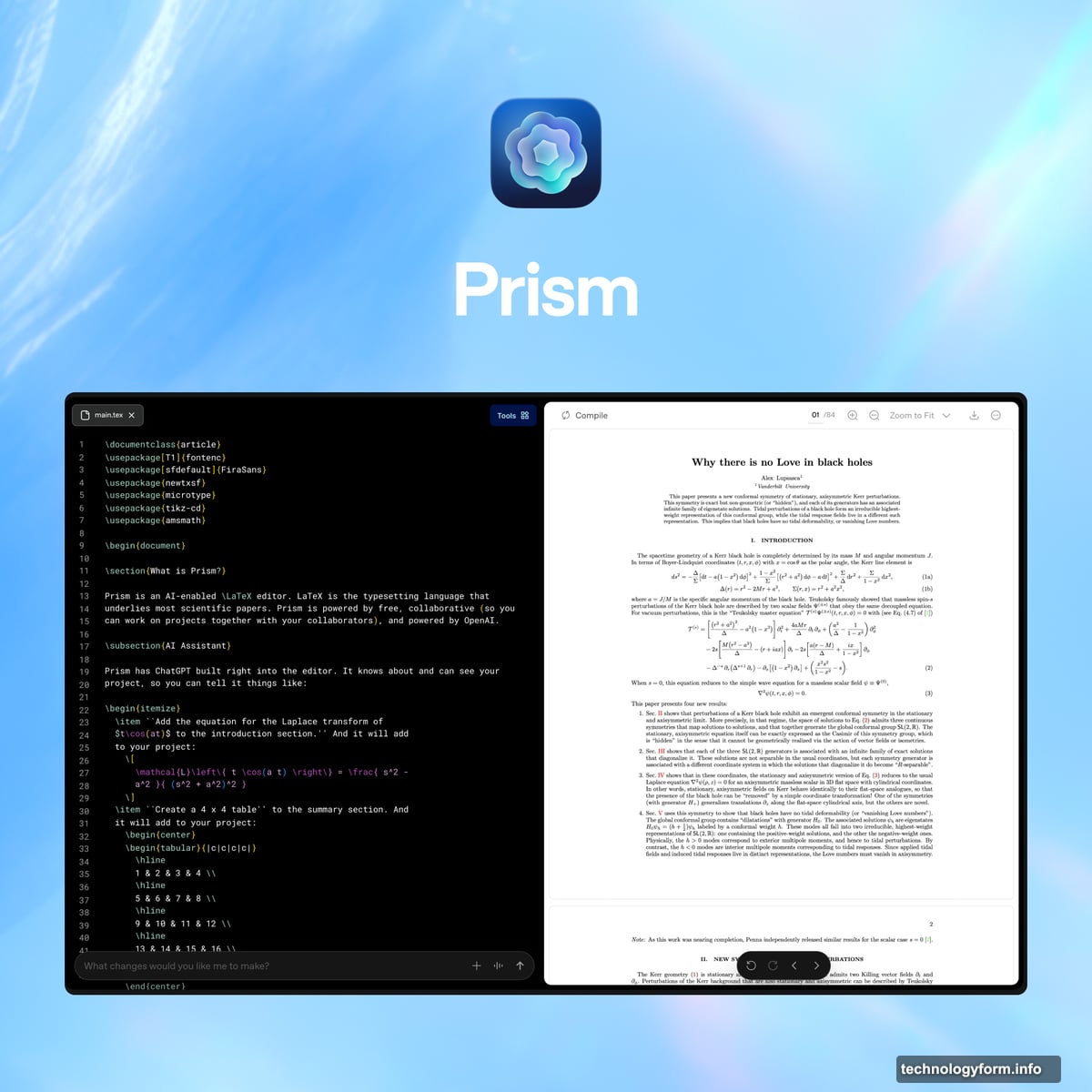
Prism isn’t another chatbot. It’s a full-blown scientific word processor powered by GPT-5.2 that handles LaTeX formatting, literature reviews, and diagram assembly. Plus, it understands your entire research context, making responses smarter than standalone ChatGPT queries.
The timing matters. ChatGPT already receives 8.4 million science-focused messages weekly. So OpenAI built a proper tool for researchers instead of forcing them to jury-rig consumer products.
What Makes Prism Different From ChatGPT
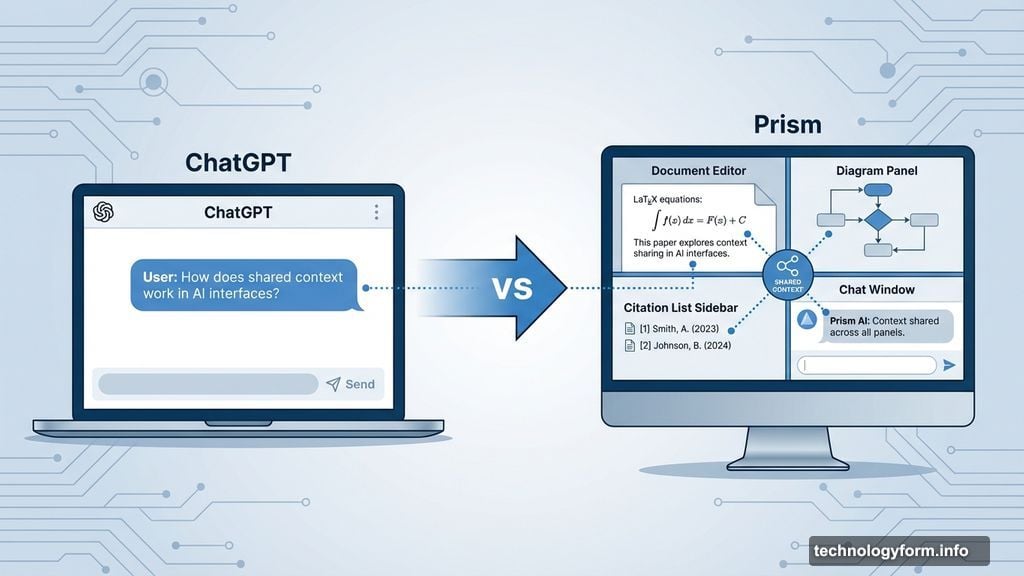
Most AI tools treat each conversation independently. Prism changes that completely.
When you open a chat window in Prism, GPT-5.2 sees your whole research project. Every citation. Every diagram. Every previous draft. That context transforms generic AI responses into genuinely useful scientific feedback.
The interface handles LaTeX natively too. That’s huge for scientists. LaTeX is the standard typesetting system for scientific papers, but most LaTeX editors feel like they’re stuck in 1995. Prism modernizes that experience while maintaining full compatibility.
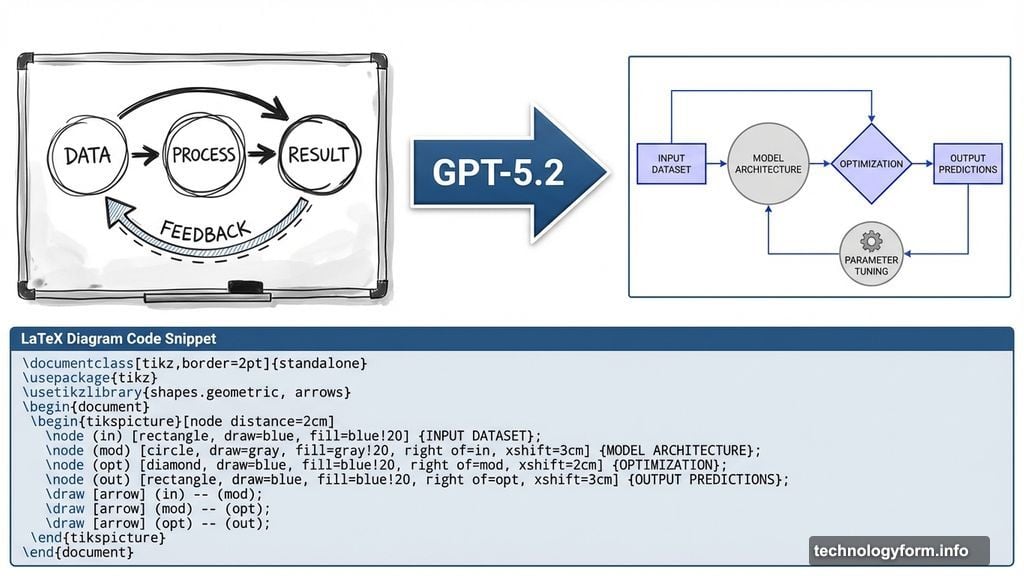
Moreover, Prism converts whiteboard sketches into proper scientific diagrams. Anyone who’s fought with diagram software knows this saves hours of frustrating work.
AI Is Already Proving Mathematical Theorems
Scientists are using AI models to solve real research problems right now. Not hypothetically. Today.
Mathematicians recently used AI to prove several long-standing Erdos problems. The models combined literature review with novel applications of existing techniques. Yes, experts still debate the significance. But the proofs are valid.
A December 2025 statistics paper took this further. Researchers used GPT-5.2 Pro to establish new proofs for a central statistical axiom. Human scientists only prompted and verified the model’s work. The AI did the heavy mathematical lifting.
OpenAI believes this represents the future of scientific research. Not AI replacing humans. But AI accelerating human work through what they call “human-AI collaboration.”
The Software Engineering Parallel
Kevin Weill, OpenAI’s VP for Science, draws a direct comparison to coding tools. Specifically, he mentions Cursor and Windsurf, which transformed software development in 2025.
Those tools succeeded because of two factors. First, powerful AI models. Second, deep workflow integration. They didn’t just provide AI assistance. They rebuilt development environments around AI capabilities.
Prism attempts the same approach for scientific research. Instead of scientists adapting their workflow to AI tools, OpenAI adapted AI tools to scientific workflows. That’s the key difference between Prism and generic ChatGPT usage.
“I think 2026 will be for AI and science what 2025 was for AI and software engineering,” Weill said. Bold prediction. But the software engineering analogy is solid.
Free Access Matters More Than You Think
Prism is completely free for anyone with a ChatGPT account. That’s a big deal for science.
Research funding is tight. Universities operate on shoestring budgets. Graduate students barely scrape by. Free tools democratize access to cutting-edge technology.
Plus, making Prism free means OpenAI gets more usage data from actual scientists. They’ll learn faster what works and what doesn’t. So the free tier serves both researchers and OpenAI’s development process.
However, don’t expect this to stay free forever. OpenAI will likely introduce premium tiers eventually. But the free version provides genuine value today.
The Limitations Nobody’s Talking About
Prism can’t conduct research independently. It needs human guidance for every step.
That’s intentional. OpenAI designed Prism as a tool, not a replacement for scientists. The system assesses claims, revises prose, and searches literature. But it doesn’t form hypotheses or design experiments without direction.
This approach avoids the biggest AI research pitfall. Models that try to work autonomously often produce plausible-sounding nonsense. By keeping humans in control, Prism reduces that risk.
Still, you’ll need to verify everything. AI models hallucinate. They cite nonexistent papers. They confidently state wrong answers. So treat Prism like a very smart research assistant who sometimes makes stuff up.
What This Means For Academic Research
Scientific publishing is about to change significantly. Maybe not overnight. But definitely faster than most academics expect.
Papers drafted with AI assistance will become standard. Not controversial. Just normal. The question won’t be whether to use AI tools. It’ll be which AI tools work best for your specific research needs.
That shift will accelerate research cycles. Scientists will publish more papers faster. Literature reviews that took weeks will take days. First drafts that took months will take weeks.
But quality concerns remain valid. More papers doesn’t automatically mean better science. Peer review must adapt to handle AI-assisted research appropriately. Otherwise we risk flooding journals with technically correct but ultimately meaningless work.
The Real Bet OpenAI Is Making
OpenAI believes scientific research represents AI’s next major conquest. Software engineering fell first. Science is next.
If they’re right, Prism is just the beginning. Expect specialized versions for biology, chemistry, physics, and other fields. Each optimized for domain-specific workflows and terminology.
The company is clearly positioning itself as the AI platform for serious research. Not consumer queries. Not creative writing. High-stakes scientific work where accuracy matters most.
That’s a smart play. Scientific institutions move slowly but commit deeply. Win over researchers now, and OpenAI locks in institutional customers for years.
Your move, Google and Anthropic. OpenAI just made a strong opening bid for the scientific research market.