Spotting AI-Written Text: A Professor’s Honest Guide
The internet has a slop problem. Everywhere you look, there’s content that looks polished at first glance but falls completely flat the moment you actually read it. Generic, soulless, machine-generated text has flooded classrooms, workplaces, and websites — and most people don’t know what to look for.
As a professor who receives AI-generated assignments regularly, I can tell you something surprising: spotting this content has gotten easier, not harder. Not because AI detectors have improved, but because AI writing follows the same predictable patterns every single time.
Here’s what those patterns look like — and how to catch them.
The “Wikipedia Voice” Nobody Talks About
AI text has a very specific personality. Or rather, it has no personality at all.
Think of it as the “Wikipedia Voice” — grammatically perfect, technically accurate, and completely hollow. The sentences flow smoothly. The structure is logical. But nothing feels like a real human sat down and thought about it.
Certain words show up constantly in AI-generated text. “Tapestry.” “Delve.” “Multifaceted.” “In conclusion.” These aren’t words most people reach for naturally. But large language models (LLMs) love them because they appear frequently in the formal writing those models trained on.
So when a student who normally writes in casual, choppy sentences suddenly delivers a “nuanced, multifaceted analysis,” something’s off. The voice shift alone is a red flag worth investigating.
Five Warning Signs to Watch For
Once you know what to look for, AI-generated text becomes surprisingly easy to spot. Here are the most reliable tells:
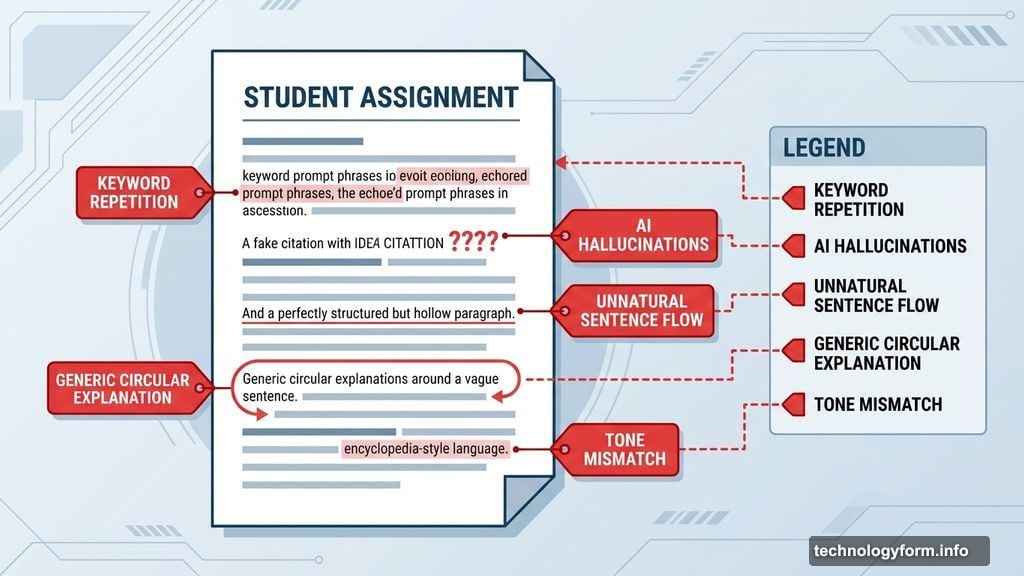
- Keyword repetition: The prompt’s exact language shows up repeatedly in the response. Real writers paraphrase and interpret. AI often just echoes the question back in answer form.
- AI hallucinations: Inaccurate facts, invented citations, or confidently wrong information. Chatbots like ChatGPT fabricate details when they don’t have the right answer.
- Unnatural sentence flow: Everything is technically correct, but nothing sounds like how a human actually talks or thinks.
- Generic, circular explanations: The writing circles around ideas without ever landing anywhere. Lots of words, very little substance.
- Tone mismatch: The voice doesn’t match what you know about the writer. A student with a casual, conversational style doesn’t suddenly write like an encyclopedia.
![A professor reviewing student papers on a laptop, looking for signs of AI-generated text and suspicious writing patterns]
How Professors Can Fight Back
Spotting AI cheating isn’t just about intuition. There are practical strategies that make the detection process much more reliable — and more defensible if you need to bring a case to your school’s administration.
Learn what AI actually produces for your assignments.
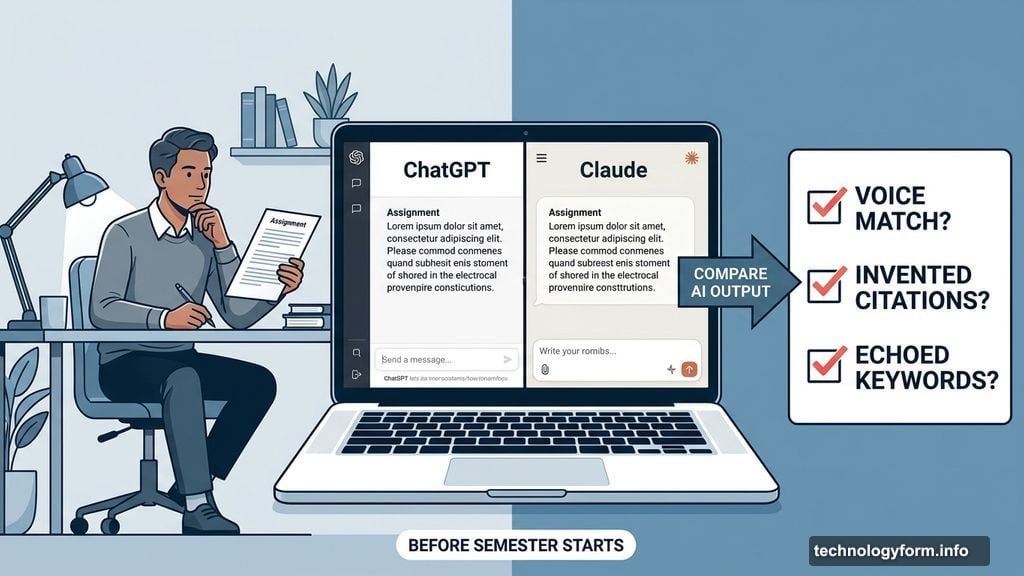
Before the semester starts, paste your own assignments into ChatGPT or Claude and let it generate responses. This sounds counterintuitive, but it’s incredibly useful. You’ll see exactly what kind of output these tools produce for your specific prompts. When a student submission looks suspiciously similar to that output, you’ll recognize it immediately.
Collect a real writing sample early.
On the first day of class, ask students to submit something short and personal. A 200-word story about their favorite childhood toy. A quick memory from a family trip. Something specific enough that an AI can’t fake it convincingly, and personal enough that a student would actually write it themselves.
That sample becomes your baseline. Later, if you suspect a submission is AI-generated, you can compare it directly against a student’s genuine voice.
Use AI to catch AI.
This one surprises people, but it works. If you suspect a piece of work is AI-generated, paste it into ChatGPT and ask it to rewrite the content. In most cases, AI rewrites its own work in the laziest way possible — swapping synonyms while keeping the structure nearly identical. The “original” and the rewrite look almost interchangeable.
Now try the same experiment with something written by an actual human. Take a genuine piece of personal writing and ask ChatGPT to rewrite it. The result loses something essential. The voice gets flattened. Personality drains out. The difference becomes obvious fast.
Tools like GPTZero and Smodin exist specifically for this purpose too. They scan assignments against AI writing patterns and can give you documented evidence to present alongside your own assessment.
What AI Detection Can’t Do
Here’s the honest part: no detection method is foolproof.
AI tools are improving constantly. A determined student using AI as a starting point and then heavily editing the result might produce something genuinely difficult to flag. And AI detection tools can produce false positives — occasionally flagging writing by non-native English speakers or writers with unusually formal styles.
That’s why the strongest approach isn’t a single detection tool. It’s a combination of things: your knowledge of individual students, a baseline writing sample, prompt design that makes AI cheating harder, and documented reasoning when you suspect something is wrong.
The goal isn’t to catch every instance. It’s to make cheating harder and less appealing than actually learning.
Making Learning More Appealing Than Cheating
The real problem isn’t that students have access to AI. It’s that the temptation to shortcut feels stronger than the motivation to engage.
That’s worth sitting with as educators. When assignments feel meaningless or disconnected from anything real, using a chatbot to fill in blanks feels like a rational choice. Designing assignments that require personal insight, genuine reflection, or recent real-world knowledge makes AI far less useful as a shortcut.
AI tools like ChatGPT are good at some things — brainstorming, drafting grocery lists, generating outlines. They’re terrible at being a specific human with specific experiences and a specific perspective. Assignments that demand exactly that become naturally cheat-resistant.
Stay curious, stay skeptical, and try not to take it personally when a robot shows up in your inbox. It’s all part of figuring out what education looks like now — and that’s actually a pretty interesting problem to solve.